A Bulk Carrier Burns at Eleven-Fifteen
The 1986 Kapitan Sorokin inquiry found that the ignition source could not be determined with certainty: hot work, residual vapour, a spark from equipment not rated for the environment. The investigators' language was careful. The dead remained dead. The September 10 Qingdao cargo fire aboard the Ocean Melody at the Beihai Shipbuilding Co. yard reads, from the desk, with a familiar arithmetic — not random, not unprecedented, but structurally recurring.
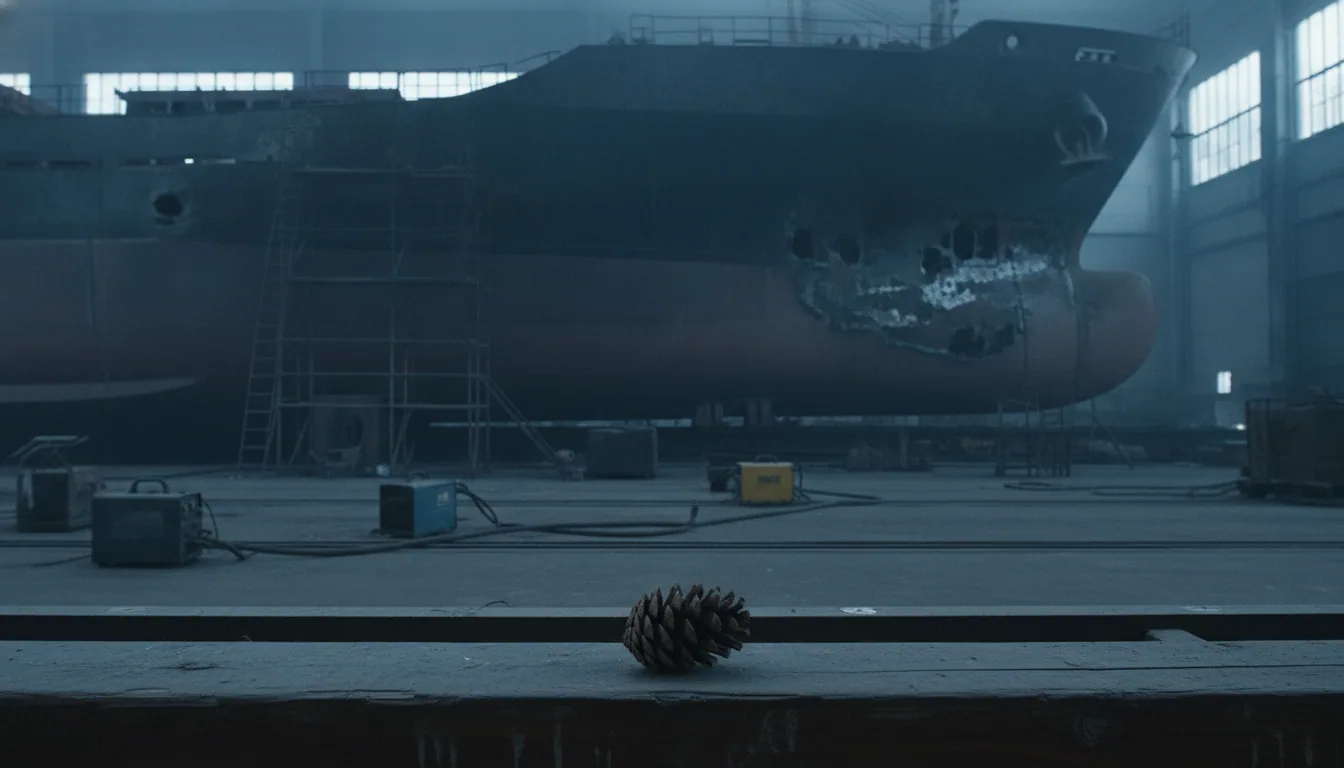
At 11:15 am local time, fire broke out on the Ocean Melody, a 190-metre bulk carrier sailing under a Liberian flag and undergoing maintenance at the yard. Forty-two persons were aboard. By 2:30 pm the fire was declared extinguished: three hours and fifteen minutes to contain what the count, by Thursday evening, fixed at twenty confirmed dead and five still missing.
Twelve people were successfully evacuated. Five were hospitalised with stable vital signs. The remaining arithmetic — forty-two aboard, twelve off, five in hospital — is not difficult to perform, and what it says about escape routes aboard a vessel in a shipyard drydock is not ambiguous.
Hot work during repair is the oldest ignition category in marine incident records: welding torches, grinding sparks, open flames near enclosed spaces where residual cargo vapour or insulation compounds accumulate. It is classified as a structurally recurring risk, not an accident of misfortune. The specific ignition source on the Ocean Melody remains unconfirmed. That uncertainty does not change the category. What burned here was not simply a ship. It was a maintenance protocol, applied inside a yard owned by the world's largest state shipbuilder, on a morning that started like any other in a busy port.
The Corporation Behind the Yard
Qingdao Beihai Shipbuilding Co. is a subsidiary of China State Shipbuilding Corporation, the largest shipbuilder in the world by tonnage. That fact is not background. It is the ownership line from which everything else follows. The yard where twenty people died belongs to a state enterprise, which means the state owns this disaster.
The vessel itself sits inside a further layering of legal entities. The Ocean Melody is registered to Huili Shipping Co. Ltd. as owner, managed by Yuyangkunpeng Shanghai Ship Management, and sails under a Liberian flag. Three jurisdictions, three liability envelopes. Maritime registration law makes this arrangement unremarkable; the Liberian flag is a commercial convenience, not a statement of national interest. What matters is that the management company is Chinese, the yard is Chinese state property, and the flag is not.
Xi Jinping and Li Qiang issued instructions for rescue, medical support, and strict accountability. The Ministry of Emergency Management dispatched a specialised team to Qingdao. The political reflex is familiar: the commanding authority issues the directive, the investigative machinery arrives, and the state signals to a watching public that no one will be spared.
Ask the small question first: who is the borderland here, and who is the empire? In this case the borderland is the investigation itself, caught between the genuine demand for answers and the structural incentive of a state agency examining a state subsidiary. The Ministry of Emergency Management is not independent of the system it is now auditing. Whether that audit produces a structural finding or a decorative one is the only question the coming weeks will answer.
The Second Fire in Six Weeks
Six weeks before the Ocean Melody burned, Qingdao was already on fire. On August 2, a blaze tore through a warehouse operated by Qingdao Xiangyu Suchuan Supply Chain Co., a logistics facility in the same city. Commodity traders reached for their terminals before the smoke cleared. The clarification came quickly: the facility was a trade warehouse, not a Shanghai Futures Exchange delivery warehouse, so exchange-registered stocks were untouched.
The practical lesson was narrower than the relief suggested. Two major industrial fires in one port city within six weeks is not a pattern until it is. Qingdao connects to more than 700 ports across 180 countries, which means disruption there does not stay there.
When a concentration point of that density catches fire — literally or otherwise — the exposure radiates outward faster than any port authority can contain it. The system was already carrying weight before either blaze. SeaVantage reported heavy congestion at Qingdao in early 2026, with berth delays running to several days. Ships were waiting; cargo was stacking; schedules built on the assumption of reliable throughput were quietly slipping. The September shipyard fire added casualties and a 190-metre vessel of uncertain future seaworthiness. The practical question for anyone routing cargo through Shandong is not whether Qingdao remains essential — it does — but how much more load a system already registering delays can absorb before the delays compound into something harder to name.
Twenty dead in a yard owned by the world's largest shipbuilder, at a port stitched to seven hundred others, is not a local story.
Global Logistics and a Rising Tide of Fire at Sea
Cargo fires at sea rose 20 percent year-on-year, according to the Allianz Safety and Shipping Review 2025. That is not an anomaly. It is a trend with a mechanism: the electrification of everything, loaded into steel boxes and moved across water.
The primary driver is lithium-ion batteries. Electric vehicles, power tools, e-bikes, consumer electronics — all of them drawing on the same chemistry, all of them capable of thermal runaway at temperatures that defeat a conventional CO2 system. The batteries travel legally when declared correctly. The problem is the gap between what the manifest says and what sits in the hold.
Misdeclared hazardous cargo is the systemic failure underneath the fire statistics. A shipper who declares lithium batteries as "electronic equipment" saves on handling fees and avoids the scrutiny that slows a schedule. The yard, the carrier, the port authority — none of them can inspect every container. By the time the chemistry announces itself, the question is no longer prevention but containment.
When containment fails, General Average follows. Under that centuries-old maritime doctrine, all cargo interests on a vessel share the loss proportionally when the ship or its freight must be sacrificed to save the voyage. Insurers have begun repricing that bet. A vessel carrying misdeclared cargo that burns triggers disputes over who carries the cost — the honest shipper, the insurer, the carrier who took the manifest on trust. The premium line is moving. The manifest line is not.
The Pressure System Before Anyone Struck a Spark
The Middle East escalations of June 2026 did not announce themselves as a logistics crisis. They announced themselves as a geopolitical event. The freight consequences arrived quietly: rerouted ocean lanes, compressed schedules, vessels held at anchorage longer than their maintenance windows were designed to absorb. By the time a spark found the Ocean Melody in September, the shipping network had been running hot for months.
Compare this to the disruptions of 2021 and 2022, when the pandemic-era backlogs at least came with a visible cause and a rough timeline. The 2026 pressure was more distributed. A rerouted lane in the Red Sea transfers load to the next node; that node absorbs it until it cannot; the vessel that sits three days longer in a yard is the one that needs a welding crew while the schedule is already slipping. Hot work and compressed time are not a coincidence. They are a calculation.
In May 2026, China's regulators fined several shipping giants over container rate filings, adding a layer of regulatory friction precisely when operators could least afford distraction. The fines signalled that Beijing was watching the commercial conduct of the sector, even as the operational conditions the sector was navigating grew more difficult. SeaVantage reported heavy congestion and berth delays of several days at Qingdao in early 2026, well before September. Qingdao connects to over 700 ports across 180 countries. A pressure system that size does not release its energy evenly.
Watch the Investigation, Not the Photograph
The Ministry of Emergency Management dispatched its team within hours. What its eventual report says will matter more than any photograph of the hull. The one thing to read, when the document appears, is whether the named cause is a site-level human error — an individual welder, a shift supervisor, a local lapse — or a protocol failure systemic across CSSC yards. One is moulding. The other is load-bearing.
The distinction is not semantic. A disciplinary proceeding against a site manager closes the file without touching the wall. A China-wide safety audit of state-owned shipyards would mean Beijing has read its own investigation as structural. Insurance markets will confirm which reading prevailed — a sustained rise in hull and cargo underwriting costs would signal that the market, which prices risk unsentimentally, has reached the same conclusion.
The Qingdao cargo fire is not a local story. Twenty dead in a yard owned by the world's largest shipbuilder, at a port stitched to seven hundred others, is a stress test of the entire chain — the maintenance protocols, the flag registries, the manifest honesty, the investigative independence. If the report says human error, watch whether the premiums move anyway.