
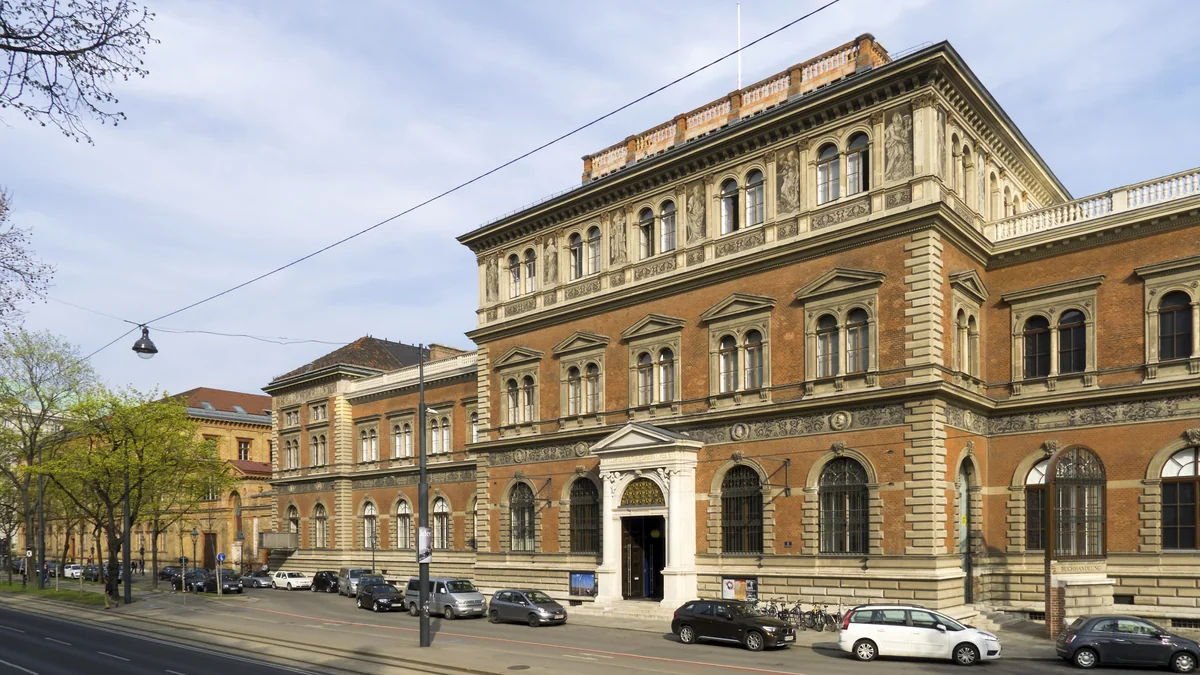
On August 27, 2026, two men entered Vienna's Museum für angewandte Kunst (MAK) with 15-euro tickets and a hammer, walking away with a 673-diamond Van Cleef & Arpels necklace valued at 4 million euros. The robbery, which follows a string of high-profile thefts at the Louvre and the Lalique Museum, highlights a systemic failure in European cultural security where brute-force simplicity consistently defeats high-tech institutional defenses.
Imagine, for a second, that you are a museum security chief. You have spent the better part of your career carefully curating a sense of control, attending endless meetings where the word "procedure" is uttered more frequently than most people breathe, and crafting risk assessments that look like they were written by someone who views the world through a very expensive, very protective spreadsheet. You are convinced, with the quiet arrogance of a man who has never been punched in the face by reality, that you have the situation under control. Then comes Thursday.
August 27, 2026, 2:00 PM, Vienna. The MAK — the Museum für angewandte Kunst, for those of you who don't speak German or "pretentious architecture student" — is one of Europe's most prestigious shrines to applied arts. It is broad daylight. The museum is packed with tourists, security personnel, and enough natural light to make a cinematic heist look like a bad idea. Two men buy tickets. They don't sneak in through the vents. They don't rappel from the ceiling like Tom Cruise in a mid-life crisis. They walk in through the front door, looking as visible and mundane as two guys trying to find the nearest public restroom.
Then came the hammer.
One man shattered the display case. The other stood by, armed and ready to remind everyone that physics beats philosophy every single time. Within seconds, a platinum necklace encrusted with 673 diamonds — a Van Cleef & Arpels masterpiece worth an estimated 3.5 to 4 million euros — disappeared. The suspects didn't have a getaway driver in a blacked-out Audi waiting with the engine running. They left on foot. They just walked away, as if they'd simply decided that the era of polite observation was over and the era of "this is mine now" had begun.
This is the smash-and-grab aesthetic in its purest, most insulting form: no hacking, no Mission: Impossible theatrics, no sophisticated night-time infiltration. It was just physical brutality in the middle of a Thursday afternoon, and it turned out to be entirely sufficient. Police spokesperson Anna Gutt was quick to confirm that a massive international search operation had been launched — which, in the dialect of European bureaucracy, is slang for "we are incredibly confused and are currently filling out the paperwork to document exactly how confused we are."
Here is the detail that should actually keep you awake at night (not that the looming climate collapse or the price of butter isn't already doing that): the suspects didn't wear masks. Their faces are perfectly visible on the security footage. They knew the cameras were there, and they did it anyway. That implies a level of confidence that is genuinely terrifying — it means they didn't fear being caught enough to even bother with a five-euro balaclava from a hardware store.
The Biography of a Necklace: How 673 Diamonds Went from a Queen's Neck to a Museum Floor
Back in 1939, the artisans at Van Cleef & Arpels weren't just making a piece of jewelry; they were constructing an argument. The argument was made of platinum, Art Deco geometry, and over 200 carats of diamonds. It was a physical manifestation of all the visual intelligence humanity can cram into a single object when money is no object. The piece was commissioned for the wedding festivities of Egyptian Princess Fawzia, who was marrying the Crown Prince of Iran — it was an object born at the exact moment two dynasties decided to stake a claim on eternity.
Historically, the necklace belonged to Queen Nazli Sabri, the wife of King Fuad I. This isn't just a bit of royal trivia for people who watch too much Netflix; it's a crucial detail because royal provenance (which is a fancy word for "this belonged to someone who didn't have to work for a living") turns the disappearance of an object into something far more significant than a common theft. This necklace carried the weight of an Egyptian royal-dynastic biography that ended the way most royal biographies end: with a spectacular, slow-motion catastrophe.
In 1975, while living in exile in the United States, Nazli sold the necklace to satisfy the demands of her creditors. A royal wedding gift becoming a debt settlement is a sentence that shouldn't be grammatically correct, but in the cold, unfeeling world of global finance, it's just another Tuesday. From there, the piece wound up at a Sotheby's auction in 2015, where a new owner paid 4.3 million dollars — not just for the stones, but for the entire complex geology of human fate that had accumulated on the metal.
And then: a museum. A display case. A hammer. Four centuries of royal context, two dynasties, an exile, and an auction, all undone by two guys for whom all that history meant absolutely nothing. It's a reminder that civilization is just a very thin layer of lacquer over a very large pile of bricks.
A Security Concept That Couldn't Withstand a Tool from the Bronze Age
Let's go back to the two guys. They had tickets. Their faces were bare. They looked like they were just there to appreciate the craftsmanship — because they were there to appreciate it, they just decided the best way to do that was to take it home. No masks. No camouflage. Just a hammer and the unshakable conviction that no one would be fast enough to stop them.
That conviction was, unfortunately, a masterpiece of accurate analysis.
The display case held an object with an insurance value of up to 4 million euros, and yet it took exactly one strike of a hammer to break it. That is the entire security analysis, the whole post-mortem, and every institutional lesson learned, all packed into a single second of shattering glass. There was no software exploit here. No one broke in at night using ropes and pulleys. No one hid in a closet until closing time. They came, they hit, they left.
In the aftermath, several institutions temporarily closed their exhibitions or "updated their security concepts" — which is institutional-speak for "we weren't ready for this and it's deeply embarrassing." The paradox is that a museum's mission is to be open. Foot traffic is the metric of success; it's where the funding comes from. But openness is, simultaneously, the largest security flaw in existence — a vulnerability that you cannot patch without destroying the very essence of what a museum is supposed to be.
This is the real dilemma: do you protect the object, or do you protect the idea that art belongs to everyone? At the MAK, they defaulted to the second option, while the security firm's readiness assumed the first. Falling into the gap between those two choices was a hammer and a three-and-a-half-million-euro void.
Unfortunately, dignity is not bulletproof.
The Vienna Heist is Not an Isolated Incident: Louvre, Lalique, and the European Art Theft Season
If you think this was just a fluke, congratulations, you're a beautiful optimistic idiot and I'd like to sell you some magic beans. In October 2025, the Louvre — that concrete and glass cathedral dedicated to the best of human taste — lost 88 million euros worth of French royal jewels in a single day. Eighty-eight million. Write that number down on a piece of paper and look at it for a second, because the brain automatically tries to file it away as fiction. But it happened, and someone just walked out with it.
Then came July 2026. The Lalique Museum in France — same script, different actors, same banal simplicity. August brought Spain: the Treasure of Villena, stolen with the same speed and the same brute force. And then Vienna.
There is a pattern here that should disturb you: enter as a visitor, exit with violence. No hacking. No crawling between laser beams like a bad thriller from the early 2000s. Just a human being, a ticket, a hammer, and five seconds of determination. This isn't a tactic; it's an announcement. It's a declaration that Europe's memory institutions are structurally exposed because their mission requires them to be open, and openness is exactly what criminals are looking for, like moths to a very expensive, diamond-encrusted light.
A museum cannot turn itself into a fortress without losing its soul. This tension — openness versus security — isn't a technical problem. It's a philosophical trap that Europe has walked into over the course of decades, operating on the assumption that culture protects itself through the sheer force of its own dignity.
As it turns out, a hammer doesn't care about dignity.
Balkan Syndicates, Algorithms, and Other Things That Shouldn't Comfort You
Police spokesperson Anna Gutt confirmed that investigators suspect a link to organized crime from the Balkan region. This is simultaneously a perfectly logical conclusion and an absolutely depressing statement, because "Balkan organized crime" is a phrase in European security discourse that basically means "we know someone did it, but they've been gone for two days and are probably in a different time zone by now." The maskless faces of the suspects are no longer evidence; they're just pictures floating in a cloud, increasingly irrelevant as the clock ticks.
Then the technology people show up. Researchers have been touting APT methodology — Anchor-aligned Perturbations — which is a digital forensics framework designed to detect AI-manipulated surveillance footage. They claim an accuracy rate of 0.92 — which is academic-speak for "very good" and real-world-speak for "it's too late." It's like building a state-of-the-art flood barrier after the city is already underwater and the fish are starting to move into your living room.
Here lies the supreme irony of the technological arms race. Forensics are evolving. Algorithms are getting more precise. International warrants have been issued. But the robbers used a tool that hasn't changed much since the Iron Age. They entered the museum with a ticket, just like any other tourist who wanted to look at pretty things behind glass. Simplicity won over complexity. Again.
Historical analogues are easy to find here: from the "Pink Panthers" to modern professional Balkan robbery crews, the craftsmanship has remained the same — speed, audacity, and a clear exit route. Only the surroundings have become more beautiful. And more expensive.
What Happens Next: Three Things We Don't Know, and One Thing We Know Too Well
So, let's look at the facts. 673 diamonds are gone. The suspects are gone. The fate of the necklace is unknown — either it will be sold whole to an anonymous collector living in a place where questions are considered a breach of etiquette, or it will be broken down into 673 separate stones and scattered into the global black market ether. Given the economic logic of these things, the second option is much more likely.
Cameras recorded everything. The men didn't wear masks. The police have launched an extensive search. And yet, weeks later, the identity of the suspects remains unknown — which means they are either exceptionally good at hiding, or the kind of people who buy 200 carats of diamonds are also very good at getting new passports on short notice.
The technical failure of the MAK's display cases remains officially unexplained. Was it a contract job or a lucky strike at a known vulnerability? We don't know. In the end, it doesn't matter, because the system failed in the most embarrassing way possible.
Here is the thing about the Vienna museum heist that nobody wants you to understand: it didn't need hackers, it didn't need a network of deep-cover agents, and it didn't need a mastermind with a monocle. It just took two guys, one hammer, and two tickets costing 15 euros each.
Anyway, we're all doomed. Sleep well.