The Man Who Should Not Have Been There: What Happened at Baptist Health Richmond
The organ donation uncertainty at the heart of the Kentucky case is this: a system built to give life nearly took one. That is the central contradiction sitting at the heart of what unfolded at Baptist Health Richmond, Kentucky, in October 2021 — a case that has since forced legislatures, federal agencies, and ordinary citizens to ask whether the protocols designed to protect the dying are, in fact, doing so.
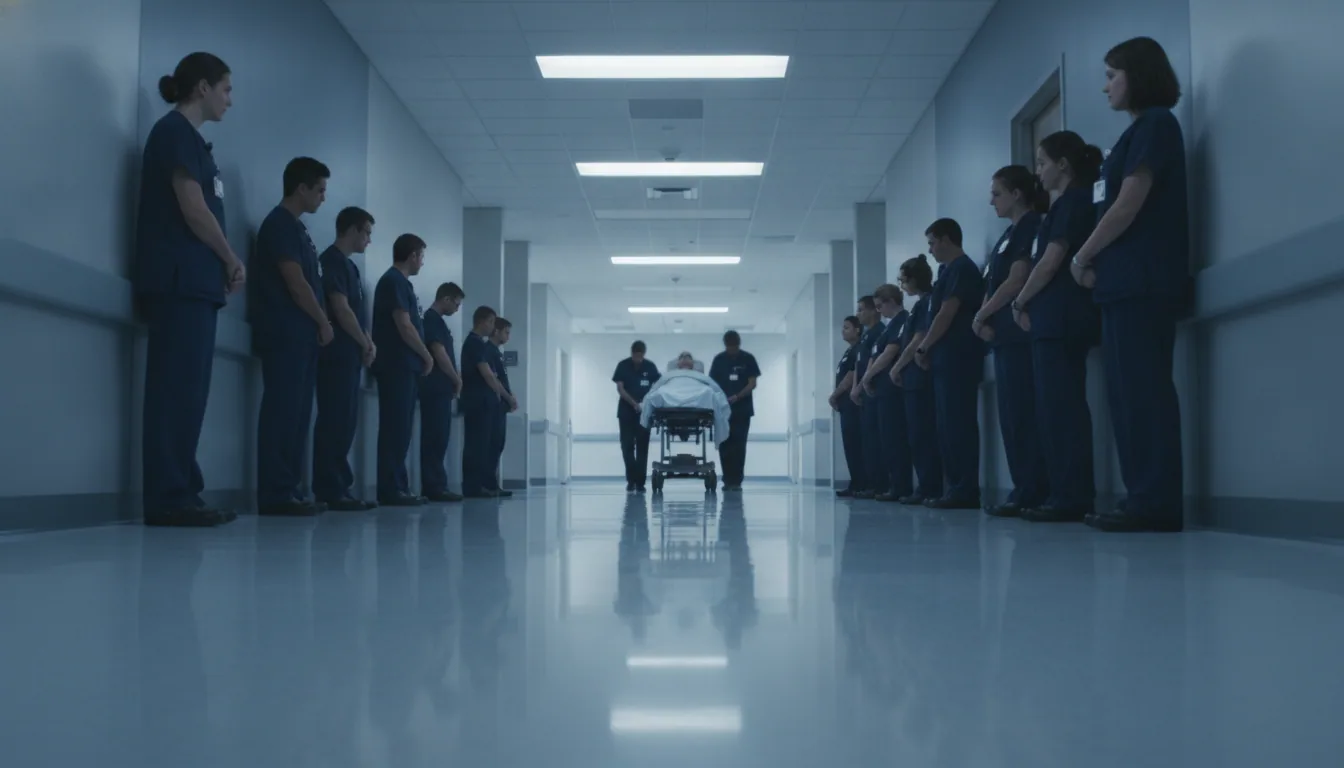
Anthony Thomas "TJ" Hoover II had suffered a cardiac arrest following a drug overdose. Declared brain dead, he was prepared for organ donation and walked through an Honor Walk — the solemn hospital ritual where staff line the corridors to mark a donor's final passage to the operating room. His sister, Donna Rhorer, was present. She watched his eyes open and follow the movement around him.
What happened next is clinical fact, not contested interpretation. During cardiac catheterization to assess his heart for transplant suitability, Hoover began moving on the table. He was thrashing. Tears streamed visibly down his face. Former Kentucky Organ Donor Affiliates employee Natasha Miller, who witnessed the scene, later described it without ambiguity: "He was moving around, kind of thrashing. And then you could see he had tears coming down. He was crying visibly."
The surgeons at Baptist Health Richmond stopped. Their refusal to continue became, itself, the most damning piece of evidence in the case — because institutional pressure, according to whistleblower testimony, had demanded otherwise.
Hoover survived. That outcome, on its surface, reads as a success. But survival carried its own weight: he now lives with lasting neurological damage, impaired speech, and reduced mobility. A man who was declared dead walks among the living, diminished by the experience of being treated as otherwise.
The question the case forces is not whether one institution failed. It is whether a system did.
Coordination or Coercion? The Institutional Behavior of KODA
The firewall was built for good reason. In organ procurement, the physician treating a patient and the OPO retrieval team are meant to operate as separate entities, each serving a distinct mandate. That separation is not administrative formality; it is an ethical load-bearing wall.
In the operating room at Baptist Health Richmond, that wall failed. Whistleblower Natasha Miller witnessed it directly. She described a patient moving on the table, thrashing, tears visible on his face. "He was moving around - kind of thrashing. And then when we got over there, you could see he had tears coming down. He was crying visibly," she later recounted. The attending surgeon refused to proceed. What followed, according to Miller's account, was not a pause for clinical review. A KODA coordinator allegedly instructed staff to find a different doctor willing to perform the retrieval.
This is where institutional behavior becomes a diagnostic tool. If the refusal of one physician triggers a search for a more compliant replacement, the system is no longer coordinating — it is applying pressure. The coordinator's alleged instruction, "you're going to do this case," framed to a reluctant doctor, suggests a procurement culture oriented toward output over caution.
KODA subsequently merged with regional entities to become the nonprofit Network for Hope. The organizational rebranding did not resolve the underlying dynamics. If the institutional logic that produced the alleged coercion in 2021 was carried forward into the successor organization, a new name is structural camouflage, not structural reform. That distinction matters enormously to regulators, to patients, and ultimately to any state asking whether its oversight architecture is adequate.
73 Anomalies in 351 Cases: How Deep Does the Systemic Failure Run?
One case is a tragedy. Seventy-three cases is a pattern. When the Health Resources and Services Administration reviewed 351 failed organ donation cases across procurement organizations, investigators found that 73 patients had shown neurological signs inconsistent with confirmed brain death. That is a 20.8% anomaly rate in a system where the acceptable margin for error is, by any defensible ethical standard, zero.
One case is a tragedy. Seventy-three cases is a pattern.
The practical implication is stark: if you or someone close to you was declared brain dead in a US hospital, the probability that the determination was wrong was not negligible. Soft evidence from the same review points to at least 28 cases where retrieval processes appear to have begun on patients who may not have been dead. These are not administrative errors. They are irreversible procedures initiated on the wrong side of a line that cannot be uncrossed.
Drug overdose cases compound the brain death determination problem in ways that existing protocols were not designed to handle. Certain substances can temporarily suppress neurological function to a degree that mimics brain death on standard clinical tests. Hoover himself had suffered cardiac arrest following an overdose, creating precisely this ambiguity. If your diagnostic framework was built before fentanyl-era overdose patterns became a clinical norm, you are working with instruments calibrated for a different era.
What makes this actionable rather than merely alarming is what is missing at the federal level. There is no standard benchmark for the false-negative rate in brain death determination across US procurement organizations. No floor, no ceiling, no mandatory reporting threshold. The 73 cases were discovered through a retrospective review, not a functioning early-warning system. For any policymaker reading this: the absence of a metric is itself a policy choice, and right now, that choice has a body count attached to it.
The Trust Collapse: Organ Donation Uncertainty and 170 Registry Withdrawals a Day
Word spread the way it always does now: fast, flat, and unfiltered. When the details of TJ Hoover's case became public in 2024, the organ donor registry did not just lose members. It hemorrhaged them. Donate Life America reported that removals spiked tenfold, reaching approximately 170 people per day at peak withdrawal.
That number deserves to sit on the page for a moment. One hundred and seventy individuals, every single day, deciding they no longer trusted the system with their bodies. Donate Life America was explicit: this was not a crisis of individual fear about death or donation. It was a crisis of institutional credibility.
The distinction matters enormously. Fear can be addressed with reassurance. Credibility loss requires structural proof. If people believe that the machinery designed to save lives has been warped by pressure to deliver organs, no awareness campaign corrects that.
Congress recognized the severity. In July 2025, a House subcommittee convened a dedicated hearing focused specifically on safety lapses at Network for Hope, the successor organization formed after KODA merged with regional partners. Whistleblowers testified. Documents were entered into record. The hearing was not a formality.
Each registry withdrawal carries a quiet, irreversible cost: somewhere on a transplant waiting list, a patient's odds quietly worsen. The system depends on public participation, and public participation depends on public belief that the rules are enforced without exception. When that belief fractures, the statistical consequences fall not on administrators, but on the next person waiting for a kidney.
Decertification and the Architecture of Reform: From Frankfort to Washington
Rarely does a federal agency deploy its most powerful sanction against a nonprofit it helped create. Yet on August 5, 2026, HHS Secretary Robert F. Kennedy Jr. announced precisely that: the decertification of Network for Hope, the successor organization formed from KODA's regional merger, citing persistent patient safety failures. Decertification strips an OPO of its operating license — a mechanism so infrequently used that its deployment here signals something beyond routine oversight.
Kentucky did not wait for Washington to move first. A new state law reforming organ donation protocols took effect on July 15, 2026, predating the federal action by three weeks. The sequencing matters: state reform preceding federal enforcement is the structural inverse of how regulatory corrections typically flow in American healthcare governance.
The more consequential shift operates at the architectural level. The federal overhaul aims to structurally separate death certification from the procurement process itself — severing the conflict of interest that allowed a coordinator to allegedly demand another physician when the first refused to continue. Compare this with the European model, where procurement and clinical care have long been governed by distinct institutional chains in most member states. The US is, in effect, engineering toward a standard that parts of Europe inherited by design. The strategic question now is whether structural separation, imposed reactively after a near-catastrophe, can rebuild what voluntary registry withdrawal is quietly dismantling: the public belief that donation systems exist to save lives, not to meet procurement targets.
What Europe's Opt-Out Model Reveals About the American OPO Monopoly — and What It Does Not Solve
Spain retrieves 49.6 donors per million people annually. The United States retrieves roughly 44. The gap seems modest until you examine the structural machinery underneath it. European presumed-consent systems — Spain, Austria, France, Estonia — operate through state-integrated coordination bodies rather than private entities holding federally granted regional monopolies. That distinction matters more than the consent model itself.
In the United States, OPOs are private nonprofits awarded exclusive geographic territories by federal designation. There is no competitive mechanism. No alternative provider can enter a region when standards slip. When HRSA reviewed 351 failed donation cases and found 73 instances of neurological signs inconsistent with brain death, the organisation responsible for those failures — KODA, later Network for Hope — remained the only legal actor in its territory until decertification in August 2026. A monopoly without a credible exit threat produces exactly the incentive architecture that Kentucky exposed.
Europe's opt-out regimes do not automatically eliminate this risk. The conflict-of-interest firewall between the treating physician and the retrieval team exists in theory across most systems, but enforcement quality varies significantly by country. Estonia's transplant coordination sits within the public health framework, which introduces different accountability channels but does not guarantee immunity from pressure dynamics. Public trust remains the primary driver of donation rates everywhere: the 170 daily registry withdrawals in the United States after the Hoover story broke are a warning that no legal presumption of consent survives a credibility collapse.
Decertification removes one actor. It does not redesign the monopoly model. The strategic question for any legislature — in Frankfort, Tallinn, or Brussels — is whether the organ donation uncertainty Kentucky exposed can be resolved through oversight alone, or whether a structure that concentrates life-and-death authority in a single, uncompetitive body is itself the failure.