194 Years Old: The Number That Makes You Read It Twice
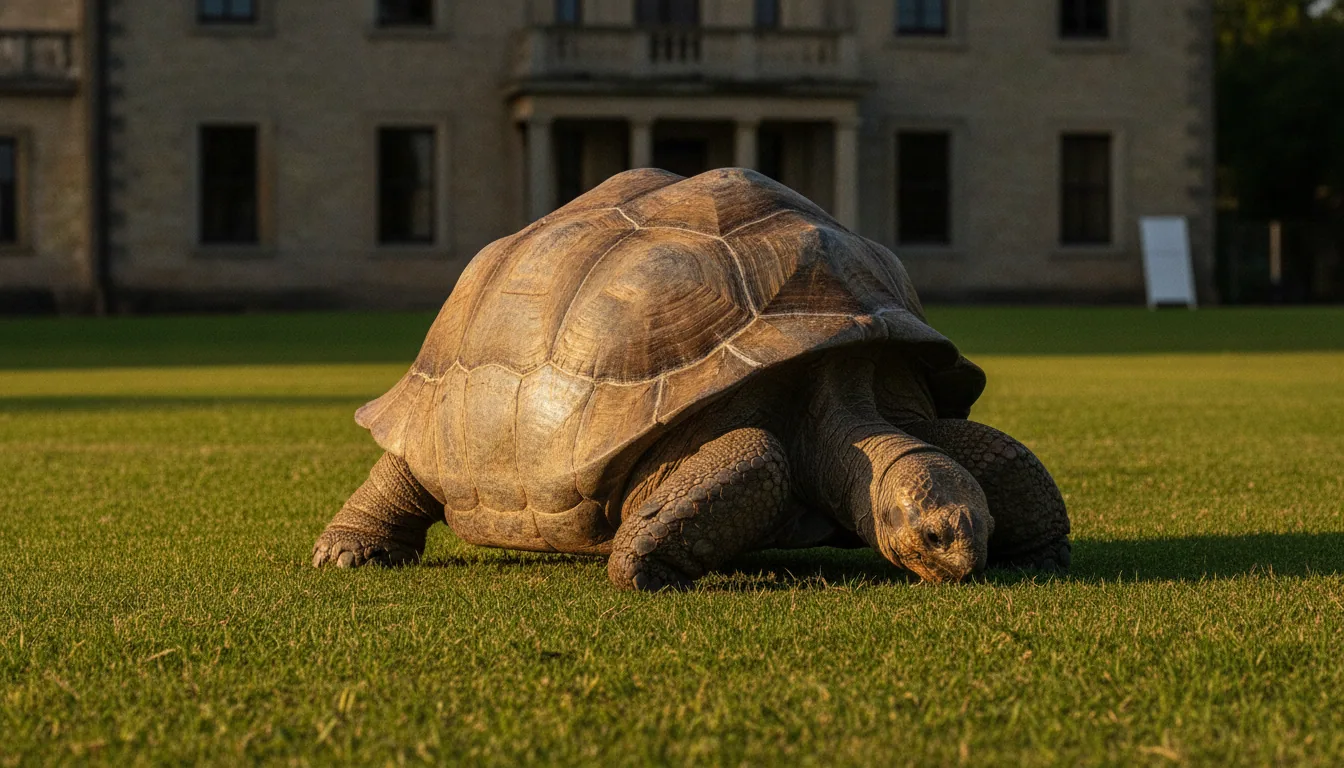
Say it slowly. One hundred and ninety-four years. Not the age of a building, or a family heirloom, or a country's constitution. The age of one animal, alive right now, eating a banana on a lawn in the South Atlantic.
Jonathan the tortoise was born in 1832. That is the year the railway age was just finding its stride in Britain, almost three decades before Darwin published On the Origin of Species. Every human alive today is a grandchild of a grandchild of someone who was already old when Jonathan hatched.
The numbers keep arriving. He has seen 31 governors come and go at Plantation House on the island of Saint Helena. Guinness World Records lists him as both the oldest living land animal and the oldest chelonian — that is, the oldest member of the entire order of turtles and tortoises — ever confirmed. In June 2026, Guinness went further, designating him an "ICON," a status that acknowledges something rarer than a record: a creature who has become genuinely irreplaceable.
As of October 2026, Jonathan is 194 years old. That fact does not get easier to hold in your mind. It is supposed to feel impossible. That is where the science begins.
The Tortoise Who Has Watched Thirty-One Governors Come and Go
Jonathan arrived on Saint Helena in 1882, a gift from the Seychelles to Sir William Grey-Wilson, the colonial governor of the island. He was delivered to Plantation House, the governor's official residence, and he has not left. The lawn he grazes today is the same lawn he grazed when Queen Victoria still had fifteen years left on the throne.
Governors rotate through Plantation House on diplomatic schedules. Jonathan does not rotate. He has outlasted thirty-one of them, a succession of appointments, ceremonies, and departures that adds up to a single tortoise's unremarkable Tuesday. It is the most quietly absurd measure of time available to us: not centuries, not wars, but the steady human churn of authority around one unhurried animal.
He shares the grounds today with three younger tortoises, David, Emma, and Fred. They are, relative to Jonathan, practically newborns.
His current condition is worth stating plainly, because it carries its own kind of evidence. Jonathan is blind, his vision clouded by cataracts that no one has risked treating. His sense of smell is gone. But his hearing remains sharp, and the keepers at Plantation House report that he still responds to familiar voices. A creature that has lost two of its primary senses and continues to orient by sound alone is not merely surviving — it is adapting, still, after nearly two centuries. That stubbornness is, as we will see, written into his genome.
How Scientists Determined Jonathan Was Born in 1832
The evidence begins with a photograph. In 1882, someone on Saint Helena pointed a camera at a tortoise and took a picture. That tortoise was already fully grown, which is the crucial detail. Seychelles giant tortoises, Aldabrachelys gigantea hololissa, reach adult size at roughly fifty years of age. Work backwards from 1882, add fifty years, and you land somewhere around 1832.
That is the entire calculation. It is elegant, and it is honest about what it is: a lower bound, not a birth record. Nobody was watching a nest in the Seychelles in the 1830s, notebook in hand. The 1882 photograph tells us only that Jonathan was already mature by then; the actual hatch date is, and may always be, unknown.
Still, an estimate needs a fixed point to be useful. In 2022, Governor Nigel Phillips gave Jonathan one. He officially designated December 4, 1832, as Jonathan's birthday, a date chosen to mark the milestone without pretending to more precision than the evidence allows. It is a human convention imposed on a biological fact, which is exactly the right way to handle it.
The species name matters here too. Aldabrachelys gigantea hololissa, the Seychelles giant tortoise, is a subspecies with its own growth timeline and its own genetic signature. Knowing precisely what Jonathan is turns out to be important later, when researchers go looking for what makes him so extraordinarily durable.
Getting DNA From a Giant Tortoise You Are Not Allowed to Harm
The first attempt was almost embarrassingly simple: swab the inside of his cheek, send the sample to the lab, wait for results. The Cambridge and Kallel Foundation researchers had come all the way to Saint Helena to unlock the genome of the oldest living land animal on Earth. What they got back, from those first cotton-tipped swabs, was a rich catalogue of bacterial DNA from Jonathan's mouth. Not Jonathan. Bacteria.
Back to the drawing board, on an island in the middle of the South Atlantic.
The team switched to cheek scrapings, collecting cells directly from the epithelial lining rather than whatever was floating in the tortoise's saliva. A blood draw, which would have yielded cleaner material, was ruled out entirely. Dr. Joe Hollins, who had cared for Jonathan for years, put the logic plainly: "I didn't want to be the doctor that killed Jonathan." A 194-year-old tortoise is not a routine patient. You do not take chances.
The scrapings worked. The study, published in Science Advances on October 7, 2026, became the first deep genomic and epigenomic analysis of Jonathan's longevity. To make the findings meaningful, the team needed a baseline — a younger tortoise whose genome could serve as a reference point for what "normal" looks like. That animal was Tank, a 36-year-old Aldabra tortoise, standing in as the control against which 194 years of extraordinary biology could finally be measured.
The 287 Variants That Refuse to Age
Here is a useful way to think about what aging actually is, before we look at what Jonathan's genome says. Every cell in your body contains DNA, but having the right DNA sequence is only half the story. The other half is a layer of chemical tags sitting on top of it, switching genes on or off like a lighting board. That layer is called the epigenome, and the specific tags most relevant here are called DNA methylation marks. Over time, those marks accumulate errors. Genes that should stay quiet start firing; genes that should stay active go dark. The organism frays.
Now compare that to what the Cambridge team found when they finally read Jonathan's genome. His DNA methylation patterns, in the pathways that matter most to cellular maintenance, look like those of a tortoise that hatched five years ago — not slowed, not merely well-preserved, but genuinely young by this particular measure, despite nearly two centuries of living.
The 287 gene variants they identified sit at the centre of two interlocking systems: DNA repair machinery and telomeres. Telomeres are the protective caps at the ends of chromosomes. In most animals they shorten with each cell division, a cellular clock ticking toward disorder. Jonathan's variants appear to keep both the repair crews working and the clocks running slow.
The crucial distinction the researchers draw is between luck and mechanism. Jonathan's longevity does not seem to be simply inherited luck, some ancestral gift he passively carries. The evidence points instead to an active, ongoing resistance to the biological entropy that quietly dismantles everything else. He is not immune to time. He is, somehow, unusually good at arguing with it.
He is not immune to time. He is, somehow, unusually good at arguing with it.
What a Tortoise's Genome Has to Say to Human Medicine
Biology, at its core, is a war against entropy. Every living cell is a standing order against disorder, and entropy keeps filing appeals. In most organisms, the appeals eventually win — proteins misfold, mitochondria leak, DNA repair falls behind. Jonathan's genome suggests his cellular machinery is filing unusually effective counter-arguments.
The 287 variants identified in the 2026 Science Advances study cluster around two linked processes: DNA repair and telomere maintenance. Neither is unique to tortoises. The relevant aging pathways, as researcher Greer Dolby noted, share their architecture with human aging pathways — a broader signature of growing old that appears conserved across wildly different species. That shared structure is precisely what makes the data interesting to medicine.
Mitochondria are the clearest example. Think of them as the cell's power plants: the older they get, the more they leak reactive byproducts that damage the very machinery running them. Jonathan's mitochondrial stability markers suggest this feedback loop stays unusually tight in his cells — the leakage rate remains low, the damage accumulates slowly.
The Kallel Foundation, the Nashville-based nonprofit that co-funded the study with a specific mandate to translate comparative longevity data into human applications, is now focused on whether the 287 variants have human counterparts, called orthologs, that could be targeted in geriatric therapy. The data does not offer a cure. It offers a map, drawn by one very old tortoise, of roads worth exploring.
What We Still Cannot Explain About the World's Oldest Tortoise
December 4, 1832, is a birthday assigned by decree, not discovered in a ledger. It was calculated backwards from a photograph: Jonathan was fully grown in 1882, giant tortoises reach maturity around fifty years old, therefore subtract. The logic is sound; the precision is borrowed. We know he is very old. We do not know exactly how old.
The 287 variants raise a question that the genome itself cannot yet answer. Are these switches unique to Jonathan, a private biological lottery he happened to win? Or are they shared across the Seychelles giant tortoise subspecies, waiting to be found in any individual given the right environment, the right remote island, the right unhurried life? The study cannot say. The reference animal was one tortoise, thirty-six years old. The sample size is still, essentially, one.
His hearing remains sharp. His eyes do not. We don't know whether his advancing sensory loss marks a ceiling or merely a detour, and no researcher will predict a date. Jonathan the tortoise stands at the outer edge of what animal life has been observed to do — a living question mark about where that edge actually sits. The explanation ends here, and the next adventure, as it always does, starts precisely at that boundary.