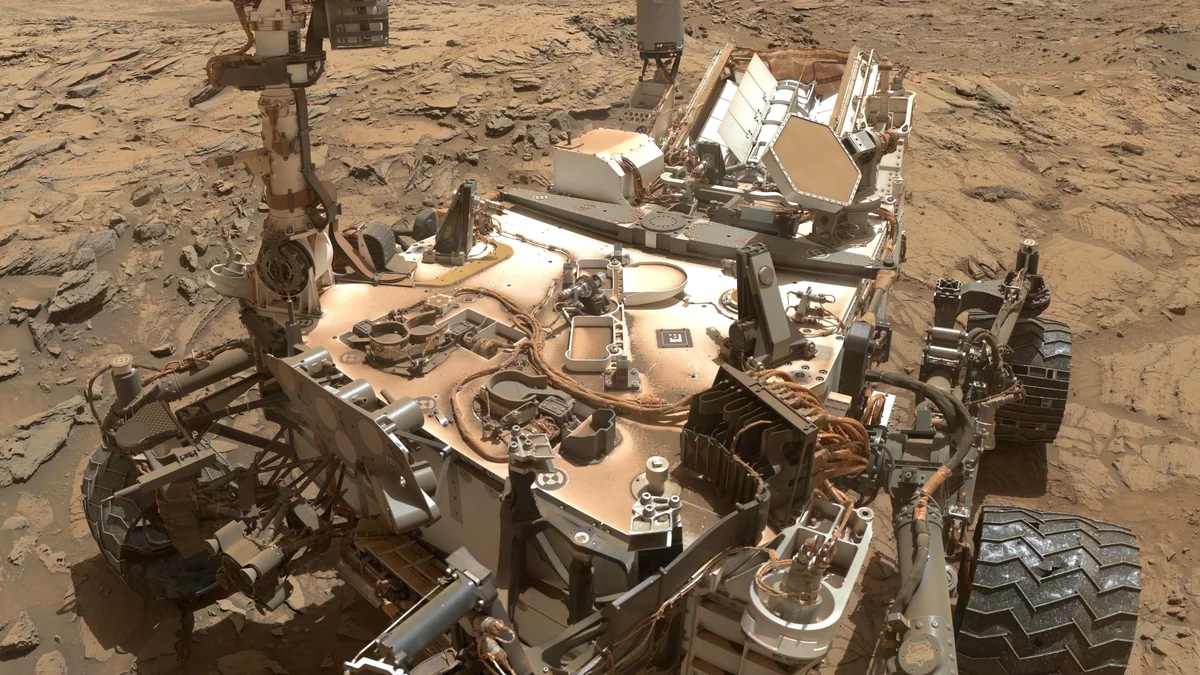
A Robot Climbs a Mountain, One Sol at a Time
On August 26, 2026, Curiosity's unending mission crossed a threshold no object from Earth had ever reached: one full kilometer of vertical gain on another planet's mountain. There was no ceremony, no arrival gate. Just another sol on Mars, and a number that finally clicked over.
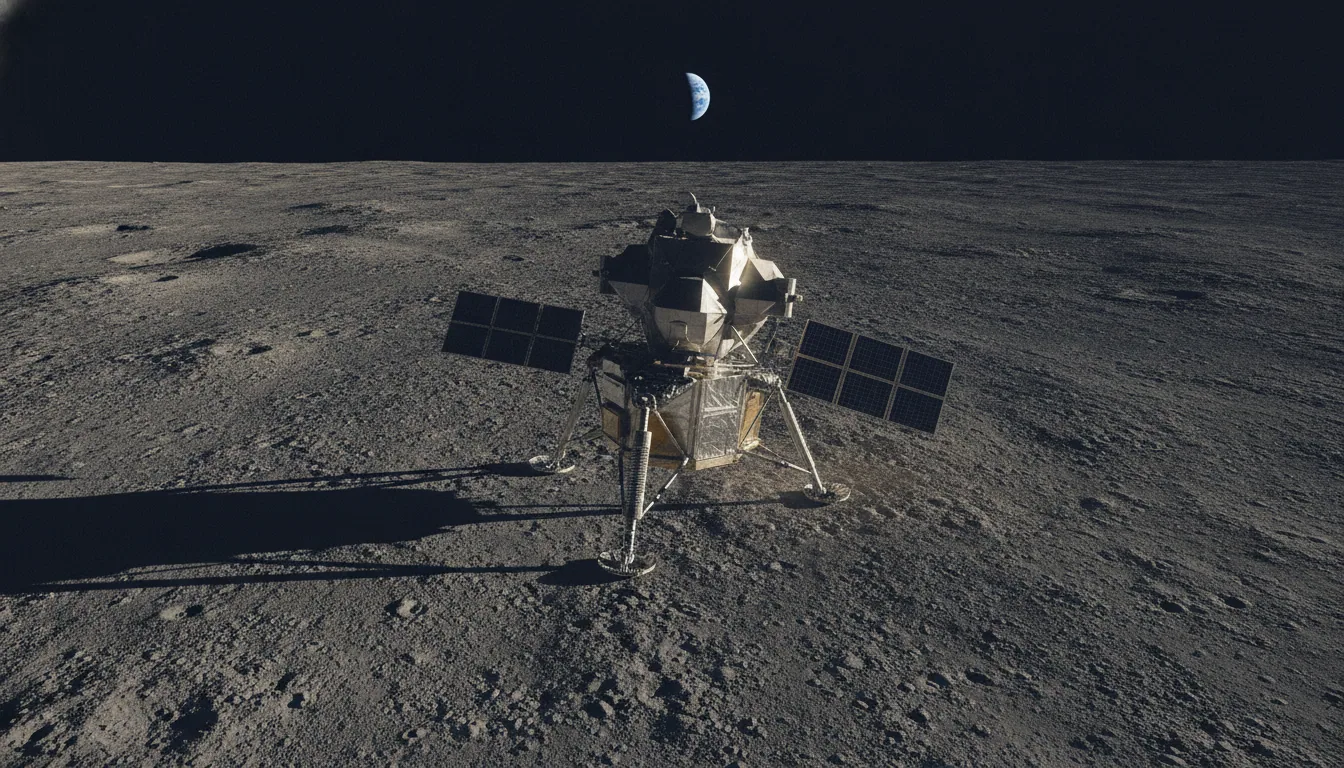
That machine is Curiosity, and its story begins fourteen years earlier. On August 6, 2012, the rover landed in Gale Crater, a 96-mile-wide bowl punched into the Martian surface by an ancient impact. The crater holds, at its center, a mountain called Mount Sharp, rising roughly 5 kilometers from the crater floor. Curiosity began climbing it in 2014. It has been climbing ever since.
The numbers, held at arm's length, are hard to feel. So try this: 37.43 kilometers of total driving distance as of mid-July 2026, across terrain that would shred a car's tires in an afternoon. More than 5,000 Martian sols of operation, each sol running 24 hours and 40 minutes long. That is over 14 Earth years of waking up, taking readings, and driving a little further up a mountain, on a planet where no one can hear it.
Here is why the vertical kilometer matters more than the horizontal 37. Elevation on Mount Sharp is time. Each meter gained moves Curiosity into rock layers deposited in a different Martian era, a different climate, a different chapter of a planet's long transformation from wet to dry. Distance is just distance. Altitude is the archive.
The rover recently sent back a 323-image panorama of a broad valley called Valle Grande, stitched together on August 1 and 2, 2026. Think of it as a postcard from a place no human eye has ever seen, taken by a machine that, by every original plan, should have retired a decade ago.
Every Meter Up Is a Chapter Back in Time
Mount Sharp is not just a mountain. It is a library, and the books are stacked in order: oldest at the bottom, youngest at the top, each layer of sediment a sentence written by a Martian climate that no longer exists. When Curiosity drives upward, it is not merely gaining altitude. It is turning pages backward through roughly three billion years of planetary history.
The grammar of that history changes as the rover climbs. The lower slopes, where Curiosity spent its earlier years, are thick with clay minerals, the chemical signature of prolonged contact with liquid water. Lake-bed chemistry, essentially. Higher up, the rock transitions to sulfate-rich layers, minerals that precipitate when water is scarce and evaporation wins. That boundary, somewhere in the middle of the mountain's flanks, marks the moment Mars tilted from wet to arid. Reading it in stone is different from inferring it from orbit. Curiosity is reading it in stone.
Two discoveries from the current elevation sharpen the picture considerably. In the Gediz Vallis canyon, geologists identified native elemental sulfur on Mars for the first time — sulfur in its pure form rather than bound inside other compounds. That distinction matters: elemental sulfur typically requires very specific chemical conditions to crystallize, and unpicking those conditions tells us something precise about what fluids were moving through the rock and when. Then, in June 2026, the rover's cameras revealed honeycomb-shaped polygonal fractures in the surface, geometries that form on Earth when sediment swells and contracts repeatedly through wet-dry cycles. Each hexagon is a fossilized rhythm of a Mars that breathed in water and breathed it out again, season after season, long before anything on Earth had figured out how to build a spine.
The Chemistry That Makes Astrobiologists Hold Their Breath
Early in 2026, researchers analyzing Curiosity's drilled samples from ancient mudstone announced something that made a particular corner of the scientific community go very quiet: fatty acids. Not exotic, not alien — fatty acids, the same class of molecules that form the outer membrane of every living cell on Earth. Found in rock that has not seen liquid water for perhaps three billion years.
Then there is Glen Torridon, the clay-rich region lower on the mountain, where organic compounds structurally resembling DNA precursors have turned up in the sediment. The chemistry is getting more interesting the higher the rover climbs.
Here is what "biosignature" actually means, because the word is doing a lot of work. A biosignature is any substance that provides scientific evidence of past or present life. Fatty acids qualify — in principle. So do the organic molecules in Glen Torridon. But here is the careful part, the part that separates good science from a headline: abiotic chemistry, the kind that requires no life at all, only heat and pressure and the right mineral catalysts, can produce exactly these molecules. Meteorites carry them. Lab benches produce them.
So the honest answer is not "life." The honest answer is "we have found chemistry that life, if it ever existed here, would have used." That is a meaningful distinction, and it is worth holding onto.
What it tells us, practically, is that Mars was once the kind of place where the raw ingredients were present. The planet had the molecular vocabulary. Whether anything ever spoke with it, we cannot yet say. The samples exist, the analysis is ongoing, and the question — the real one — remains stubbornly, wonderfully open.
A robot the size of a car, running on nuclear decay and remote code patches, is sitting on a neighboring world patiently turning rock into questions.
Thirteen Years of Software Hacks and the Art of Not Giving Up
Picture the engineers at JPL in Pasadena, gathered around a monitor, writing code for a machine 225 million kilometers away that cannot be touched, rebooted by hand, or carried to a repair bench. This has been their reality not for two years, Curiosity's original design life, but for thirteen. The mission has quietly become one of the longest-running software improvisation projects in the history of exploration.
The wheels tell the most visible part of that story. Curiosity's six aluminum wheels were built for two years of Martian terrain; they have now endured fourteen. The grousers, the raised metal treads that grip the rock, have cracked. Some damage appeared years ago, and mission controllers could do nothing to replace them. What they could do was write code — a specialized traction control algorithm that now adjusts wheel speeds in real time, redistributing load across the damaged surfaces to slow the deterioration. The rover walks more carefully than it used to. It has learned to be gentle with itself.
The instruments tell a harder version of the same story. The ChemCam laser, which once vaporized rock samples from a distance of seven meters and read the resulting light like a chemical fingerprint, now operates under strict restrictions because the high-voltage subsystem that drives it has degraded. The left Mastcam lost its filter wheel to mechanical failure, ending the rover's capacity for narrow-band multispectral imaging — a way of reading mineral compositions through color. Two eyes partially closed, two tools partially silenced.
And yet the rover climbs. The engineers patch. Software fills the gaps that metal can no longer close, and the mission continues to return data that no other spacecraft on Mars can produce. There is something almost philosophical in watching a machine designed for two years reach year fourteen on sheer ingenuity alone, its team refusing, methodically and without drama, to give up.
The Nuclear Heartbeat Powering Mars Exploration
Most spacecraft beyond the asteroid belt die by darkness. Solar panels, useful enough on Mars, become progressively less useful the further you travel from the Sun, and even on the red planet, a dust storm lasting months can strand a solar-powered rover as effectively as a drained battery. Curiosity was built around a different answer: plutonium-238, sealed inside a Multi-Mission Radioisotope Thermoelectric Generator, or MMRTG. The physics is elegant in its simplicity. Plutonium-238 decays naturally, releasing heat; thermocouples convert that heat into electricity. No sunlight required.
The contrast with solar power is instructive, but it comes with a built-in clock. Plutonium-238 has a half-life of roughly 87 years, which sounds generous until you do the math on what declining output means for a machine that cannot be serviced. The MMRTG has been losing power steadily since 2012, and engineers at JPL now manage a tighter and tighter energy budget, deciding which instruments get power on any given sol the way a household manages a failing generator in a long winter.
Here is the strange part. That same nuclear source means the rover carries its own radiation signature, and measuring what Mars adds on top of it has become genuine science. Curiosity completed radiation measurements spanning a full solar cycle, recording its highest dose rate in May 2024, near solar maximum. That data point is not a hazard footnote. It is the most complete radiation map future mission planners have for designing shielding, scheduling surface time, and calculating what a human body would actually absorb during a stay on Mars.
What the Mountain Has Not Yet Said
Four questions still have no answers. What made the fatty acids in that ancient mudstone, biology or ordinary chemistry? What formed the elemental sulfur in Gediz Vallis, volcanic heat or something stranger? When will the cracked grousers finally betray the rover on a bad slope? When will the MMRTG's slow plutonium fade cross below the threshold where science stops?
These are not embarrassing gaps. They are the mission's remaining heartbeat.
Fourteen years, 37.43 kilometers, 5,000 Martian sols — and still the most productive sentence in planetary science is "we don't know yet." Curiosity's unending mission, running on nuclear decay and remote code patches, keeps turning rock into questions on a neighboring world. That, more than any single number, is what human curiosity actually looks like when it's working.