What the Record Shows: A Life Sentence, a Fugitive, and a Death in The Hague
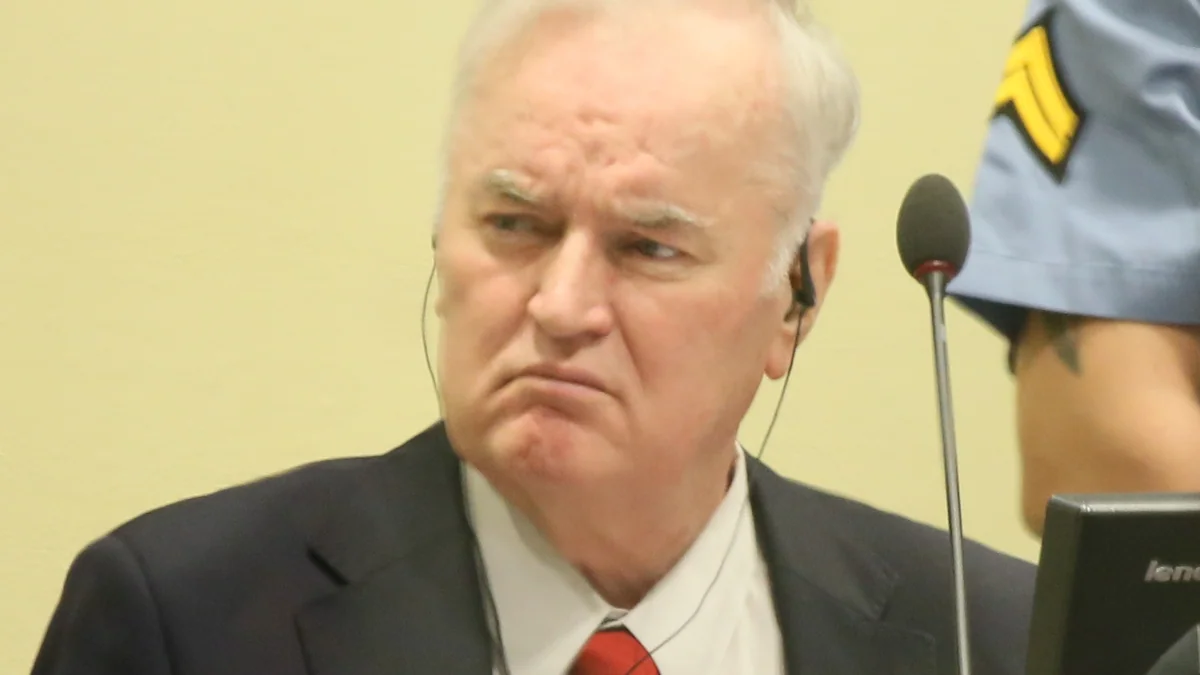
The legal record beneath the controversy over Ratko Mladic's state funeral is precise: the International Criminal Tribunal for the former Yugoslavia handed down its initial verdict in November 2017, and the appeals chamber confirmed the life sentence in June 2021. The conviction covered genocide at Srebrenica, where a minimum of seven thousand Bosniak men and boys were murdered in July 1995, crimes against humanity, and violations of the laws and customs of war across the full span of the Bosnian conflict. The juridical record is not contested by any competent legal authority; it is simply a record.
Ratko Mladic died on August 27, 2026, at age 84, in the United Nations Detention Unit in The Hague. He had spent fifteen years in custody and sixteen years before that as a fugitive, sheltered inside Serbia — sheltered, that is, by arrangements whose precise architecture no Serbian government has ever fully explained. The state that now deliberates over military honors is the same state that once made his concealment possible.
The International Residual Mechanism for Criminal Tribunals, the ICTY's successor body, has opened an inquiry into the circumstances of death. That inquiry keeps the institutional record open; the cause of death beyond general reports of ill health and past strokes remains unconfirmed. This is routine procedure, and it should be read as exactly that — not exoneration, not persecution.
Ask the small question first: who is the borderland here, and who is the empire? The facts assembled over three decades of legal proceedings answer part of it. What Belgrade does with those facts is a separate question entirely, political in nature, and it is only beginning to find its answer.
Full Military and State Funeral Honors: Belgrade's Announcement and Its Load-Bearing Logic
Justice Minister Nenad Vujic left little room for misreading. "It is certain that General Mladic will receive all the military and state honors to which he is entitled." That sentence is the structural element. Everything else Belgrade has said since August 27 is molding.
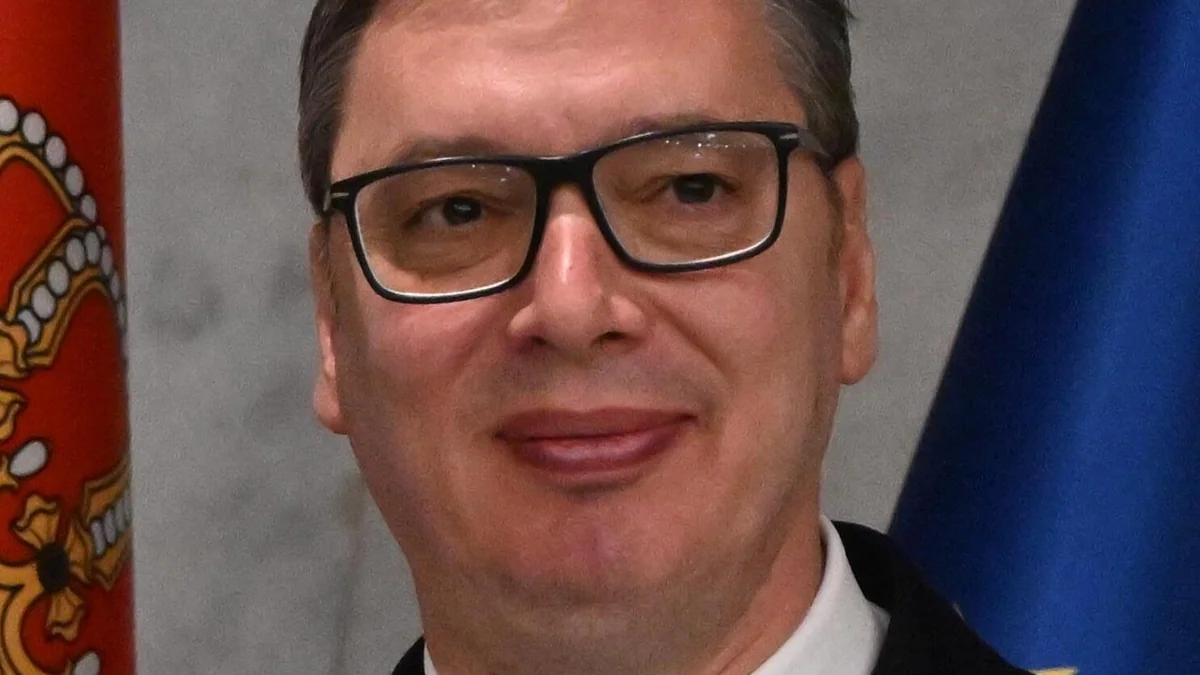
The framing around the announcement is worth reading in sequence. First, Vujic declared the honors. Then President Aleksandar Vucic attacked the Hague tribunal for refusing to release Mladic for medical treatment, converting a convicted genocidaire's death into an institutional grievance — the court as perpetrator, the prisoner as wronged party.
The burial location, Vujic clarified, rests with the Mladic family alone, though the government is in regular contact with them. Deniability is built into the load-bearing wall itself: Belgrade issues the honors, the family makes the choice, and no single official finger pulls the trigger.
Aleksandar Vulin contributed the register's ceiling. Calling for a national day of mourning, he offered this: "From Gavrilo Princip to Ratko Mladic, the best Serbs are killed in chains." Princip assassinated an Austro-Hungarian archduke in 1914. Mladic was convicted of genocide by a tribunal whose procedures Serbia nominally accepted.
The sentence placing them in the same breath is not careless — it is the argument.
Running beneath all of this is the soft legal cover Serbian officials have floated: that punishment loses its purpose when a prisoner is in the final stages of life. The argument is not without philosophical precedent, and in any ordinary criminal case it carries weight. Mladic was not an ordinary case.
The ICTY found him responsible for the murder of at least 7,000 men and boys at Srebrenica and for 10,000 civilian deaths during the siege of Sarajevo. The proposition that finality dissolves accountability is precisely what a life sentence was designed to refuse.
The Borderlands React: Srebrenica, Republika Srpska, and Zagreb
The Srebrenica Memorial Center issued its statement quickly, and the language was exact: his death does not change the judgment, does not clear the mass graves, does not bring back the dead. Emir Suljagic, the center's director and a survivor of the 1995 massacre, offered no commentary beyond the record. That restraint was itself a form of precision — the facts require no ornament from the living, because the dead already numbered at least seven thousand.
Across the entity border, Republika Srpska Prime Minister Savo Minic moved in the opposite direction. He named Mladic a national hero. The distance between a genocide conviction handed down by a UN court and the language of heroism is not ambiguity — it is a choice, made publicly, by a sitting head of government within Bosnia and Herzegovina's own political architecture.
The Dayton Agreement created that architecture in 1995. Minic's framing tests how much weight it still carries.
Croatia registered formal protests at the state level, the first government-to-government diplomatic friction to surface in the wake of Belgrade's announcement. Zagreb has its own memories of the 1991-1995 wars and its own ledger of shelled cities. The protest was not symbolic.
It was the earliest concrete signal that Serbia's domestic political performance will carry an external cost — the question being how sustained that cost proves, and which European capitals choose to amplify it rather than file it quietly. The map of the 1990s and the map of today's rhetoric remain, in the relevant places, nearly identical.
Moscow's Condolences and the Uses of a Convenient Corpse
The Russian Ministry of Foreign Affairs did not mourn Ratko Mladic. It used him.
The statement issued after his death on August 27 noted that Moscow had "consistently pointed out" that the Hague proceedings and the conditions of his detention showed "disregard for his basic rights." The verb tense is worth noting: consistently, past continuous, as though the condolence were a ledger entry being closed out.
The framing is not grief. It is an instrument. Russia has spent two decades arguing that the UN tribunal system is a Western tool, politically calibrated and procedurally corrupt.
A deceased Mladic, held in The Hague until his final hour, is more useful to that argument than a living one would have been. The body becomes a text, and Moscow reads it aloud for the Balkan audience.
The choreography is familiar. Russian condolence statements for figures the West has convicted tend to arrive quickly, precisely worded, aimed at three targets simultaneously: the court's legitimacy, the regional alliance's cohesion, and the domestic Serbian audience that Moscow still regards as a constituency worth tending. Belgrade's echo of the medical-care criticism — Vucic's complaint that the tribunal refused to release Mladic for treatment — runs parallel to the Russian line close enough to be audible.
What sits uneasily beside all this is the EU accession file Serbia still nominally holds open. The same government that repeats Moscow's critique of the Hague tribunal is the one that signs progress reports in Brussels.
The two positions are not impossible to hold simultaneously. They are simply very hard to explain in the same sentence.
Serbia's Domestic Fracture: The Opposition, the Accession File, and the Nationalist Ceiling
Pro-European opposition groups condemned the state honors plan. That condemnation matters less as a moral statement than as a structural signal: the decision is contested, not consensual, and Belgrade knows it. A government confident in its nationalist floor does not need consensus to proceed, and Vucic's has not sought it.
The comparison with 2003 is useful, and it breaks in one precise place. Since Zoran Djindjic's assassination, Serbian politics has run on a standing tension between the European trajectory and the nationalist floor, each government managing the distance between the two.
What has changed is that Brussels once accepted the performance of both simultaneously. The question now is whether it still will.
Offering military honors to a man the ICTY convicted of genocide is not a procedural irregularity Brussels can file away quietly. It is a stress test of whether European language and nationalist performance remain compatible within a single government's vocabulary.
Vucic has calibrated that combination with considerable skill since 2012. The calibration works only so long as the European side reads the signals selectively. Glorifying a convicted genocidaire is a harder thing to read selectively than a delayed extradition or an ambiguous communique.
Glorifying a convicted genocidaire is a harder thing to read selectively than a delayed extradition or an ambiguous communique.
The domestic fracture, then, is not a crisis for the government. It is a measure of exactly how much the accession file can absorb before the ceiling becomes the floor.
The Marker to Watch: One Decision, One Ledger Line
The question that matters now is not rhetorical. It is procedural, and it has a date attached.
If a serving Serbian minister attends Mladic's funeral in an official government capacity, the honors announcement ceases to be a deniable decoration. It becomes state policy, on the record, photographed.
At that point, someone in Brussels will be required to respond — not in a press release, but in the procedural language of the accession file. The European Commission cannot treat a sitting minister's presence at a convicted genocidaire's military funeral as an inconvenience to be noted and absorbed.
If no minister appears in an official role, the honors announcement remains what Vujic's language already permits it to be: a family matter, a legal entitlement, molding rather than a load-bearing wall. Deniable, manageable, forgotten by the next news cycle.
The Srebrenica record is fixed. The ICTY found Mladic guilty in 2017; the appeal confirmed the life sentence in 2021; at least 7,000 men and boys died at Srebrenica, and no state funeral choreography alters those numbers.
What remains open is the simpler question: whether Belgrade's European partners treat ministerial attendance as a cost, or merely an inconvenience. Watch the guest list at Mladic's state funeral. It will tell you which conversation this actually is.