
Air Baltic's €380 Million Bond Pyramid Is Closer to Collapse Than Anyone Wants to Admit
Air Baltic's bond crisis centers on Latvia's state-owned carrier having issued €380 million in bonds at a 14.5% interest rate — a figure that functions, in financial markets, less as a borrowing cost and more as a distress signal. With negative equity of €166 million by end-2024 and credit ratings at CCC+/CCC−, the airline's survival now hinges on a €325 million rescue package assembled under acute political and market pressure.
When State Ownership Is No Longer a Guarantee
There is a structural contradiction at the heart of this story that deserves considerably more scrutiny than it typically receives. Latvia holds an 88.37% stake in Air Baltic. In theory, sovereign ownership functions as implicit backing — a signal to markets that the state will not permit default. In practice, Air Baltic issued bonds in May 2024 at an interest rate that markets classify as high-risk, low-credibility. That is: junk.
This is not a semantic distinction. A 14.5% coupon on a sovereign-majority-owned carrier is a verdict, not a cost of doing business. Markets assessed the airline's creditworthiness independently of its ownership structure — and found it wanting.
The initial issuance of €340 million was extended by a further €40 million in October 2024, bringing the total to €380 million. When a primary issuance falls short of operational needs within months of launch, the implication is either that capital requirements were systematically underestimated from the outset, or that the financial position deteriorated faster than the models projected. Neither reading is reassuring.
Estonian aviation analyst Toomas Peterson has described the financing structure plainly: it resembles a pyramid scheme sustained by successive injections of new loans and state capital. By year-end 2024, negative equity had reached €166 million — a figure that points toward structural insolvency, not a cyclical downturn.
Bondholder votes do not alter this underlying logic. The emerging paradigm is stark: a state-owned enterprise is just as exposed as any private firm when institutional behavior diverges from the rules of market rationality.
The financing model resembles a pyramid scheme sustained solely by new loans and state injections.
Three Days, 83% of Value Erased
In mid-August 2026, Air Baltic's bond price fell more than 40% across three trading days. This was not a gradual market correction — it was a coordinated exit, with prices reaching €16,500 per €100,000 face value. An investor who bought at par in 2024 now faces a paper loss exceeding €83,500 per bond held.
Fitch and S&P have both downgraded the airline to CCC+ and CCC− respectively — ratings that, in institutional portfolio management, function as automatic sell triggers. The Euronext Dublin-listed securities reflect this reality in real time, and the speed of the price collapse is structurally explicable: institutional mandates prohibit holding CCC-rated paper, so the exit is not discretionary.
The planned IPO, already a subject of considerable uncertainty, now faces an indefinite postponement. The cross-border correlation is unambiguous: when a state-backed carrier issues junk bonds and subsequently fails to recapitalize, the market's response is not merely a price adjustment. It is a structural judgment on the entire business model.
Capitalizing Interest Is Not a Solution. It Is a Deferral.
The August 17th bondholder vote centers on a mechanism that has been framed, in some quarters, as resolution. It is not. Capitalizing the 14.5% coupon — adding unpaid interest to principal or converting it to equity — does not create liquidity. It transfers the obligation to the future while compounding the underlying debt.
Air Baltic posted a net loss of €118 million in 2024. A further €44.3 million was added in 2025. These are not anomalies in an otherwise viable trajectory — they constitute a chronic loss pattern that persists through what the airline's own communications describe as a growth phase. If losses compound during a period officially labeled expansion, the structural question is not when they will stop, but whether the current model contains any credible path to profitability at all.
The survival plan requires €225 million in bridge financing and an additional €100 million in new equity — a total of €325 million that must be sourced in market conditions where the company's own credit ratings signal imminent default. Buying time only works if the cost of that time does not compound faster than the capacity to service it. The paradigm shift occurs when the deferral mechanism itself becomes the new source of debt accumulation.
Fleet Contraction as Triage
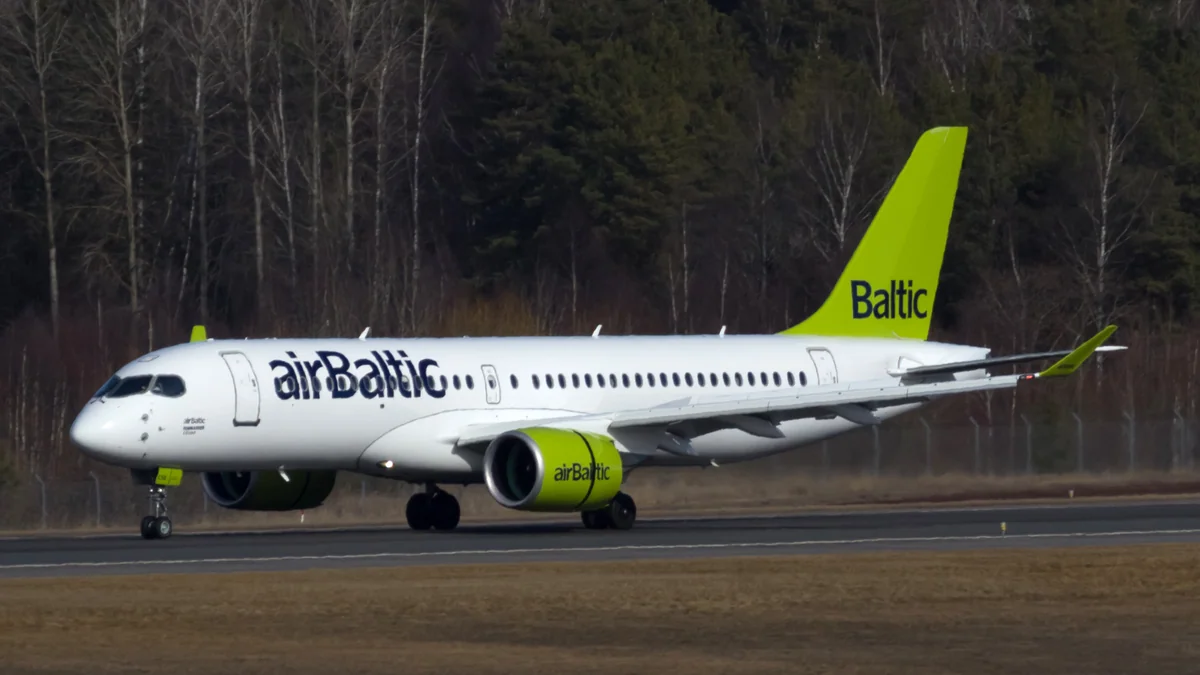
The Airbus A220-300 jets sitting idle on the tarmac at Riga Airport are not awaiting new routes. They are awaiting a decision on whether they remain in the fleet at all. By end-2026, Air Baltic's fleet is scheduled to shrink from 54 aircraft to 36 — a reduction of one third.
For CEO Martin Gauss, this is the central strategic paradox: to save the airline, you must first make it substantially smaller. Latvian Prime Minister Andris Kulbergs has called this Air Baltic's last opportunity to avoid bankruptcy. When a head of government uses the word "last," it signals that the threshold between commercial strategy and political accountability has already been crossed.
Tallinn Airport has noted the situation with measured attention, projecting that competing carriers will absorb some of the capacity reduction. That may be true for passengers — but for Air Baltic, every route conceded during this period of contraction is market share surrendered at precisely the moment when revenue growth is most urgently needed.
Lufthansa's 10%: Strategic Insurance or a Positioned Acquisition?
In 2025, Deutsche Lufthansa AG acquired a 10% stake in Air Baltic. The institutional logic is transparent: a minority position provides optionality without full exposure to downside risk. Lufthansa's historical acquisition pattern is instructive — the group has repeatedly moved from minority stakes to full control of carriers in deep distress.
Latvia's risk profile is categorically different. With an 88.37% stake, a bankruptcy or forced restructuring of Air Baltic is not merely a financial event — it is a political crisis and a test of coalition stability. The pressure to inject capital continues regardless of commercial logic, because the alternative is electorally intolerable.
EU state aid rules impose hard legal constraints on capital injections that Riga cannot ignore. Domestic political pressure and Brussels regulations form a structural bind that narrows the airline's financial maneuvering room from both directions simultaneously. The state cannot let it fail, cannot freely rescue it, and cannot attract private capital on terms that make the rescue viable.
The Baltic Connectivity Question Estonia Cannot Ignore
In the Estonian context, Air Baltic's bond crisis is not a Latvian problem viewed from a comfortable distance. It is a direct vulnerability in the connectivity architecture of the entire region. The Tallinn-Riga corridor, Baltic hub routing, and the frequency of regional services all depend in part on Air Baltic's operational continuity.
If a carrier of Air Baltic's regional scale loses one third of its fleet, competitors do not fill that void overnight. Frequencies decline, ticket prices adjust upward, and the thinner regional markets — the ones that major European carriers have little structural incentive to serve — are precisely the ones most exposed to deterioration.
The state's 88.37% ownership stake creates a systemic incentive to continue subsidizing operational inefficiency rather than forcing the structural adaptation that market logic demands. This delays the inevitable reconfiguration of Baltic aviation while compounding the cost of the eventual adjustment.
Baltic policymakers face a strategic question that the current crisis has made unavoidable: is the three-carrier, three-nation model — each with its own vulnerabilities, its own political dependencies, its own capital requirements — a sustainable socio-economic blueprint for regional connectivity? Air Baltic's bond crisis does not answer that question. But it makes the cost of not answering it considerably higher.