
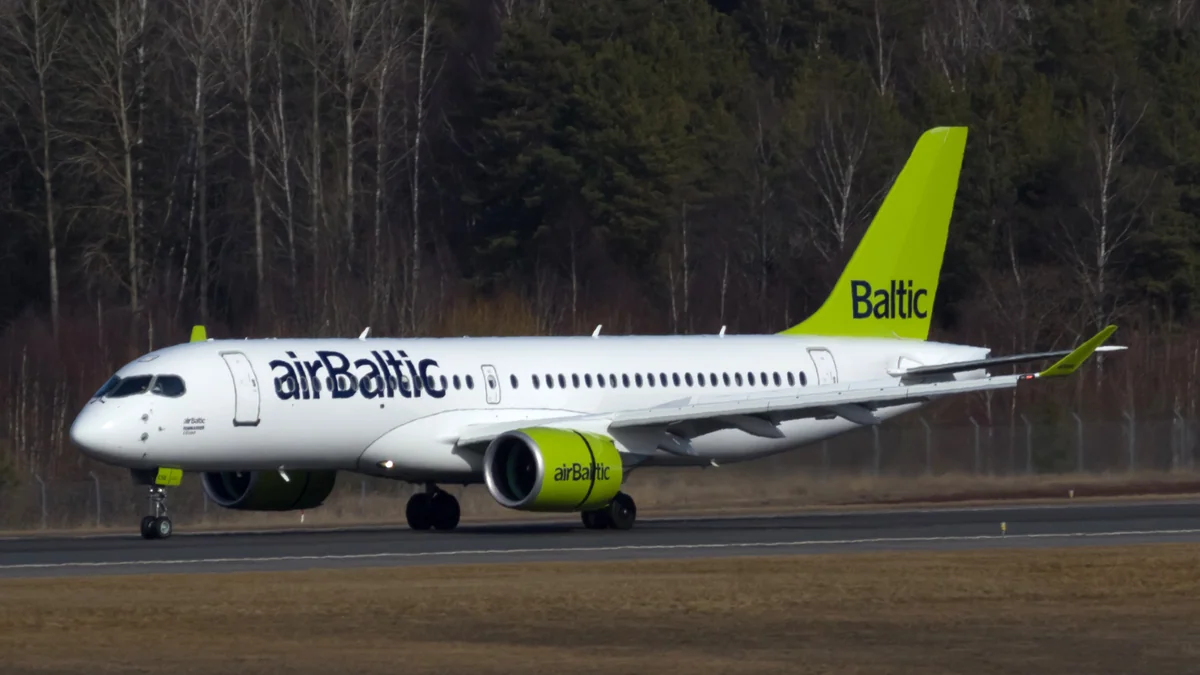
airBaltic is navigating an acute liquidity crisis, marked by a €70.1 million loss in early 2026 and a debt load of €380 million. To survive, the carrier is slashing its fleet from 54 to 36 aircraft and seeking €225 million in bridge financing, signaling a forced retreat from expansion to aggressive cost-cutting.
The glamour of high-level aviation strategy often collides with the cold geometry of a balance sheet. In the case of airBaltic, a vision of aggressive regional dominance has finally met the hard limit of empty coffers; by early 2026, the company reported a staggering loss of €70.1 million. This fiscal reality has forced an immediate strategic pivot, as the airline seeks €225 million in bridge financing just to maintain operational altitude.
We are witnessing the unraveling of a growth model that long ignored global market signals. While former CEO Martin Gauss was removed in April 2025, his legacy of high-cost structures continues to weigh on the institution’s behavior. If a state-backed entity operates in a vacuum of accountability, then the eventual correction is rarely a soft landing; as Latvian Prime Minister Andris Kulbergs noted, the airline appears to have been operating in a bubble detached from economic gravity.
The 14.5% Trap: Bond Markets as Risk Arbiters
Financial credibility is built on stability, yet airBaltic’s recent institutional behavior suggests an era of desperation. The company’s €380 million bond issuance carries a 14.5% interest rate—an astronomical figure for the aviation sector. Such a premium is not merely a cost of capital; it is a clear risk marker reflecting the market’s deep skepticism regarding the firm’s socio-economic blueprint.
This trust deficit materialized sharply when a bondholders’ meeting was postponed to August 2026 due to a lack of quorum. If institutional investors refuse to even sit at the table, it indicates a fundamental breakdown in the relationship between the state as an anchor investor and the private sector. The upcoming requirement to repay a €30 million short-term loan to the Latvian state by August 31, 2026, further tightens the vise between short-term obligations and long-term viability.
To avoid a total financial collapse, the carrier is now proposing to convert part of its 2029 bonds into equity. This maneuver is a necessary balance-sheet cleanup, but it forces creditors to fundamentally re-evaluate their positions. In the Estonian context, this serves as a stark warning: if a regional infrastructure project relies on an unstable financial foundation, then its strategic value to the state becomes a liability rather than an asset.
From Baltic Connector to European Contractor
The dream of the Nordics’ largest air bridge is currently being rewritten by the necessity of physical contraction. By the end of 2026, the fleet will shrink from 54 to approximately 36 Airbus A220-300 units. This is not just a resizing; it is a paradigm shift where operational resilience takes precedence over route network expansion.
Under the new business plan led by Erno Hildén, the airline aims for €45 million in annual cost savings. A significant component of this emerging paradigm is the shift toward ACMI—leasing aircraft and crews to other airlines. By summer 2026, up to 25 airBaltic planes are expected to operate within the Lufthansa Group network. If a "national carrier" spends more time serving external partners than its own region, its institutional role must be reconsidered.
In the Estonian context, this shift is already visible at the departure gates. The cancellation of the strategically critical Tallinn–London route for the 2026/2027 winter season leaves Tallinn with only 12 direct destinations. This thinning of regional connectivity forces a difficult question: how do we maintain global access when our primary carrier is more interested in stabilizing its cash flow in foreign markets?
Cross-Border Correlation: The Baltic Divorce
While Riga struggles to maintain the narrative, its neighbors are practicing a sober form of distancing. Lithuanian Transport Minister Juras Taminskas has already confirmed a contingency plan should airBaltic’s financial troubles lead to an abrupt cessation of service. This cross-border correlation of doubt suggests that regional trust is nearly exhausted.
Estonia’s recent official decision not to purchase a stake in airBaltic marks a new, more pragmatic era of fiscal protectionism. This is a deliberate decoupling from a high-risk asset characterized by overextended budgets and deepening liquidity gaps. We are seeing a fundamental shift in how the Baltic states view collective infrastructure; the old order of "at any cost" connectivity is being replaced by a data-driven skepticism.
As airBaltic casts its eyes toward a 2031 revenue target of over €1 billion and a potential IPO, we must ask if this is a realistic socio-economic blueprint or a desperate attempt to swap debt for public market confidence. If the market fails to see a functional economic model behind the ambitious numbers, the resulting crash could be systemic. Does the current institutional behavior allow for the necessary evolution, or is this fleet reduction simply a controlled descent before a final landing?