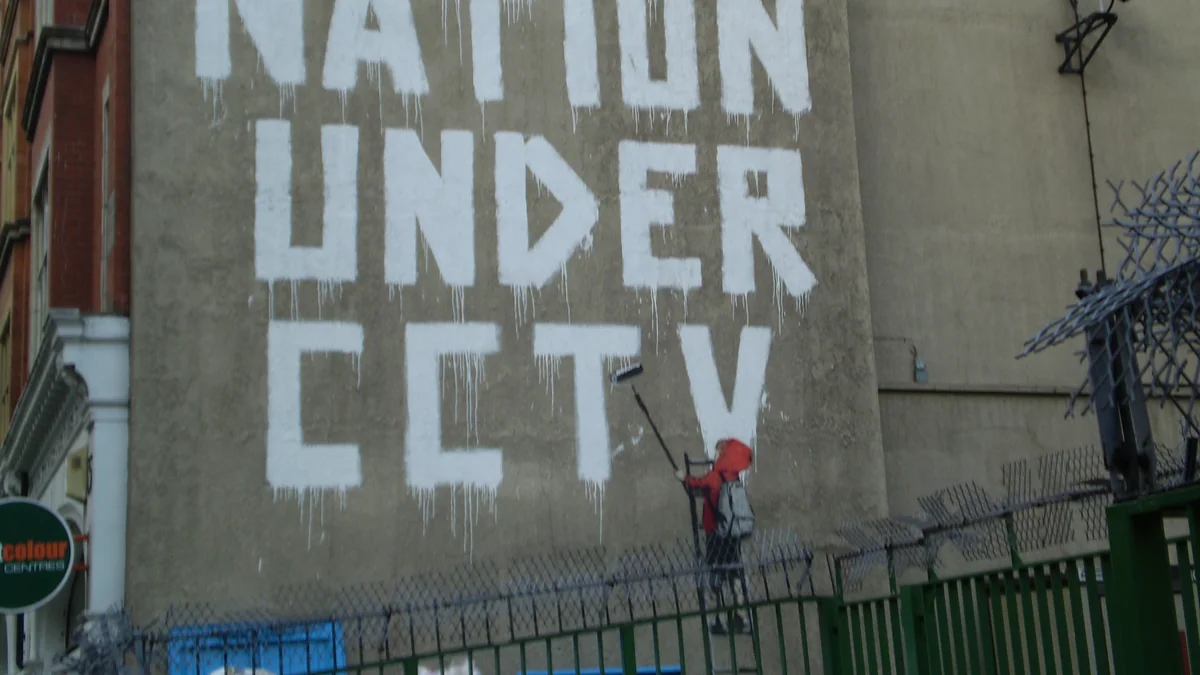
Managing three Banksy artworks has cost British taxpayers approximately £150,000 (€175,000) in cleaning and security fees. This includes a £50,000 bill for pressure washing the Royal Courts of Justice and £60,000 for security, highlighting the fiscal absurdity of social commentary treated as property damage.
Don’t Look a Gift Horse in the Mouth, Especially When Its Dental Bill is Six Figures
If you’ve ever wondered what it feels like to wake up and find a masterpiece of social criticism on your living room wall that is also, legally speaking, a financial pipe bomb, then welcome to the wonderful world of modern urban management. It’s a bit like waking up after a particularly regrettable stag do to find someone has tattooed a profound quote about the death of capitalism across your forehead—except they used ink made from your own life savings, the removal costs more than your car, and the guy who did it is wearing a hoodie specifically so he doesn’t have to pay for your therapy.
Banksy’s works aren’t exactly “artistic gifts” in the way a normal person understands the word; they are fiscal landmines wrapped in stencils. Recent figures have revealed that managing just three of these “surprises” has cost the British taxpayer nearly £150,000. That’s pure overhead for the privilege of having someone spray-paint piranhas or protesting judges on a wall that was previously just minding its own business. If that number doesn’t make your left eye twitch, congratulations, you beautiful optimistic idiot, you’ve clearly never had to look at the rental agreement for an industrial-grade soda blaster.
This entire circus usually begins with a single, innocent-looking Instagram post, which, for the local bureaucracy, is essentially an official indictment. The moment Banksy hits “share,” a random patch of masonry is promoted to a national priority (a bit like how a mediocre mid-level manager becomes “essential personnel” the moment there’s a buffet in the conference room). The authorities are then forced to guard, clean, and manage these works as if they were shards of the True Cross, rather than illegal graffiti. Banksy is effectively that distant relative who shows up uninvited, leaves a live elephant in your hallway for your birthday, and then fucks off to a boutique hotel while you figure out how to put a shovel to the resulting mountain of dung. We let them get away with it because we like the idea of “subverting the system,” conveniently ignoring the fact that the system’s retaliation is just a very, very long invoice.
Law, Order, and the Fifty-Thousand-Pound Power Wash
Bureaucracy is an art form far more expensive than anything involving a spray can. When Banksy decided in September 2025 that the Royal Courts of Justice needed a bit of a vibe shift, the state didn’t see a masterpiece. They saw the desecration of a Grade II listed building, which the legal system—being famously devoid of a sense of humor—immediately classified as criminal damage.
The Metropolitan Police didn’t stand around debating the epistemological value of the work or whether the depicted judge was sufficiently droll (though I’m sure a few of them had thoughts). They called the cleaners because the system is algorithm-rotted and doesn’t do irony. This wasn’t just a random wall in a tube station; it was a national symbol. And because it’s a protected structure, every unauthorized brushstroke is a crime by default. The Ministry of Justice announced, with the dry delivery of a man explaining a spreadsheet to a goldfish, that removing the work from a heritage surface was a legal necessity. You can’t just say “it looks cool” when the bureaucracy-brain demands a return to the status quo.
Now, here is the part that will make your wallet and your remaining sanity ache in unison: the bill for removing the paint from that one royal wall came to £50,000. This single operation was the most expensive act in this £150,000 absurdity-show. We are literally spending a small fortune to erase criticism of the very system that is currently setting that money on fire. It’s pure spreadsheet-poisoning where legal obligation overrides any semblance of human logic. On a state level, there is no such thing as a gift; there is only a line item and a fifty-grand power wash.
Piranhas in a Police Box: How to Guard a Crime Scene with Your Own Money
National security is exactly as expensive as spreadsheet-poisoned officials want it to be, provided they’re spending someone else’s cash. When Banksy scrawls something on a wall, it triggers an immediate existential crisis: do we scrub it off, or do we hire twelve angry men to watch it behind a fence? Westminster City Council took the scenic route and spent an unhinged £60,000 on security and barriers for a statue at Waterloo Place.
It’s a total systemic short circuit—the municipal equivalent of a toaster in a bathtub. The police classify the work as a crime against property, while simultaneously sending patrols to guard it so that nobody else can vandalize the original vandalism. At the Royal Courts of Justice, this dance cost an additional £35,300 in security measures and police overtime.
Then we have the piranha-themed police box, which is the definition of institutional surrealism. Removing and transporting it cost £2,200—pocket change compared to the rest, but the kicker is that it’s now being ceremoniously put on display at the Museum of London. This is the exact moment where a criminal act becomes national heritage and the taxpayer’s pocket becomes an endless buffet for anyone who knows how to use a stencil in the right zip code. Anyway, the world is a place where we spend fortunes protecting things we are technically still investigating as crimes. If that doesn’t make you want to repeatedly hit your head against a desk, congratulations, you’re still that beautiful optimistic idiot. Sleep well.
Tallinn vs. Tartu: Where You Get a Fine and Where You Get a Grant
If you think cleaning a London courthouse is pricey, welcome to the Estonian front, where the bureaucracy smells like wet concrete and existential dread. In Tallinn, the morning after a visit from an anonymous artist doesn’t bring an auction house representative; it brings the municipal police. Their logic is as straight as a ruler: if someone defaces your wall, it’s your fault for having a wall in the first place.
In Estonia, owners are required to remove graffiti at their own expense, or face a fine of up to €1,300 for individuals. Removing the stuff costs between €10 and €40 per square meter. It’s a polite way of saying you’re paying your hard-earned salary directly to a soda-blasting rental company, because the machine doesn’t care if the scrawl was a profound manifesto or just a drunk teenager’s shaky autograph.
But then there’s Tartu, where the officials have decided that if you can’t beat them, you should probably just put them on the payroll. Since 2010, the Tartu city government has supported the Stencibility street art festival, which is a unique model of systemic co-opting. It’s a method that turns illegality into semi-legal coziness, saving owners from an eternal cycle of cleaning. In this ecological niche, we find Edward von Lõngus, often called the “Estonian Banksy.” The system’s adaptability here is impressive; Lõngus’s works aren’t washed away; they’re photographed for tourists. It’s a fine line between art and vandalism, and it’s drawn not by a brush, but by a city council stamp. We live in a schizophrenic reality where you get a scholarship in one city and a fine in another for the exact same physical action. Congratulations, your art’s value depends entirely on whether the local official skipped breakfast. Sleep well.
Half a Million for Photocopies: The Algorithm-Rotted Logic of the Art Biz
The modern art business is basically paying an admission fee to look at someone else’s screenshots in expensive frames. While the UK Ministry of Justice is burning money to fight “vandalism,” the PoCo museum invested €500,000 to bring a Banksy exhibition to town. It’s about as logical as paying half a million for air because it might smell like rebellion.
This exhibition, dragged here by the German company COFO Entertainment, didn’t contain a single piece that Banksy actually touched. Globalization is a weird fever dream where Germans sell us reproductions of British street art. We’re talking about over 150 “reproduced works,” which is corporate-speak for “very high-quality copies.”
We stand in line to pay the salaries of people who built a business model on the back of an anonymous rebel. To even break even on this €500,000 hobby, they needed to sell at least 55,000 tickets. That’s roughly the number of people it takes for a mid-tier influencer to have a total public meltdown. The whole thing is an epistemological dumpster fire where we consume rebellion in a temperature-controlled environment because capitalism is just that unhinged. It’s like buying a Che Guevara T-shirt on Amazon with a credit card that has an interest rate higher than your self-esteem on a Monday morning.
The system never actually breaks; it just adapts and sends you a registered letter with the bill. €175,000 vanished just to manage three pieces of art, which is enough to buy a decent apartment in a city that doesn’t smell quite so strongly of bureaucracy. It’s accounting-as-interior-design, where anarchy has been replaced by a convenient monthly installment plan and the price of street art is just another boring row in a public procurement register.
Sleep well.