The Solar Eclipse 2026 will be the first total solar eclipse in mainland Europe since 1999. On August 12, the path of totality will sweep across Northern Spain, offering high clear-sky probabilities. This rare celestial event marks the beginning of the "Iberian Trio" of eclipses.
You can witness the Solar Eclipse 2026 from a 293-kilometer-wide corridor stretching from A Coruña and Bilbao down to Valencia and Palma. Since 1999, the moon's deepest shadow has skipped over mainland Europe like a stone over water. For twenty-seven years, we have lived in a strange astronomical drought. A child born during that last European totality is now an adult who has likely never seen the sun vanish.
On August 12, 2026, that silence finally breaks. The umbra, the technical term for the darkest heart of the moon's shadow, will come rushing across the Atlantic. It is a cosmic reset button for an entire continent.
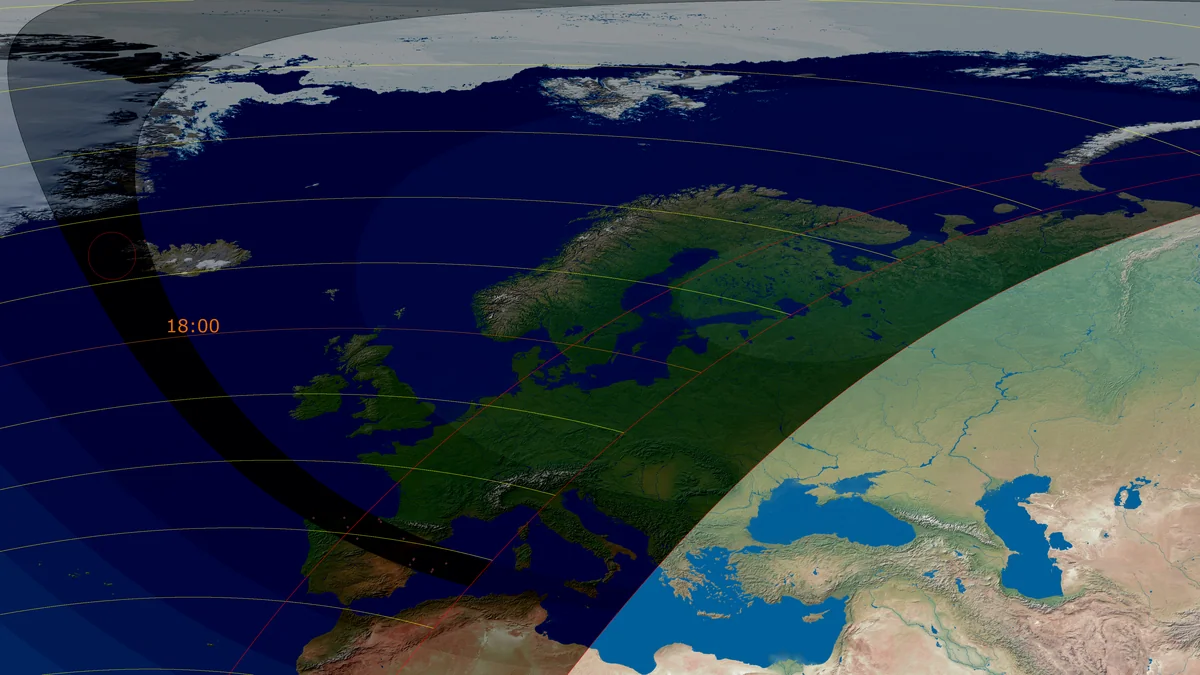
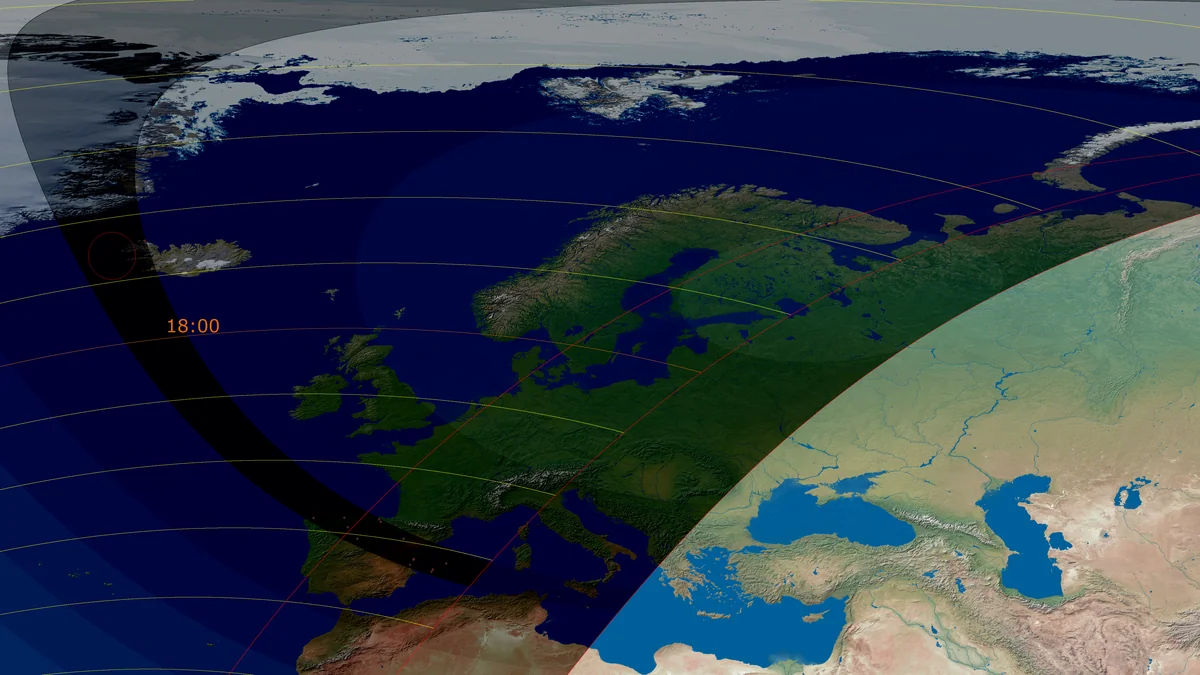
The geometry required for a total eclipse is incredibly fussy. That 293 km-wide path must thread a needle across a spinning Earth to land squarely on the Iberian Peninsula. At approximately 18:25 UTC, the shadow makes landfall on the Spanish coast.
The last time mainland Spain stood in this shadow was in 1905 and 1912. To someone standing there then, the event would have been recorded in grainy photos and ink. Today, we wait with digital sensors, yet the primal chill of the shadow remains exactly as it was a century ago.
A Shadow 8,300 Kilometers Long
The moon's footprint on Earth, the Umbral Shadow, is a narrow ribbon of temporary night. This ribbon stretches for a staggering 8,300 kilometers across the globe. It is roughly the distance from London to Tokyo.
This shadow does not stroll; it sprints at thousands of kilometers per hour. It races from the jagged ice of Greenland to the warm Spanish coast in the time it takes to finish a long lunch. To someone standing here in 1610, this velocity would have been indistinguishable from magic.
The peak of the event, the maximum duration of totality, lasts exactly 2 minutes and 18 seconds. This happens in the Denmark Strait, a remote and notoriously cloudy stretch of water between Iceland and Greenland. In this region, seeing the sun at all is often a statistical gamble.
While the Denmark Strait gets the extra seconds, Northern Spain gets the crowds because it offers the highest probability of clear weather. Even a tiny slice of northeastern Portugal sits within the path, catching the darkness for a fleeting moment. Watchers here trade duration for the reliability of a dry Spanish horizon.
The Geometry of the Solar Eclipse 2026 and the Golden Hour
In Spain, the moon will not swallow the sun high overhead. Instead, totality arrives during the "golden hour," just as the day begins to bruise into evening. Depending on where you stand, the solar altitude will be between 2 and 11 degrees above the horizon.
Extend your arm and stick up your thumb against the sky to visualize the height. That thumb covers roughly 2 degrees of the horizon. In some locations, the entire eclipse will happen just one or two "thumbs" above the Earth.
The geography of your specific town square suddenly becomes the most important map in the world.
This low angle makes the event a photographer's dream but a navigator's nightmare. A sun hanging that low allows for incredible shots of the solar corona framed by Spanish cathedrals. However, it also means that the smallest obstacle can ruin the entire experience.
A low sun means a clear western horizon decides everything. If a single apartment block or a row of pine trees sits in your line of sight, you miss the show. You are not just looking up; you are looking across.
Thankfully, Spanish geography is on our side. The probability of clear skies in the interior is between 65 and 78 percent. This is the best statistical bet for an eclipse in decades.
Today, we understand the celestial clockwork, but the feeling remains the same. It is a game of precision where the reward is seeing the stars come out while the sun is still touching the hills. The golden alignment of 2026 will be a moment where science and wonder perfectly overlap.
The Iberian Trio and the 830% Surge
For a small village in the Spanish interior, the cold mechanics of the solar system are about to become very personal. Usually, a quiet hamlet might see a dozen visitors in a typical week. Now, rural accommodation searches in the path of totality have surged by 830 percent.
This is the start of what scientists call the "Iberian Trio," a three-year celestial marathon. Spain is entering a cosmic windfall that includes back-to-back total eclipses in 2026 and 2027, followed by an annular eclipse in 2028. This sequence is an unprecedented opportunity for European astronomy.
Today, we treat the arrival of the umbra with the same rigorous preparation as a major sporting event. Regional governments in Madrid and Valencia are already drafting civil protection plans. They are establishing 52 official viewing points to ensure the influx of visitors does not overwhelm local infrastructure.
In the rolling hills of Castilla y León, wineries are trading their fermentation schedules for astronomical calendars. These estates are positioning themselves as prime seats for the "golden hour" display. It is a rare moment where the machinery of tourism meets the clockwork of the heavens.
We can calculate the moon's position to the millimeter, but we cannot predict the human tide. That uncertainty is honestly the best part of the adventure.
The Double Feature: Black Sun and Falling Stars
Most astronomical events are solitary performances. On August 12, 2026, the universe is putting on a double feature that feels almost scripted. A black sun in the afternoon will be followed by a sky full of fire at night.
To someone standing here in 1610, this would have felt like a divine message. Today, we call it orbital resonance, but the feeling of awe remains exactly the same. The secret to this synchronization is the moon.
To have a solar eclipse, the moon must be new, tucked perfectly between the Earth and the sun. This ensures zero moonlight during the peak of the Perseid meteor shower that same night. It is the ultimate dark-sky gift for astronomers.
The eclipse acts as a cosmic stage-hand clearing the set. It removes the glare of the moon, leaving a pristine, velvet-black canvas for the falling stars. Within a twelve-hour window, the sky offers its two most spectacular shows back-to-back.
This unique overlap is a permanent entry in my notebook of things that shouldn't quite work. We still don't know if we will ever see a more perfect synchronization in our lifetimes. Seeing it requires more than just being in the right country; it requires a clear night.
Through the Looking Glass: The Science of Looking Up
Safety is where wonder meets rigor. To watch the partial phases, you need filters meeting the ISO 12312-2 standard. These dark sheets of polymer are the only thing between you and permanent retinal damage.
For those 2 minutes of totality, you must cast the filters aside. It is the only time you can safely stare at the sun's corona, its glowing outer atmosphere, with your own eyes. Totality provides a rare window into the sun's hidden structure.
The map of 2026 is a study in brutal binary outcomes. If you are in Madrid or Barcelona, you are tantalizingly close but still outside the path of totality. You cannot see the famous "hole in the sky" from a 99 percent zone.
Just before the sun vanishes, look for Baily's Beads—tiny glimmers of light peeking through lunar valleys. These sparks are the moon's actual mountains and craters rendered in brilliant light. Scientists use these beads to refine our measurements of the solar diameter.
Even with high-tech satellites, the ESA still chases these shadows from the ground. Seeing the corona from Earth allows for high-resolution studies that instruments in orbit often struggle to match. Astronaut Sara García Alonso is helping lead the call for public awareness and scientific participation.
We have the coordinates, the ISO-rated glass, and the 2026-08-12 date. Yet, a sudden bank of coastal fog or a plume of wildfire smoke could still turn the show into a gray smudge. We still do not know if the weather will cooperate for the Solar Eclipse 2026, but the chase is the best part of the adventure.