The Maasai Mara Management Plan 2023-2032 is a legal governance framework designed to stabilize Kenya’s flagship ecosystem. By establishing protected zones and a moratorium on new tourism construction, the plan aims to reverse a 41 percent decline in the resident wildebeest population and secure vital migration corridors.
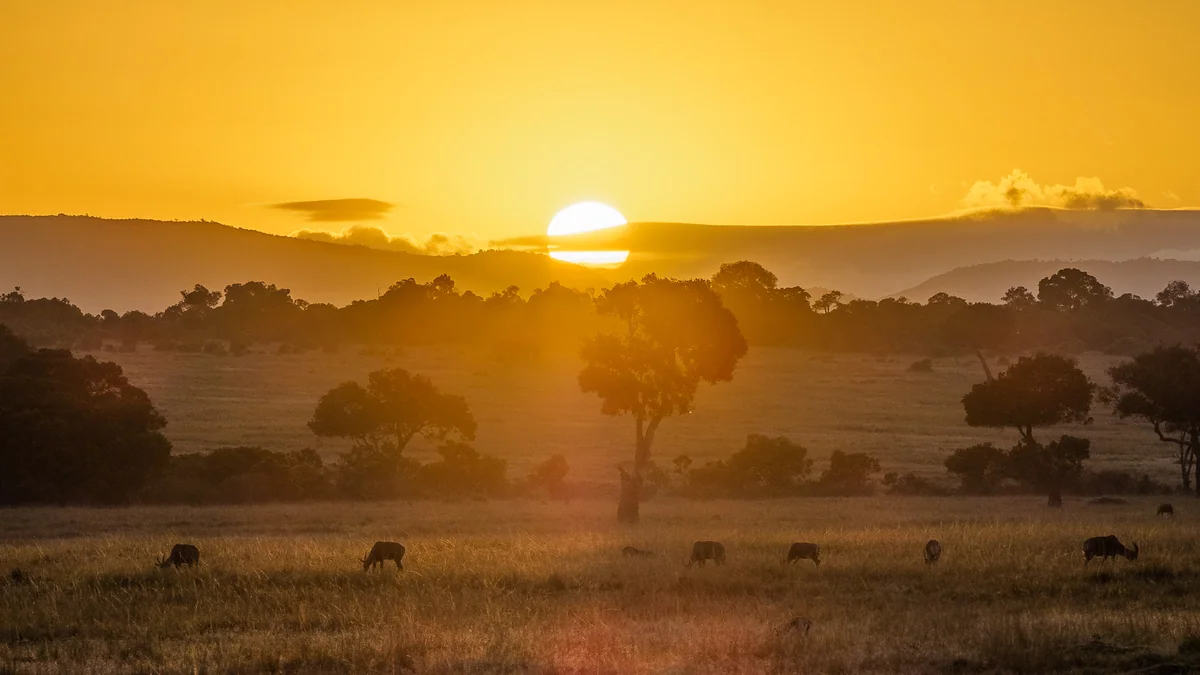
The Maasai Mara Management Plan protects the savanna by freezing new lodge developments and removing physical fences that block the Great Migration. Narok County has produced something rare: a technical map that treats the landscape as a finite biological engine. The Maasai Mara Management Plan 2023-2024 defines protected ecological and low-use zones to prevent further urban sprawl into the wild.
Implementing the Maasai Mara Management Plan: Halting Habitat Loss
Here is what actually works: a 2023 moratorium that prohibits any new tourism accommodation in the reserve’s most sensitive zones. That is not a gesture; it is a lever designed to preserve the Great Migration, where over a million wildebeest move between the Serengeti and the Mara. The 2023 moratorium provides a hard limit to prevent infrastructure from severing the planet’s most famous wildlife corridor.
The numbers show why this hard limit is necessary. In 2023, the local wildebeest population stood at 58,000; by 2025, it had fallen to only 34,200 animals. This 41 percent decline is a systemic failure that proves losing nearly half of a primary species is a clear signal to stop building.
Despair is just procrastination with better PR, but a moratorium is a functional response to a measurable threat. The 2032 blueprint provides the first honest scorecard for the ecosystem by prioritizing rangeland conservation over further luxury construction. For the 1,400 cheetahs remaining in Kenya, only open ground counts.
The Migration Math: Why the Numbers are Dropping
The Great Migration is often described in poetic terms, but the math of the million wildebeest moving between the Serengeti and the Maasai Mara sustains the ecosystem. It feels like an infinite cycle. The 2025 data shows the resident population fell from 58,000 to 34,200 in just two years.
This 40 percent drop creates a dangerous ripple effect for other species like buffalo and the critically rare hirola antelope. These grazers are the biological engine of the rangeland, and when they vanish, the nutrient cycle of the savanna grass slows down. The loss of biomass represents a mechanical failure of the system that supports Kenya’s remaining predator populations.
Erratic rainfall and reduced vegetation are real pressures, but the math suggests weather alone cannot account for such a sharp, localized decline. While the sky provides less water, man-made barriers are closing the ancient corridors to the remaining grazing grounds and water sources. We are witnessing the moment where the geography of the Mara is no longer large enough to accommodate its own migration math.
The Luxury Paradox: When High-End Tourism Becomes a Barrier
High-end tourism is often marketed as the primary financial engine for Kenyan conservation. At $3,500 per night, these camps promise low-impact luxury that directly funds the protection of the savanna. The core question is whether these developments function as a lever for restoration or as a physical barrier to wildlife survival.
Currently, the East Africa Law Society and groups like Natural Justice are challenging the industry’s expansion in court. They have filed suits against global giants including Marriott International and the Ritz-Carlton over developments in the Mara. These legal actions allege that unchecked tourism expansion is destroying the very migration corridors that make the ecosystem viable.
The Ritz-Carlton Maasai Mara Safari Camp is a primary focal point of these legal disputes. It stands accused of lacking a valid Environmental Impact Assessment (EIA) license, a basic regulatory requirement for any project. The absence of such paperwork is a failure of transparency in a sector where sustainability is the primary brand.
Data from the University of Glasgow shows that the Sand River migration route effectively ceased functioning after construction began in 2022.
The physics of a blocked crossing is simple and devastating. This blockage disrupts the path used by over a million animals moving between the Serengeti and the Mara. When a physical structure sits on a historical path, the biological flow stops.
While these camps use solar power, their true footprint is measured in hectares of obstructed rangeland. Despair is just procrastination with better PR, so the solution requires enforcing the 2023 governance framework to see what actually moves the needle. Revenue cannot offset the biological cost when luxury camps sit directly on vital migration paths.
Land Tenure and the Fencing of the Commons
Stand on the edge of the Pardamat Conservation Area and you will see the exact moment a landscape stops being an ecosystem and starts being a grid. It is the rhythmic sound of a hammer hitting a cedar post. What used to be communal rangeland is now a series of private plots, each bounded by tight, galvanized wire.
Subdividing the land feels like economic progress for individual families, but the data says it is a gridlock for the rangeland. Private fencing in community conservancies like Pardamat is now a primary driver of habitat loss, effectively slicing the Mara into pieces. A single wire fence does not just stop a cheetah; it turns a functional hunting ground into a series of dead ends.
The shift from communal to private land is often entangled with local political interests. In the Olkiombo region, the Environment and Land Court recently ruled in favor of Livingston Kunini regarding 4,700 acres of disputed land. Kunini is the brother of the sitting Governor of Narok County, Patrick Ntutu.
When the family of the primary regulator wins the rights to the land being regulated, the conflict of interest becomes a biological barrier. The honest scorecard shows that private ownership without shared corridors is not a lever for prosperity. This legal shift represents a mechanical failure in the shared ecosystem.
Accountability Systems: From Labor Disputes to Human Rights
In April 2026, headlines reported a "hostage" situation at Muthu Keekorok Lodge. Norbert Talam, Director General of the Tourism Regulatory Authority, clarified that the event was a protracted labor dispute between management and staff. Sensationalism distracts from the real mechanisms of accountability needed to govern the savanna.
The June 2026 ruling by the African Commission on Human and Peoples’ Rights found that Tanzania violated Maasai rights through forced evictions. This creates a transboundary legal precedent that groups like the East Africa Law Society are now using. By moving the fight from the grass to the courtroom, these groups force a scale check on luxury expansion.
A labor strike at a single lodge is a localized friction, but a regional court ruling on land tenure is a systemic shift. The catch is that rulings require enforcement from authorities often implicated in the expansion. One stops a dinner service; the other can stop a bulldozer.
The Honest Scorecard: What Actually Moves the Needle
If a camp sits on a migration path like the Sand River, the eco-labels are meaningless. Between 2023 and 2025, the Mara wildebeest population dropped from 58,000 to 34,200. This means an average visitor sees 15 fewer wildebeest on every square kilometer of the plains compared to two years ago.
Distinguishing between a gesture and a lever is now critical. An eco-friendly straw is a gesture, while removing the private fencing in community areas like Pardamat is a lever. The Narok County Government must audit every lodge for a valid Environmental Impact Assessment license to restore the system.
We must treat the Serengeti and the Mara as one transboundary unit because a fence in Kenya is a death sentence for a herd in Tanzania. The solution is not to stop tourism, but to fix its geography through strict EIA enforcement and cross-border cooperation. That is not a gesture; it is a lever. For the 1,400 cheetahs left in Kenya, enforcing the Maasai Mara Management Plan is the only one that matters.