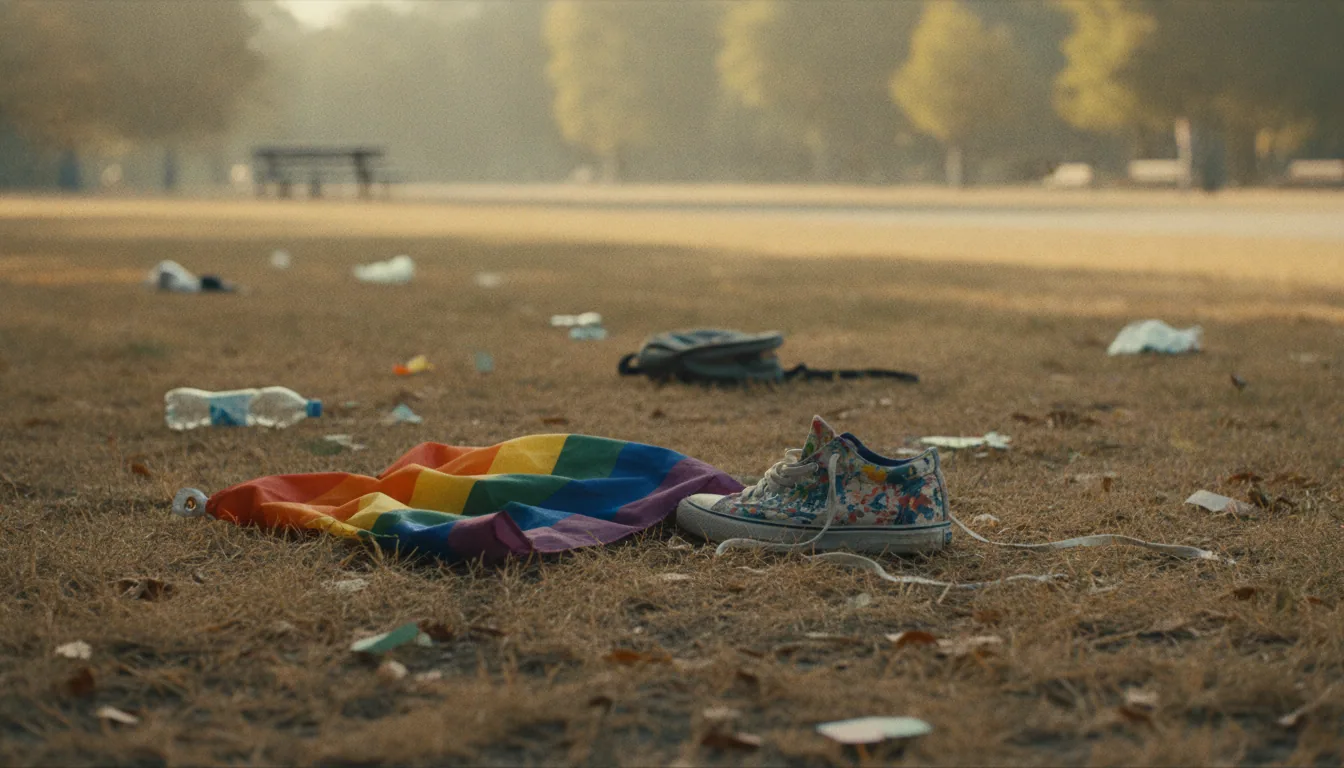
At 10:00 PM on July 25, 2026, the music near Berlin’s Brandenburg Gate was still loud enough to vibrate in your chest. It was a Saturday night in Tiergarten Park, the kind of evening where the cost of a cold soda matters more than politics. Then the sound changed from bass notes to breaking wood and screaming.
The Berlin Pride attack and European event security protocols were put to the ultimate test when a white van cut through a celebratory crowd, killing one woman and transforming a public square into a crime scene. A white van, now resting uselessly against a tree, had left a trail of chaos behind. By 10:15 PM, the Pride celebrations were officially terminated.
Do the arithmetic of a tragedy. One life gone, several more fighting for theirs in hospital beds, and a city of thousands sent home in the dark. This is what policy feels like when it fails to protect the most basic human right: the right to exist safely in a public square.
Berlin Mayor Kai Wegner said a gathering for a tolerant and peaceful city had been "most brutally attacked." German Chancellor Friedrich Merz used the words "heinous act" to describe the ramming. Words do not fix the tire tracks in the grass or the silence that followed the music.
The van sat abandoned, its doors likely still open, as police flooded the area. It was just a vehicle, the kind you see delivering groceries or furniture every morning. In a moment, it was turned into a weapon against people who had gathered to feel safe.
I write so that we do not forget how quickly a summer night can turn cold. We talk about security budgets and "state strategies," but for the families involved, the numbers are much smaller and more painful. One empty chair and one phone call change everything.
The Man the Police Are Looking For
The person at the center of the manhunt is Abdul B., a 21-year-old man. Berlin police describe him as 1.90 meters tall and slender, with black hair. He disappeared into the city on foot after the white van he was driving collided with a tree in Tiergarten Park.
Officer Florian Nath has confirmed that the search is now a multi-state operation. The suspect is reportedly linked to "Islamist circles," a detail that shifts the investigation from a tragic accident to a matter of state security. It is the kind of news that makes every resident look twice at the people in their hallway.
The attack was not limited to the impact of the heavy vehicle. Witnesses and police officers reported that some victims appeared to have been wounded with stabbing weapons. Authorities are now investigating if the ramming was merely the first phase of a coordinated attack.
The human cost of these few minutes is precise and painful, with between 16 and 25 people injured. Three of those victims sustained life-threatening injuries and are currently fighting to survive in Berlin hospitals. One woman has already been confirmed dead.
Dominik Pretz, a spokesman for the Berlin fire department, provided updates on those who escaped physical wounds but not the trauma. Thirty people were treated for shock on the grass of the park. That is what policy feels like when it fails, looking like thirty people shivering under emergency blankets on a July night.
There were 2,200 police officers deployed for the Christopher Street Day event before the attack happened. Despite this massive presence, the suspect managed to flee the scene of the crash. Even with thousands of uniforms on the street, a single man and a van can rewrite the story of a city.
Even with thousands of uniforms on the street, a single man and a van can rewrite the story of a city.
The Arithmetic of Protection: Berlin Pride Attack and European Event Security Standards
More than 2,200 police officers were deployed for Christopher Street Day in Berlin before the van entered the crowd. That sounds like a massive force, almost an army. But Tiergarten Park is a labyrinth of open lawns and dense trees where you cannot guard every meter.
This is the reality of modern urban safety. We remember the 2016 Berlin Christmas market and the 2024 attack in Magdeburg. These tragedies showed that a single vehicle can bypass traditional patrols in seconds.
The burden of stopping such acts is shifting from the police to the people who organize the events. Since January 2026, a new Europol regulation has been in effect to strengthen operational hubs for major events. This turns local festivals into high-stakes security zones.
This is about a permanent link between local event planners and international intelligence databases. Then there is the "Enhanced Tier" of responsibility. New standards are being applied to any gathering with a capacity over 800 people, borrowing from the UK’s Martyn’s Law.
If you cross that threshold, you are legally required to have a rigorous counter-terrorism plan. Even smaller venues with capacities over 200 must now meet basic requirements. These are the new mandates for public life.
That’s what policy feels like when you are a volunteer trying to celebrate a community. It means higher insurance premiums and the cost of security barriers that can stop a white van. Security is a fundamental right, but it is becoming an expensive one.
Policy in the Park: Emergency Boxes and the Digital Threat
If you walk through Tiergarten on a Tuesday morning, the park feels like any other green space in a capital city. You will see runners, dog walkers, and the new bright yellow emergency phone boxes. These pillars were a central piece of the March 2026 State Strategy for Queer Safety.
The boxes are meant to be a literal lifeline to make the park's pathways safer after dark. However, a phone box cannot stop a van cutting through a crowd. As Julian Miethig said after the tragedy, "It's a dark day for the community."
The European Pride Organisers Association (EPOA) conducted a study in 2026 that put numbers to the anxiety. EPOA found that 81% of Pride organizers had already experienced online hate speech. That is four out of every five people trying to run an event.
Even more sobering is the shift from words to actions. The same EPOA data showed that 25.8% of European Pride organizers reported direct threats of violence. More than a quarter of the people who make these celebrations possible are operating under threat.
When the threats are that high, the security budget starts to look like a war chest. Berlin’s response has been to lean into technological integration, including AI-powered surveillance and drones. This layer monitors mass gatherings to track crowd movements in real time.
It is an expensive, high-tech layer of protection that many find unsettling. We are told these drones are for our safety, yet a tension persists between surveillance and the basic right to protest. The March 2026 strategy recognized that some citizens face more risks than others just for existing.
What Happens When the Headlines Fade
The sirens have stopped, but the math of the tragedy is still shifting. Emergency services and police are still reconciling their reports, with the final injury count sitting between 16 and 25 people. Three of those neighbors are still fighting for their lives in hospital beds tonight.
The 21-year-old suspect, Abdul B., remains a ghost in the system. While authorities point to "Islamist circles," a specific motive has not yet been confirmed by evidence. We are left with the silence of an abandoned white van and a city looking over its shoulder.
This is not an isolated tremor in a vacuum. The EPOA tracks these threats across the continent to warn others of what is coming. Digital shadows often precede physical violence, creating a climate of fear long before an attack occurs.
Mayor Kai Wegner called this "an attack on our free and cosmopolitan society." Compared to the 2016 Berlin Christmas market attack, our response systems are faster, but the fear is more distributed. Policy often fails to catch the hate before it turns into a weapon.
Do the arithmetic. In Riga or Berlin, we often think of safety as something the state provides, like water or electricity. Security is also found in the neighbors who stayed to treat 30 people for shock.
July is not a month for looking away. Policy can build emergency boxes in the Tiergarten, but it cannot mandate the courage to keep showing up, especially as the Berlin Pride attack and European event security concerns remain at the forefront of the public mind. A full park is always safer than a silent one.