South African anti-immigration violence has escalated as an unofficial June 30 deadline forces 25,000 foreign nationals to flee Durban and Johannesburg. This crisis, driven by vigilante groups and digital mobilization, highlights the breakdown of law and the human cost of economic desperation in the working-class townships.
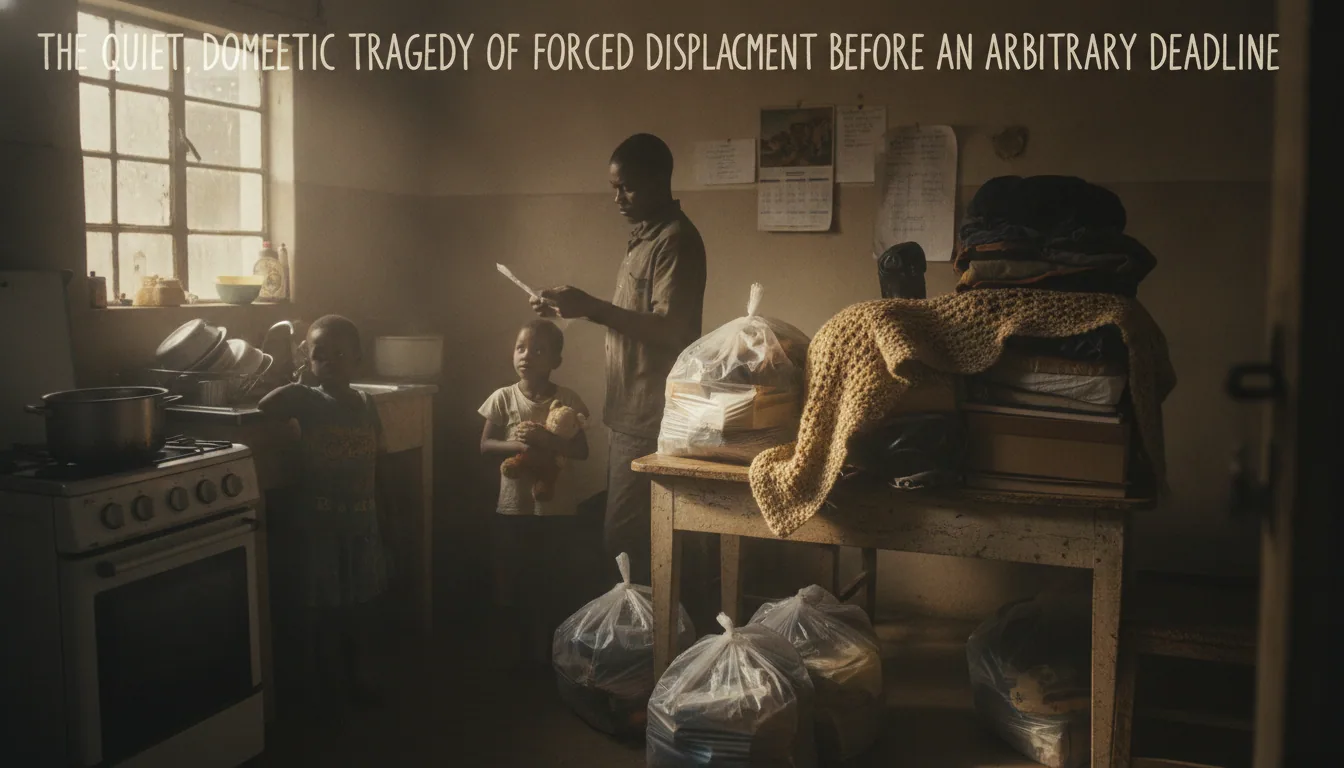
South African anti-immigration violence is the result of a zero-sum struggle for resources in an economy where unemployment has climbed above 43 percent. June 30, 2026, is not just a circled date on a kitchen calendar in Durban; it is a wall. By late June, families have already packed what they can carry to escape a deadline they did not set.
In Durban and Johannesburg, makeshift camps have appeared where families wait on the bare ground. They are leaving behind small businesses and years of work because of a roar that started on smartphone screens. For these parents, the choice is between the cost of a bus ticket and the price of their lives.
This is what policy feels like when it is enforced by the street rather than a courtroom. Vigilante groups have moved through neighborhoods brandishing sticks and chanting "Abahambe!" (They must go).
One vigilante told a man named Kaunga Nyirenda exactly what the new rules were. "If you don’t leave now, you’re going to leave in a coffin," he said. Do the arithmetic and you see why a dirt floor in a crowded camp becomes a sanctuary.
The June 30 deadline was an unofficial ultimatum issued by citizen-led movements like March & March. It was never debated in parliament, yet it has more power than many laws right now. It has turned quiet streets into corridors of panic across the nation.
When 25,000 people are uprooted in a single month, the system is not just failing; it is breaking. They carry their lives in plastic bags, heading toward camps in the major cities. I write so that we see the humans behind the numbers before they are forced to disappear.
South African Anti-Immigration Violence and the Math of Survival
In South Africa, the math of daily survival has become a zero-sum game. Unemployment now exceeds 43 percent. It is the heavy feeling of millions of people waking up with nowhere to go and no way to feed their children.
When jobs are that scarce, a neighbor is no longer just a neighbor. They become a competitor for a single loaf of bread or one shift at a construction site. This economic pressure is why 42 percent of adults told researchers in 2025 they would welcome a country with no immigrants at all.
Many see a shrinking pie and believe removing people will make their own slice bigger. But the arithmetic of anger rarely matches the arithmetic of reality. According to 2023 data from Statistics South Africa, there are 3.1 million immigrants in the country.
That is about 5.1 percent of the total population. Yet public perception often inflates that figure to 15 or 30 million people.
The gap between the real five percent and the imagined millions is where the fear grows and organizes.
The 2026 protests are fueled by a firm belief that foreign nationals take jobs, drain public services, and drive up crime. It is easier to point at a migrant worker than to fix a system where nearly half the workforce is idle.
That’s what policy feels like when it fails to provide basic dignity for its own citizens. It turns the struggle for a wage into a hunt for a scapegoat. We must do the arithmetic of the budget before we start doing the arithmetic of exclusion.
The machinery of 'Dudula' and the digital deadline
Organizing a national movement no longer requires a central office or a printing press. It happens on a smartphone screen during a lunch break or on the commute home. Operation Dudula, led by Zandile Dabula, shows how fast this shift happens.
The group began as a vigilante organization and transformed into a political party. Its name means "force out" in isiZulu. This name doubles as a direct command to those living in the townships.
This is the machinery that built the June 30 deadline. The March & March movement emerged between 2024 and 2025 as the lead organizer for the 2026 protests. They do not rely on traditional news cycles to reach their audience.
Instead, they use WhatsApp and AI-generated visuals to coordinate grassroots anger into a single, sharp point. It is efficient, cheap, and very hard for any police force to manage.
The face of this digital mobilization is Nkosikhona Ndabandaba, also known as Phakel’umthakathi. He has 1.7 million Facebook followers. In a country where many feel ignored, a man with a phone becomes a shadow authority.
Ndabandaba claims to have architected the June 30 deadline himself. His instructions to foreign nationals are terrifyingly simple. "June 30 is the deadline, but you don’t have to wait until then—leave now."
That is what policy feels like when it is delivered via a Facebook notification. It bypasses the slow reality of the legal system and creates a psychological clock. This clock starts ticking in every informal settlement.
The 2026 surge was fueled by a flood of AI-generated content on social media. Do the arithmetic of influence. I write so that we see how easily a digital deadline turns into a physical displacement.
When the law is a piece of paper
On November 4, 2025, the Gauteng High Court in Johannesburg handed down a clear ruling. It found Operation Dudula guilty of intimidation and harassment. In the informal settlements and outside clinic gates, however, a court order often feels like just a piece of paper.
I write so that we see the gap. While the coalition Kopanang Africa Against Xenophobia (KAAX) fought in courtrooms, the street reality changed. Vigilante groups ignored the 2025 ruling and blocked clinic doors.
These groups blocked healthcare access. That is what policy feels like when it has no teeth. A woman seeking a check-up or a father with a fever is met not by a doctor, but by a neighbor with a list of demands.
NGO platforms like Xenowatch have been monitoring these incidents, documenting a rise in xenophobic acts. It is a quiet, terrifying form of exclusion. Do the arithmetic: if you cannot enter a hospital safely, the law has failed you.
Judicial wins are vital, but they provide little warmth in a corrugated iron shack. In the settlements where the March & March movement gains ground, the High Court feels very far away. Safety is not a legal concept there, but a matter of who is standing at the end of your road when the sun goes down.
The price of policy failure: Counting the victims
Statistics can sometimes hide the truth they are meant to reveal. Since January 2026, South African police have reported arresting more than 50,000 undocumented migrants. This is a massive figure that might look like efficiency on a government report, but it represents a staggering amount of state pressure.
Do the arithmetic of what this pressure costs in human blood. In Pietermaritzburg, a mob killed a 29-year-old Malawian national in the weeks before the June deadline. In the coastal town of Mossel Bay, two Mozambican nationals died when their homes were destroyed in arson attacks.
These are not just numbers on a spreadsheet, but people with lives and families. The Mozambican government has now confirmed that five of its citizens have died in these xenophobic attacks. That is what policy feels like when it loses its grip on human dignity.
We have to look at the historical analog to understand the current fear. In 2008, a wave of anti-migrant violence left 62 people dead across the country. The 2021 unrest also serves as a fatal baseline that the current deployment of police and military is trying to avoid.
While the 50,000 arrests show a state trying to look tough on immigration, the four confirmed deaths before the deadline show the limits of that strength. A state that can arrest thousands but cannot stop a mob in Pietermaritzburg is a state failing its basic duty. This gap between enforcement and protection is where families are broken.
Comparing today to 2008 is a grim exercise in counting. We are not yet at the same body count, but the machinery of displacement is just as efficient. I write so that we do not wait for the number to reach 62 before we admit something is broken.
Beyond the deployment: Can policy replace populism?
The South African Police Service and the military are currently patrolling the streets to prevent a repeat of the 2008 and 2021 unrest. President Cyril Ramaphosa has stated that the government will not tolerate any attempts to destabilize the country. He describes the violence as the work of "opportunists exploiting legitimate grievances" in a high-pressure economy.
Those grievances are grounded in the arithmetic of daily life, where official unemployment now exceeds 43 percent. When nearly half the workforce is idle, the presence of 3.1 million immigrants becomes a target for populist frustration. Do the arithmetic, because that is what policy feels like when the labor market fails to provide for its own people.
The African Union and the United Nations are monitoring the situation and have expressed concern over the growing human rights crisis. This follows the displacement of over 25,000 people who have fled their homes since the June 30 deadline was announced. While monitoring is necessary, it provides little comfort to those living in makeshift camps in Durban or Johannesburg.
Soldiers on the corner are a temporary fix for a systemic problem, but real cohesion starts with a living wage. I write so that we focus on the root causes rather than the symptoms. A full fridge and a warm home are the only lasting cures for South African anti-immigration violence, and if we build that security, the door to peace stays open.