The Falklands diplomatic flare-up in 2026 was triggered by an Argentine football banner in Atlanta and a leaked Pentagon memo. This internal document suggested the United States might withdraw support for British sovereignty over the islands in exchange for Middle Eastern military basing rights and strategic cooperation.
The current Falklands diplomatic flare-up is a geopolitical transaction where territorial claims are being traded for military basing rights and regional influence. In April 1982, a group of Argentine scrap metal merchants raised a flag on the frozen shore of South Georgia. It was a minor bit of theater that served as the prologue to a major war.
I remember the mood in Moscow then, where the state press treated the South Atlantic as a colonialist museum piece. Today, the theater has moved to the humid air of Atlanta, but the script remains remarkably consistent. The scoreboard on July 15, 2026, recorded a 2-1 victory for Argentina over England.
It was a semi-final match, but for Buenos Aires, the pitch is always a surrogate battlefield. From the scrap metal merchants of 1982 to the multimillionaire footballers in Georgia in 2026, the Argentine claim has always relied on the stagecraft of the sudden, public gesture. Nationalism here is designed for the domestic gallery.
Argentine players Nicolas Otamendi and Giovani Lo Celso unfurled a banner stating "Las Malvinas son Argentinas" before the television cameras. The UK government responded predictably, requesting a formal FIFA investigation into an egregious violation of rules against political messaging. The rhetoric has sharpened significantly since the final whistle.
Vice-president Victoria Villarruel used social media to refer to the English as "usurping pirates." It is a vintage term, revived for a new generation of voters who need the distraction of an external enemy. The rhetoric serves to mask the structural realities of a claim that has seen little movement in decades.
The wire says the diplomatic climate is warming, but the original Spanish from Pablo Quirno says something colder: no negociable. The Foreign Minister has identified sovereignty as the load-bearing wall of the state, while the football is merely decorative molding. Pull at the sentiment and nothing falls, but the wall itself remains immovable.
The Pentagon Memo and the Falklands Diplomatic Flare-up
I have heard this promise of eternal friendship before: 1991, Moscow. It failed then for the reason it will fail now. Great power loyalty lasts only as long as the next tactical transaction.
The banner in Atlanta was merely the decorative molding. The load-bearing wall of this crisis is a leaked Pentagon email from April 2026. This internal document suggests the United States administration might review its support for the British claim to the islands.
The wire says the Special Relationship is unshakeable, but the original memo says something colder. This review was a direct response to the United Kingdom's refusal to provide military aid or basing rights for operations against Iran. In the strategic map room, no favor goes unpaid.
If London denies a base in the East, Washington may deny a rock in the South Atlantic.
On July 18, 2026, the White House defended the Argentine players’ right to free speech regarding their banner. To frame a territorial sovereignty dispute as a matter of individual expression is a classic diplomatic exit strategy. It allows a great power to distance itself from an ally without the mess of a formal decree.
The islanders rely on a protector who is currently being traded by a superior power in a distant negotiation. Somewhere a spreadsheet was quietly updated. The Pentagon treats the archipelago as a bargaining chip in a larger, more volatile game.
Integrated Defense and the Logistics of Alert
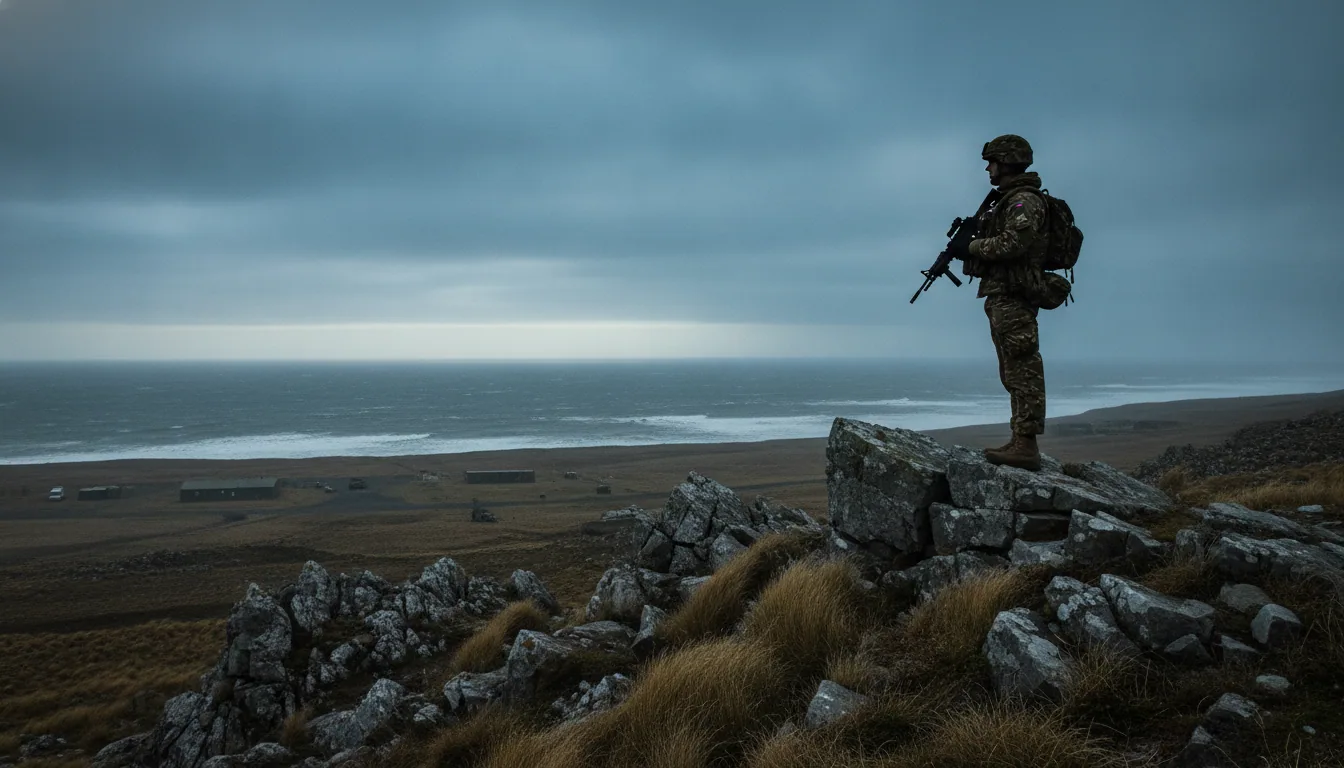
The RAF has declared a state of high alert in the South Atlantic following the US memo leak. This is the structural response to a fraying alliance. When the guarantor wavers, the garrison must wake up.
The 2025 Strategic Defence Review reaffirmed the islands as part of a so-called Integrated Global Defence Network. I have seen such networks described in Brussels and Moscow. They usually mean the center is stretching its lines too thin while the borderlands hold the weight.
Argentina recently filed a formal complaint regarding the HMS Medway, alleging the ship transited their waters without permission in July 2026. The UK rejected this, calling the move a routine logistics visit for the British Antarctic Survey. Security, in this context, is a spreadsheet.
UK defense spending is projected to reach 2.5 percent of GDP by 2027. Somewhere a spreadsheet was quietly updated to reflect the cost of a football banner. But resolve is expensive to maintain from eight thousand miles away.
The HMS Medway serves as a maritime proxy for a boundary that remains contested. If the logistics fail, the legal claim follows soon after, regardless of what is said in Atlanta. The RAF alert reminds us that sovereignty is found in the ability to refuel a jet.
The Blue Hole: Sovereignty Under the Surface
The ocean has its own ledgers, and they are currently being drained. In 2024, the Falkland Islands government was forced to cancel the Patagonian squid season. The Loligo biomass had reached record lows, leaving the local economy to starve.
Beyond the edge of the islands' protection lies the Blue Hole, a deep-water nursery where the cold Malvinas Current meets the shelf. Here, over 400 vessels operate in a lawless maritime vacuum. Their industrial lights are visible from space, a ghost city flickering on a black horizon.
Most of these ships fly the Chinese flag, hovering just outside the exclusion zone. It is a city without a town hall, where the only citizens are the squid destined for freezers in Shandong. When the great powers go hungry, the borders of small nations begin to feel like suggestions.
In May 2025, Unity Marine proposed salmon farming off East Falkland, which Argentine officials labeled "imperialist plunder." This phrase turns a cage of fish into a frontline. The real collapse is happening beneath the waves, where the resource floor is being pulled out.
The islanders are caught between a distant patron in London and a shouting neighbor in Buenos Aires. Meanwhile, the unregulated fleet continues its work. An empire does not always need a flag to occupy a territory.
The Small-Nation Floor: Who Gets Sold?
The 99.8 percent support recorded in the 2013 referendum reflected a genuine consensus that now finds itself at the mercy of a shifting market. Ask the small question first: who is the borderland here, and who is the empire cutting the deal? The 1982 comparison is lazy, and here is exactly where it breaks.
That conflict was a nineteenth-century territorial seizure, but the current flare-up is a twenty-first-century trade-off involving military aid and Iranian basing rights. The banner unfurled on the pitch in Atlanta is merely the decorative molding of the crisis. It serves the domestic populist needs of President Javier Milei.
Ignore the noise of the protests and watch one line in the final FIFA disciplinary communiqué. If the text classifies the banner as "political speech" rather than "territorial violation," the US has successfully moved the goalposts. That single shift would confirm the Falklands diplomatic flare-up has successfully turned the islands into a liquidated asset for greater strategic ends.