
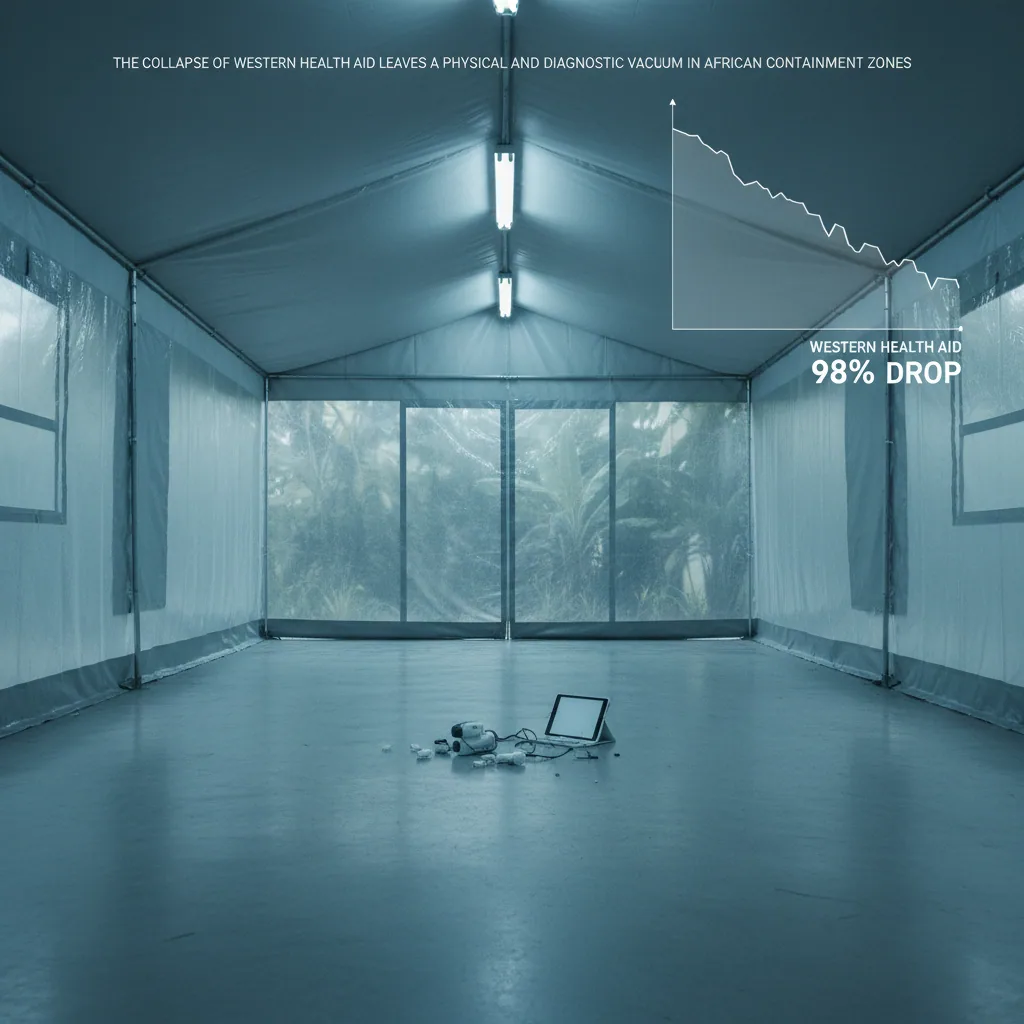
The 2026 Bundibugyo outbreak in East Africa highlights a breakdown in global health architecture. As the US retreats into isolationism, the geopolitics of Ebola containment are shifting toward a multipolar model led by Russia and India, where medical countermeasures serve as primary tools for diplomatic influence.
The geopolitics of Ebola containment dictates that regional stability now depends more on bilateral vaccine alliances than on the procedural norms of international institutions. Our global health architecture currently boasts near-instantaneous genomic sequencing, yet it remains blind to pathogens that do not fit rigid templates. Standard field tests failed to detect the Bundibugyo outbreak in its critical early stages because they were specifically tuned to the Zaire strain.
This diagnostic failure is a symptom of a shifting international order. If a state relies on a narrow socio-economic blueprint for health security, it risks ignoring the correlation between regional conflict and rapid viral mutation. WHO Director-General Tedros Adhanom Ghebreyesus declared an emergency without an Emergency Committee, signaling that bureaucratic weight is being jettisoned for raw executive intervention.
The crisis in the Democratic Republic of the Congo and Uganda presents a preview of a paradigm where we confront a strain with no approved vaccine. Even in Estonia, where digital resilience is central to state identity, the breakdown of global procedural norms should trigger a sober re-evaluation. Does this diagnostic gap signify a permanent move toward a fragmented approach where the standard rules of diagnostic sovereignty no longer apply?
The America First Vacuum: Deconstructing Global Health Hegemony
The rhetoric of global leadership founders when it meets material scarcity. While Western powers signal a commitment to biosecurity, their actions reveal a pragmatic pivot toward isolationism. In the Democratic Republic of the Congo, US health aid evaporated, crashing from $1.4 billion in 2024 to a mere $21 million by 2026.
This withdrawal undermines the functional capacity of the WHO. The Contingency Fund for Emergencies hit a historical low of $5.8 million by mid-May 2026. This fiscal collapse leaves the international health architecture incapable of absorbing sudden epidemiological shocks.
Institutional behavior remains predictably reactive, characterized by sporadic pledges rather than sustained investment. Following the escalation, the US State Department offered an eleventh-hour pledge of $23 million, failing to address the diagnostic vacuum. In the Estonian context, this transition from reliable partnership to fragmented crisis management represents a shift in how modern states calculate global risk.
We are witnessing the erosion of a singular global health hegemony and the rise of a volatile, multipolar landscape. If the primary architect of the post-war order retreats, the resulting vacuum necessitates a mapping of new economic actors. The international community must decide if biosecurity is a discretionary expense or a fundamental pillar of the global socio-economic blueprint.
The Securitization Backfire: Conflict Zones and Resistance
Sophisticated biocontainment strategies often collide with the reality of localized insurgency. In the provinces of Ituri and North Kivu, the Bundibugyo outbreak has claimed approximately 240 lives as of late May 2026. This crisis is fundamentally geopolitical, driven by the reality that armed groups like the Rwanda-backed AFC/M23 control the territories where the virus is most active.
When health interventions mirror military operations, the socio-economic blueprint of a region fractures. Residents in Mongbwalu burned two treatment centers on May 25, 2026, reacting to what they perceived as predatory foreign institutional behavior. The restriction of traditional burials, guarded by armed police, prioritizes biological safety over ancient cultural norms at the cost of local trust.
We are witnessing a multi-disciplinary synthesis where the temperature-controlled vaccine carrier carries more geopolitical weight than any diplomatic cable.
The correlation between security and medicine is evident in the proposed American containment base in Laikipia, Kenya. This facility has triggered public outrage and legal challenges that stall regional containment efforts. For many, sovereign soil is perceived as a tactical laboratory for foreign interests rather than a site of humanitarian aid.
Current public sentiment suggests that the emerging paradigm of biosecurity fails to account for human agency. This institutional behavior creates a vacuum where misinformation turns medical countermeasures into perceived instruments of state control. If the state continues to view containment through coercion, it risks rewriting the old order into a permanent state of emergency.
The New Geopolitics of Ebola Containment: Vaccine Diplomacy
The scent of antiseptic in a Moscow laboratory contrasts with the unequipped clinics of North Kivu. On May 27, 2026, Russian Health Minister Mikhail Murashko announced a breakthrough vaccine specifically targeting the Bundibugyo strain. This maneuver illustrates how the emerging paradigm of health security is no longer a Western monopoly.
In the sterilized corridors of Pune, the Serum Institute of India is fast-tracking the ChAdOx1 Bundibugyo vaccine. This collaboration provides a blueprint for how middle-income powers fill the void left by US retrenchment. Pathogen diplomacy is rapidly rewriting the old order of international aid through tangible biosecurity assets.
If Russia and India deploy these countermeasures in conflict zones, the geopolitical loyalty of African states will shift. In Estonia, we understand that the correlation between health security and state stability defines our modern strategic environment. Institutional behavior is pivoting from a reliance on outdated Western grants toward results-oriented medical alliances.
Socio-Economic Blueprint: The Global South’s New Trajectory
High-level diplomatic calendars remain hostage to the most primal biological threats. The indefinite postponement of the 4th India-Africa Forum Summit in New Delhi serves as a sharp metric of institutional fragility. If a rising power like India cannot insulate its geopolitical schedule from an outbreak, the old order of "contained" crises is dead.
In the gold-rich province of Ituri, high population mobility has rendered traditional border containment nearly impossible. This correlation between economic extraction and viral spread exposes the limits of the West’s securitized health model. The emerging paradigm suggests that global health security is no longer a gift distributed by a central authority.
Russia and India are filling the vacuum through aggressive vaccine diplomacy. This socio-economic blueprint prioritizes rapid bilateral intervention over the slow procedural norms of a depleted WHO fund. Small states must develop autonomous diagnostic and strategic agility to navigate the shifting geopolitics of Ebola containment as the centralized health security we once relied upon dissolves.