
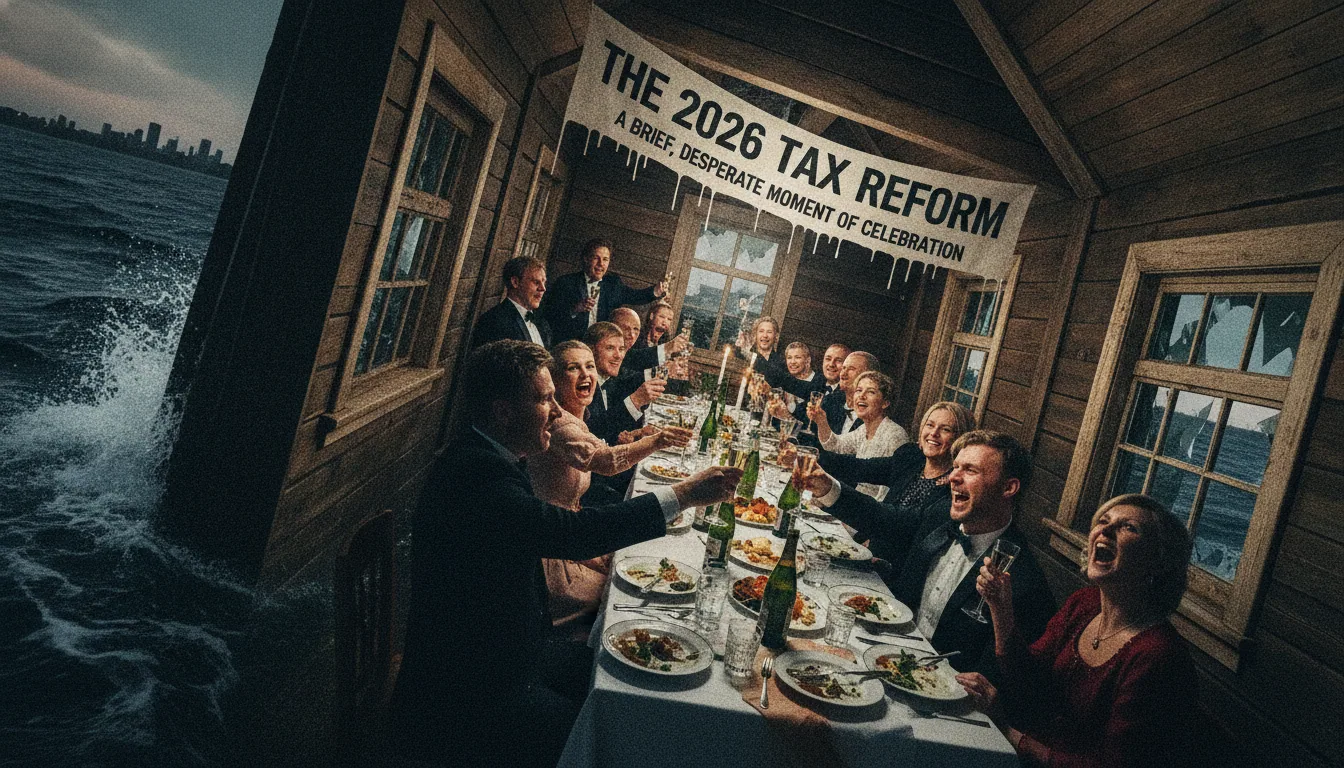
Estonia’s economic outlook for 2026 promises a fleeting hit of dopamine via income tax reform, but warns of a looming debt crisis that will see national borrowing climb past 31% of GDP by 2028, effectively ensuring that any rise in your standard of living is as hallucinated as a crypto bro’s retirement plan. While your wallet might technically catch a breath in 2026, it’s less a recovery and more the brief moment of silence you get between a car engine making a weird noise and the entire transmission falling out onto the highway.
The Death of the Tax Hump and the 10-Percent Light at the End of the Tunnel
If you’ve ever found a twenty-euro note in the pocket of an old pair of jeans and spent the next five minutes feeling like you’re about to acquire a social media platform and ruin it for everyone, then welcome to the Estonian economic forecast for 2026. We are being promised a short-term burst of euphoria that feels remarkably like that moment at a party where someone orders a round of top-shelf tequila using your credit card while you're in the bathroom. The government is finally killing the infamous "tax hump"—a uniquely local method of punishing people for the audacity of receiving a fifty-cent pay raise—and the results look great on a screen.
The Bank of Estonia claims that in 2026, average net wages will jump by a staggering 10 percent thanks to this tax reform. That is almost enough to buy half a kilo of that artisanal cheese you usually only look at on Instagram when your self-esteem is feeling dangerously high. It is roughly as believable as the promise that my cat, Kafka, will suddenly start respecting my personal boundaries, but on paper, that 10% figure is a hit of pure, spreadsheet-poisoned pleasure.
Meanwhile, the European Central Bank’s interest rate cuts are trickling down to us via the 6-month Euribor faster than a bad take travels through a Facebook community for disgruntled parents. Inflation is supposed to chill out at 2.9 percent by 2026, which almost sounds like we’re living in a functioning economy. But let’s be clear: you are absolutely delulu if you think this means life is getting cheap, because in reality, we’re just celebrating the fact that everything is becoming unaffordable at a slightly more leisurely pace.
Even the collective trauma of the car tax and the VAT hike will start to fade by early 2026, leaving us with the deceptive feeling that maybe we won’t have to burn our IKEA bookshelves for warmth this winter. It’s a trick of the light where net wages rise twice as fast as gross wages because the law changed (not because your boss suddenly developed a conscience). Enjoy the light at the end of the tunnel while it lasts, because it’s almost certainly the headlight of an oncoming freight train labeled "National Debt."
National Debt is the New Black: How to Burn 400 Million Euros for Fun and Profit
Borrowing money has officially replaced cross-country skiing as our new national sport. While the Bank of Estonia predicts 3.6 percent economic growth for 2026, that feels less like a recovery and more like trying to bail out the Titanic with a souvenir shot glass. Our debt levels are projected to climb to 31.5 percent of GDP by 2028, which is economist-speak for "we have systemic problems that we’re currently hiding under a very expensive rug."
This is the Zara-suit-wearing Ponzi scheme of modern macroeconomics: we are borrowing from our grandchildren’s future just so we can buy a few minutes of relative peace today. National debt isn’t just a boring line item in a report written by a guy who hasn't seen sunlight since the Great Recession; it’s a localized infection that is eventually going to pop. We’ve dug ourselves a hole so deep we can see the bottom, and instead of climbing out, we’re asking our neighbors if they have a more ergonomic shovel.
We’ve bought ourselves a short-term smile at the cost of a long-term, soul-crushing hangover, and soon we’ll be the ones cleaning up the broken glass with our bare hands.
By 2028, we’ll be tossing 400 million euros a year into the furnace just to cover the interest payments—the most expensive subscription service that literally nobody signed up for. Local economic oracle Raivo Vare has noted that this frantic chase for a balanced budget resembles a low-budget comedy where the actors have forgotten the script and are just screaming at the props. Our entire economic model is currently being held together by the Holy Spirit and that one leftover screw from an IKEA Billy bookcase that you were definitely supposed to use but didn't.
The Baltic Hunger Games: Why Lithuania is Winning While We’re Just Poor
If the Estonian economy is currently a lift that smells faintly of damp socks and desperation, take a look at our neighbors to the south, where the regional survival drama is reaching its peak. According to SEB’s forecast, Lithuania’s economy will be the regional valedictorian in 2026 with 3.2 percent growth, while we’re getting hit over the head with a new car tax like a character in a slapstick routine. Meanwhile, Rail Baltica and airBaltic have morphed into economic shipwrecks that swallow taxpayer cash faster than a broken vending machine swallows coins.
If you live alone in the Baltics, you are officially a luxury item, and the risk of poverty is your new best friend. In Latvia, the poverty risk for single adults is a terrifying 33.4 percent, while here in Estonia, it’s 27.2 percent. It’s a fun little game of Baltic chicken where we see who can hold their breath the longest before their heating bill arrives.
As for households with children, Lithuania held the depressing crown in 2025 with an 18.3 percent poverty risk, and Estonia is following closely behind like a loyal, shivering shadow. We are letting the people in charge sell off the future for a handful of empty promises, only to realize in 2028 that we're sitting alone in an empty apartment we can't afford to light. Systemic instability is eventually going to swallow us whole, regardless of how many politicians give TED talks about our "digital success story."
Defense Spending and the Strait of Hormuz: Why Your Money is Now a Tank
Imagine buying the world’s most expensive, high-tech smart lock, only to realize you don't actually have a door to attach it to. Estonia is set to dump over 5% of its GDP into national defense by 2026, which means your tax money is being packed into shipping containers and sent out of the country. This is pure import; it never touches your local grocery store or your already algorithm-rotted bank account.
We are buying a sense of security from foreign arms dealers who are probably giggling in plush leather chairs somewhere in Virginia. This isn't an investment in the local community; it’s an insurance premium for a house built on the side of an active volcano. If that doesn’t give you a mild panic attack, congratulations, you’re the kind of beautiful optimistic idiot who thinks the terms and conditions actually protect you.
Meanwhile, our economic survival is tethered to things like the Strait of Hormuz staying open. If someone so much as sneezes in the wrong direction over there, our shiny new tanks will be about as useful in an economic street fight as an empty ketchup bottle. SEB forecasts growth, sure, but it’s growth driven by massive state investment and consumption—essentially the economic equivalent of drinking five energy drinks to make up for a week of no sleep.
The 2028 Hangover and the Silence After the Music Stops
The 2026 economic "boom" is that specific moment at a wedding where everyone forgets they have maxed-out credit cards and starts doing the Macarena. But the Bank of Estonia predicts that by 2028, growth will slow down to a sluggish 2.5 percent, and we’ll all land face-first back in reality. We now live in a world where seven-percent unemployment is like that annoying guest at a house party who just won't leave even though you've turned off the music and started vacuuming.
Hanna Jürgenson at the Bank of Estonia can draw the charts as optimistically as she wants, but stable misery is our new national brand. It would only take one more energy crisis-induced burp from the global market for our real GDP growth to collapse like a house of cards in a wind tunnel. We’ve let distant dictators decide if we can afford to be warm, and we’ve let the system play Jenga with our standard of living.
By 2028, we’ll all just be a little older, significantly poorer, and substantially more bitter, staring at our screens and wondering where the party went. This grim Estonia and Baltic economic forecast proves that the music has stopped, the lights are on, and we’re the only ones left to clean up the mess.
Sleep well.