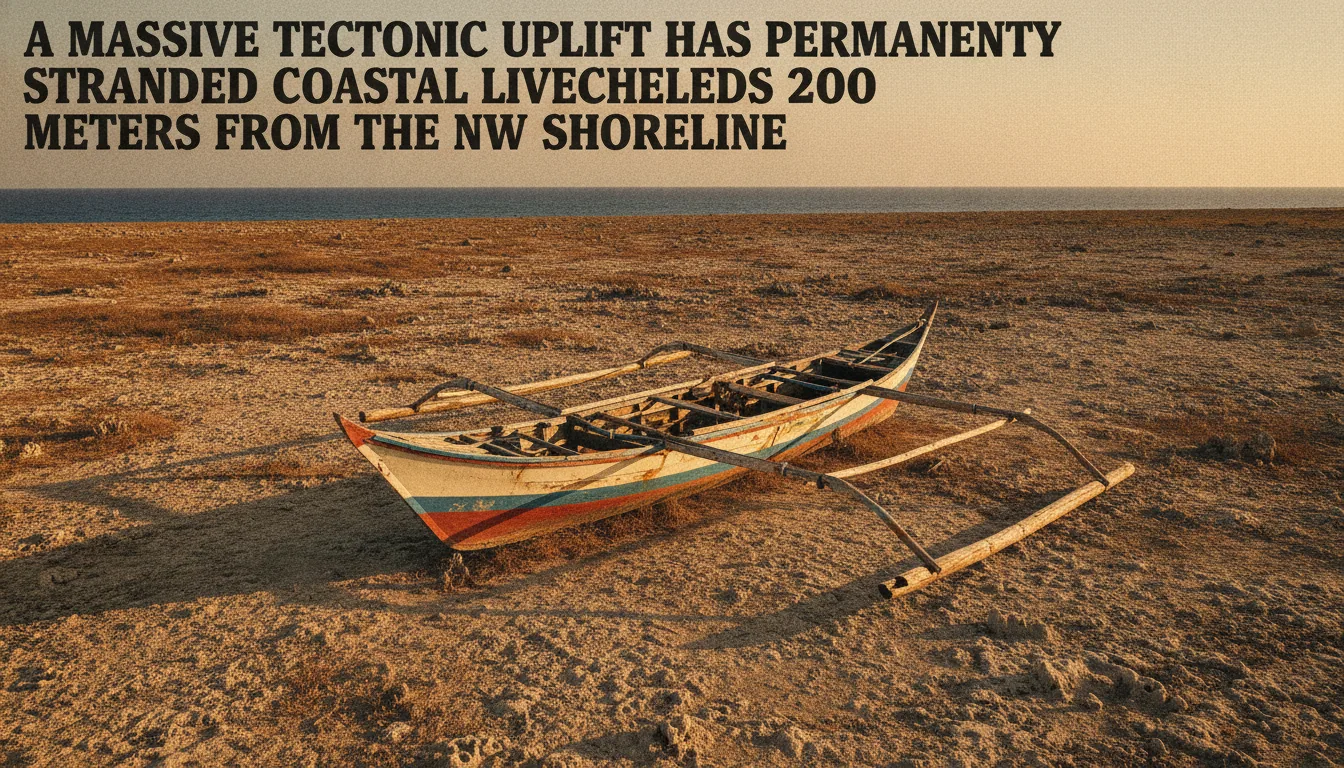
The Philippines seabed shift occurred on June 8, 2026, when a 7.8-magnitude earthquake near Sarangani thrust the ocean floor upward by up to two meters. This tectonic event permanently extended the shoreline of southern Mindanao by 200 meters, exposing ancient coral reefs and altering maritime maps.
The Philippines seabed shift was caused by intense thrust faulting along the Cotabato Trench, effectively forcing the Celebes Sea Plate beneath the Philippine Mobile Belt to hoist the land. Imagine standing on the beach in Glan and realizing the water has simply retreated into the distance. This was a permanent rewrite of the Philippine map.
At 7:37 a.m. on June 8, 2026, a massive 7.8-magnitude earthquake struck offshore near Maasim, Sarangani. As the shaking stopped, residents in Sarangani and Davao Occidental found that their world had physically grown. The shoreline had marched seaward by up to 200 meters, a distance equivalent to two football fields of new earth.
Land that had been submerged for millennia was suddenly thrust into the light, leaving the seabed exposed and the horizon altered. What was once a vibrant underwater ecosystem became a graveyard of stranded fish and eels. Even a few meters of tectonic movement can fundamentally change a coastline's biology.
The Geological Engine Behind the Philippines Seabed Shift
To understand why the beach grew, we have to look 50 kilometers offshore to the Cotabato Trench. This is a subduction zone, where the Celebes Sea Plate is shoved beneath the Philippine Mobile Belt. PHIVOLCS officials attributed the shift to thrust faulting, which turns massive horizontal pressure into sudden vertical lift.
Imagine a heavy rug lying on a hardwood floor. If you push the edge of that rug horizontally, it bunches up and creates a ridge. This is exactly what happened to the seabed when one plate slid under another, forcing the crust above it to snap upward.
The tremor occurred offshore at a depth of 33-55 km. To someone standing here in 1610, this would have been indistinguishable from magic. When a slab of rock that thick moves, it hoists the entire foundation of the ocean floor toward the sky.
The Human Scale of the Shifting Earth
When we hear that 173,000 families were affected, the number is so large it stops meaning anything. Imagine an entire region where every household suddenly finds their front door opens onto a landscape they no longer recognize. For tens of thousands across southern Mindanao, displacement became a jarring reality in a single morning.
The NDRRMC acts as the official bookkeeper for this human cost. Their reports confirm at least 61 deaths as the earth buckled and the sea shifted. Near the southern reaches of Mindanao island, the search continues for 40 people swallowed by the chaos of the moving coast.
While a two-meter rise sounds like a minor adjustment to a geologist, it is the height of a ceiling to the person on the shore. It means a fishing boat is suddenly stranded, its livelihood now 200 meters away across a field of dying coral. The earth is a restless machine that occasionally resets the boundaries of our world.
We are witnessing the start of ecological succession, where a vibrant underwater city turns into a dry limestone field.
A Reef in the Open Air
In some spots along the southern coast, the seabed jumped two meters toward the sky. For a reef, a two-meter rise is like having the roof and the floor of your house suddenly meet in the middle. Corals that lived under a ceiling of blue for centuries were suddenly blinking in the harsh afternoon sun.
The DENR described a scene of quiet, sun-baked chaos. Huge sections of coral reefs and seagrass beds were permanently pushed above the surface. The earthquake raised the seabed so abruptly it left no time for the marine residents to escape.
The mortality was absolute and swift. Stranded fish and eels were scattered across what was, minutes before, a deep hunting ground. They were essentially drowning in the air, caught in a world that no longer fit their biology.
The Sarangani Bay Protected Seascape's marine corridors have been shattered by this sudden intertidal exposure. This is a total rewriting of the map. When the bathymetry changes this fast, the old rules of the ocean simply vanish.
The Puzzling Scars of Balut Island
While the coastline was stretching elsewhere, Balut Island was being punctured. Residents found massive sinkholes opening in the earth, looking like the ground had simply forgotten how to be solid. The Mines and Geosciences Bureau arrived quickly to document these coastal deformations and map the new, jagged reality.
Usually, an earthquake leaves a linear scar, a predictable tear where the earth pulled apart. To someone standing here in 1610, the sudden appearance of these deep, circular pits would have been indistinguishable from magic. These are signatures of a landscape under immense, shifting pressure.
Balut is a volcanic island sitting right next to a subduction zone. The bureau is currently investigating whether these holes are purely tectonic or if the 7.8-magnitude shake disturbed the island's volcanic plumbing. We still don't know if these are signs of an imminent eruption or just the earth settling.
When the Earth Outpaces the Ink
In February 2026, just four months before the quake, NAMRIA released its updated official maps. The ink was barely dry before the geography it described became a historical artifact. To the planet, a map is just a suggestion.
The shift creates a massive hurdle for anyone at sea. Nautical charts rely on bathymetric data, the technical term for measuring the depth of the ocean floor. When the seabed rises by two meters, those depth numbers are no longer just slightly off; they are dangerous.
A 200-meter shoreline extension means that where the map shows open water, there is now solid ground. This makes every nautical chart for southern Mindanao effectively obsolete. We still don't know how quickly the state can catch up to the moving Earth.
The Unfinished Story of the Seabed
The story of this new land is unfinished, and whether it stays or sinks back into the depths is something we still don't know. It turns the Sarangani shore into an unintentional laboratory for the future. Nature usually takes decades to build a reef, but it can reclaim a graveyard in months.
The Cotabato Trench remains down there, fifty kilometers off the coast, a heavy mirror to our own uncertainty. We draw lines on maps and think we have captured the world, but then the seabed shrugs and we realize the ink is always wet. The legacy of the Philippines seabed shift is a reminder that the ground beneath our feet is never truly settled.