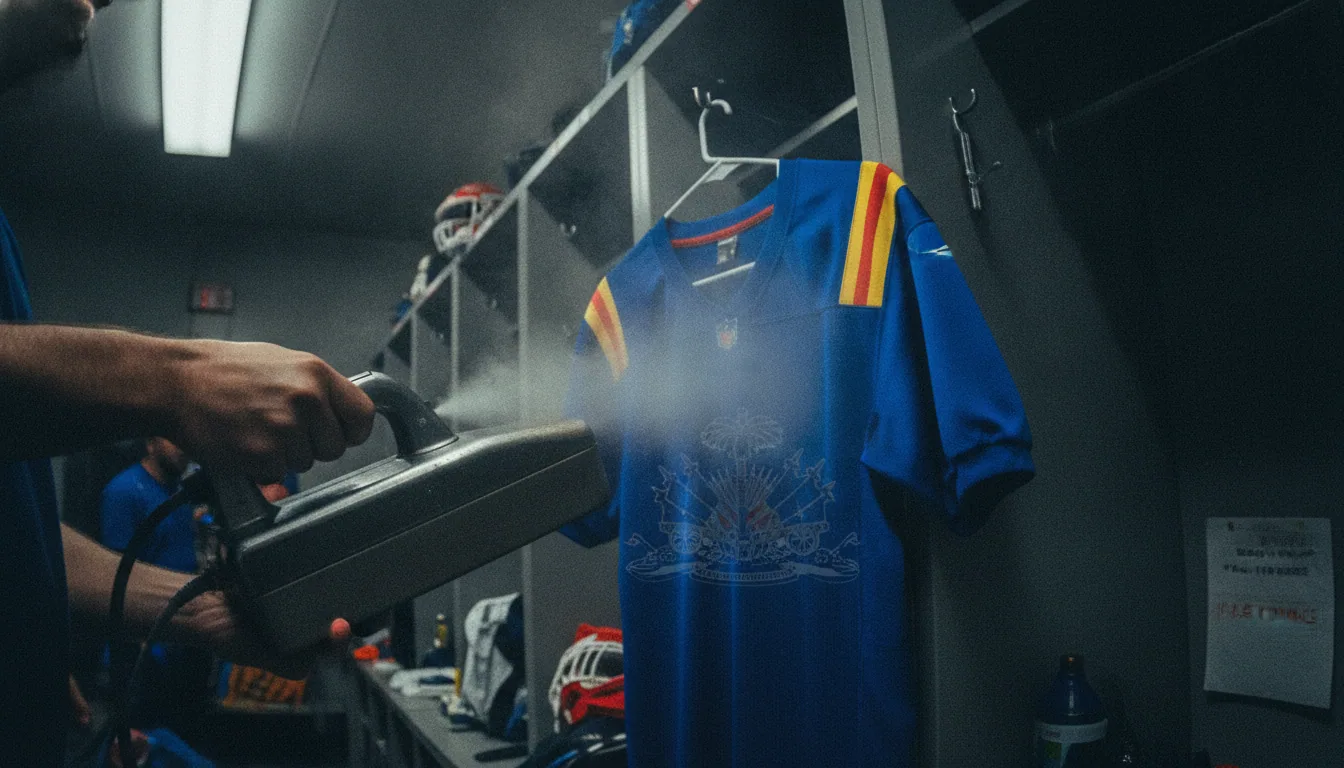
The Haiti World Cup kit controversy centers on FIFA’s decision to ban a tonal watermark of the Battle of Vertières from the national team's jerseys, claiming the celebration of a slave revolution constitutes "political messaging." This bureaucratic intervention forced the team to scrub its foundational history from its uniforms just 72 hours before their 2026 opening match against Scotland.
Welcome to 2026, where your national identity is audited by a man in a Zegna suit. FIFA decided that Haiti's jerseys were far too historically loud, which is a capital offense in the Church of Neutrality. The god of this church is an algorithm-rotted spreadsheet.
On June 10, 2026, the spreadsheet-poisoned wizards at FIFA headquarters looked at the Haitian kit and had a collective stroke. They rejected the design because it honored the end of slavery. Apparently, that is "political," unlike taking millions from states that treat human rights like an optional suggestion.
The audacity of this rejection landing 72 hours before the whistle is the kind of chaos I reserve for Tinder dates. The team was already in Boston, hydrated and focused, only to be told their clothes were officially illegal. We are talking about a total erasure of heritage three days before kickoff.
FIFA wants a world where every team is a clean, brand-compliant slab of polyester with absolutely no memory or soul. If that does not terrify you, congratulations, you beautiful, optimistic idiot, you are not paying attention.
The manufacturer Saeta managed a logistical miracle that would make a cocaine smuggler weep with envy. They successfully stripped the imagery and delivered "streamlined" versions in time for the game. We are letting them censor history for the sake of a corporate template.
We are letting them censor history for the sake of a template.
The Battle of Vertières: Why the Haiti World Cup Kit Controversy Terrifies Bureaucrats
To the average FIFA bureaucrat, history is something that happened last Tuesday during a sponsorship meeting with a crypto firm. They treat the concept of time like a spreadsheet error that needs to be deleted. When Haiti showed up with a watermark of the 1803 Battle of Vertières, the room-temperature-IQ brigade went into a meltdown.
This battle wasn't just a skirmish; it was the final victory over French colonial forces that birthed the world's first successful slave revolution. That is not just history; it is the reason the country exists. If you find a revolution against slavery too political, you are saying the existence of the liberated is a debate.
The Haitian Football Federation argued the imagery was cultural rather than provocative. They were trying to explain national heritage to people who think identity is just a marketing demographic. It is like banning the Fourth of July to avoid hurting the feelings of George III’s ghost.
Haiti qualified for this World Cup on November 18, the exact anniversary of that 1803 victory. The stars aligned to remind everyone of this win, but FIFA decided to play the role of the grumpy high school principal. This one is pure spreadsheet-poisoned malice.
Saeta included these illustrations as a subtle tribute to national resilience. Instead, it was treated like a contraband map to a secret treasure. This level of historical erasure feels calculated rather than accidental.
The Haitian team, Les Grenadiers, is being told their birth certificate is a violation of equipment regulations. It is absolutely cooked, and we’re letting them treat history like a bug in the code. If that doesn't terrify you, congratulations, you're not paying attention.
Fifty-Two Years of Waiting Only to be Told Your Shirt is Too Spicy
Haiti has been waiting fifty-two years to get back to this stage. The last time Les Grenadiers qualified was 1974, a year when people thought bell-bottoms were functional and the internet was a fever dream. Waiting fifty-two years is a lifetime of anticipation met with a bureaucratic dumpster fire.
Haiti already wore these "illegal" shirts in televised friendly matches against New Zealand and Peru without the world ending. The epistemological fabric of reality remained intact even while a drawing of a battle touched a professional athlete’s chest. FIFA-speak for "neutrality" is actually just a textile-based threat to corporate aesthetics.
Suddenly, FIFA decides the shirt is a weapon of mass distraction, which is landlord-logic applied to polyester. It is like a landlord letting you move in, then telling you your curtains are "too political" while you are unpacking. And we are letting them censor the laundry.
Now the team is staring down the barrel of Group C. They have to face Scotland, Brazil, and Morocco, a geopolitical fever dream designed by a sadist. Brazil is a collection of biological experiments designed to make you feel bad about your own legs.
Imagine preparing to mark a world-class striker while your manufacturer is frantically scrubbing history off your gear in a hotel room. This 2026 Haiti World Cup kit controversy exposes a world where team identity is a brand-compliant slab of polyester. If that does not terrify you, congratulations, you're not paying attention.
The 'Neutrality' Grift: When Your Existence is a Policy Violation
Imagine a room in Zurich filled with men whose only personality trait is "Compliance Officer." They hide behind a policy against anything political, which is Swiss slang for anything more interesting than a spreadsheet. They treat the football pitch like a sterile surgical ward.
They want the only allowed emotion to be the overwhelming desire to purchase a specific light beer. If you ever wanted to know what cultural erasure smells like, it smells like a sanitized boardroom in a Swiss winter. The pitch is a neutral venue where only the money is allowed to be loud.
This is not a new game, as the IOC pulled the same stunt with Haiti’s Winter Olympic gear. They saw Toussaint Louverture on a jacket and panicked as if they had found a live pipe bomb. It is absolute, corporate-brained madness used to sand down countries that didn't ask permission.
Investigators even squint at geometric lines to find "hidden" Vodou vèvè symbols that might scare global advertisers. It is the classic, algorithm-rotted colonial reflex. We're letting them treat heritage like a security threat to protect the brand.
"Neutrality" is a weapon used to silence those who refuse to be anonymous. They did this to Ukraine during Euro 2020 because a map of their own territory was a violation. If that doesn't terrify you, congratulations, you're not paying attention.
The 'Streamlined' Future: Saeta’s 72-Hour Miracle and the Death of Nuance
Let’s take a moment for the absolute heroes at Saeta, the Colombian kit manufacturer. These people had exactly seventy-two hours to perform emergency surgery on a country’s soul. They turned a national epic into a blank canvas faster than a politician deletes an apology.
FIFA calls this "streamlined," which is corporate-brained slang for "we’ve sanded down the edges until it looks like a loading screen." In the world of spreadsheet-poisoned sports, a miracle isn't winning against Brazil. A miracle is making sure your laundry doesn’t offend a Swiss accountant.
The original kit had history, blood, and the literal birth of a nation printed on the fabric. The new one is "compliant," which is just a fancy way of saying it’s been lobotomized. It’s the aesthetic equivalent of a bowl of unflavored oatmeal served in a beige room.
Les Grenadiers are in Boston now, ready to play Scotland despite their identity being sanitized for your protection. They survived a revolution and two centuries of debt, but they barely survived the FIFA compliance department. We’re letting them treat history like a bug that needs to be patched out.
In the end, it’s a beautiful, optimistic world where the only thing Haiti is allowed to carry into the stadium is a clean invoice. This Haiti World Cup kit controversy proves that in the eyes of the spreadsheet warriors, history is a technical violation. Sleep well.