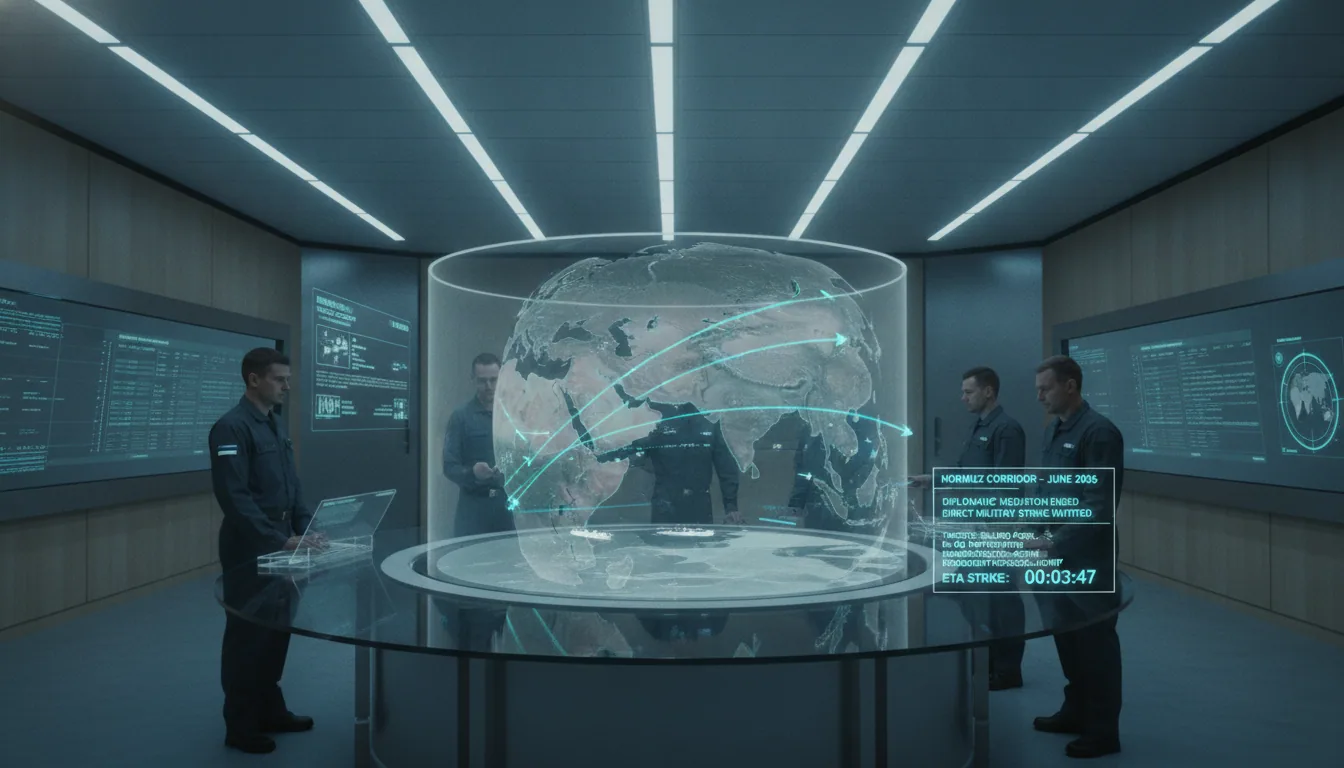
The US-Iran direct conflict phase escalated on June 10, 2026, when President Trump authorized Operation Renewed Fire. This military engagement involved retaliatory strikes against Iranian air defenses and maritime targets, signaling a shift from shadow warfare to open, state-on-state kinetic confrontation in the Strait of Hormuz.
The US-Iran direct conflict phase represents a definitive transition from proxy-led skirmishes to overt military strikes aimed at neutralizing Iranian institutional leadership and strategic maritime assets. This disconnect defines our current geopolitical moment. On April 12, 2026, a two-week ceasefire was brokered by Pakistan in Islamabad, providing a brief diplomatic buffer that many hoped would stabilize the region.
That buffer has evaporated. The U.S. military conducted retaliatory strikes against Iran for a second straight night on June 10, 2026, marking a violent departure from previous de-escalation efforts. President Trump authorized Operation Renewed Fire, targeting critical Iranian air defenses and radar sites to ensure freedom of navigation.
We are witnessing a paradigm shift in institutional behavior where the traditional shadow war has been replaced by open, kinetic engagement. Explaining his rationale, Trump stated, "We hit them hard yesterday, and we’re gonna hit ‘em again hard today." He added that the Iranians "keep playing us for suckers," signaling a definitive rewriting of the old order of strategic patience.
Nearly 20 targets along Iran’s coast and Qeshm Island were struck by U.S. Navy and Air Force jets during the operation. This escalation occurred despite Pakistani Interior Minister Mohsin Naqvi visiting Tehran twice in one week for urgent mediation. The cross-border correlation between failed diplomacy and military surge suggests the emerging paradigm of state-on-state conflict is now fully entrenched.
In the Estonian context, this collapse of the Islamabad Accord serves as a sobering socio-economic blueprint for how rapidly regional stability can dissolve. If the international community cannot enforce its mediated agreements, then we must re-evaluate the utility of traditional diplomatic norms. Can the global economic framework survive a prolonged shift from back-channel negotiations to relentless kinetic escalation?
The Post-Khamenei Vacuum and the Erosion of Institutional Boundaries
High-precision decapitation of a state's ideological core often exists alongside the devastating imprecision of urban kinetic warfare. The official confirmation of Supreme Leader Ayatollah Ali Khamenei’s death on March 1, 2026, following a massive U.S.-Israeli assault on Tehran, represents the ultimate shift in state-level engagement. It signals the emerging paradigm of total institutional decapitation as a primary military objective in the 21st century.
This collapse was preceded by the calculated erosion of Iran’s strategic leverage. Operation Midnight Hammer in June 2025 successfully targeted nuclear sites at Fordow, Natanz, and Isfahan, effectively neutralizing the nation's technical breakout capabilities. If the technical infrastructure was dismantled in 2025, the political architecture of the Islamic Republic is being systematically liquidated today.
The human cost of this institutional collapse is most visible where elite targeting intersects with civilian tragedy. On February 28, 2026, a strike on an elementary school in southern Iran killed over 170 people, mostly schoolgirls. This single event contributed to a broader toll of 700 Iranian deaths during the early 2026 war phase, illustrating the violent friction between strategic intent and kinetic reality.
The paradigm shift we are witnessing suggests that the survivability of a regime no longer rests on its military hardware, but on the resilience of its administrative continuity.
We are now observing the behavioral mapping of a rudderless IRGC. Without the unifying authority of the Supreme Leader, the IRGC’s institutional behavior has shifted toward decentralized, erratic aggression. This cross-border correlation between a leadership vacuum and tactical volatility is rewriting the old order of Middle Eastern deterrence.
In the Estonian context, this erosion of state-centric hierarchy provides a sobering socio-economic blueprint for observing modern peer-to-peer conflicts. As traditional institutional boundaries blur, we must ask how a state preserves its social contract when its sovereign head is surgically removed. The survivability of a regime no longer rests on its military hardware, but on the resilience of its administrative continuity.
Tactical Evolution: Uncrewed Systems in High-Threat Corridors
Sophisticated aerial supremacy meets low-cost lethality. On June 8, 2026, an Iranian Shahed drone successfully downed a U.S. Army AH-64 Apache helicopter near the coast of Oman. This incident catalyzed a cross-border correlation between traditional kinetic warfare and the emerging paradigm of autonomous recovery in contested waters.
While the loss of an airframe underscores a paradigm shift in threat profiles, this rescue operation highlights a new socio-economic blueprint for military efficiency. U.S. Navy Task Force 59 utilized a multi-disciplinary synthesis of law and tech by deploying a Saronic Technologies Corsair uncrewed surface vessel (USV) for recovery. If uncrewed systems can navigate corridors too dangerous for manned aircraft, then the traditional concept of a contested zone is being fundamentally redefined.
The resulting surge in hostilities saw U.S. Central Command declare that the mission is a proportional response to unjustified Iranian aggression. President Trump later claimed the destruction of 22 ships in a single night operation, a figure that highlights the rapid acceleration of maritime attrition. The tactical sinking of the IRIS Dena demonstrates the cold and decisive efficiency of modern naval institutional behavior.
For the professional observer, this shift toward uncrewed systems in high-threat corridors is rewriting the old order of maritime security and personnel recovery. In the Estonian context, the reliance on autonomous SAR assets represents more than a localized tactical choice. If state actors continue to favor uncrewed attrition over manned deployment, regional defense strategies must adapt to this new automated blueprint of conflict.
The US-Iran Direct Conflict Phase and the Energy-Inflation Loop
A carrier strike group cuts through the brine of the Persian Gulf while a logistics manager in Tallinn watches a digital ticker reset. This projection of power exists in stark contradiction to the material scarcity felt in households across the Atlantic. By May 2026, U.S. annual inflation reached 4.2 percent, driven primarily by war-related energy price surges rather than simple monetary policy.
The U.S. military reported securing passage for over 100 million barrels of oil through the Strait of Hormuz during the height of the conflict. This volume represents a triumph of naval logistics, yet it highlights a complex cross-border correlation. The risk premium attached to every gallon creates an economic shock that bypasses naval blockades to hit the citizen directly.
This friction is rewriting the old order of domestic political support for foreign interventions. Democratic National Committee official Kendall Witmer recently argued that the current economic agenda and the costly war have made life unbearable for millions of Americans. It is a reminder that institutional behavior is increasingly constrained by the immediate feedback loop between kinetic action and the kitchen table.
In the Estonian context, this socio-economic blueprint reveals our own acute vulnerability to shifts in global trade. If the world’s largest military can secure the sea but cannot stabilize the pump, then we must re-evaluate our traditional legal and economic norms. Can a state maintain a long-term strategic offensive when the economic cost of victory is as volatile as the conflict itself?
The Proxy Web and the Fragility of Regional Base Infrastructure
Extensive regional alliances meet the sudden vulnerability of fixed assets. On June 10, 2026, the IRGC bypassed traditional proxy filters to launch direct missile and drone strikes against the U.S. 5th Fleet in Bahrain. This maneuver marks a definitive departure from the shadow war era that defined the last decade of Middle Eastern geopolitics.
Historically, Tehran relied on the strategic depth provided by its "Axis of Resistance." If the 2025 strike on Al Udeid Air Base in Qatar was a warning, targeting Muwaffaq Salti in Jordan and Ali Al Salem in Kuwait signals a shift in institutional behavior. The old order of deniable attrition has been replaced by a socio-economic blueprint of overt regional destabilization.
"The war won't be limited to the region," as Ebrahim Azizi notably cautioned, reflecting a paradigm shift in Iranian military doctrine. This cross-border correlation suggests that regional base infrastructure is no longer a deterrent but a primary target. The emerging paradigm requires a total re-evaluation of how the U.S. protects fixed installations against high-volume drone swarms.
In the Estonian context, this fragility of regional infrastructure offers a sober lesson in modern deterrence. We must analyze how the erosion of safe havens in the Gulf might mirror shifts in Eastern European defense logistics. As the US-Iran direct conflict phase unfolds, the answer to whether collective security frameworks can survive physical transparency will dictate the future of institutional behavior.