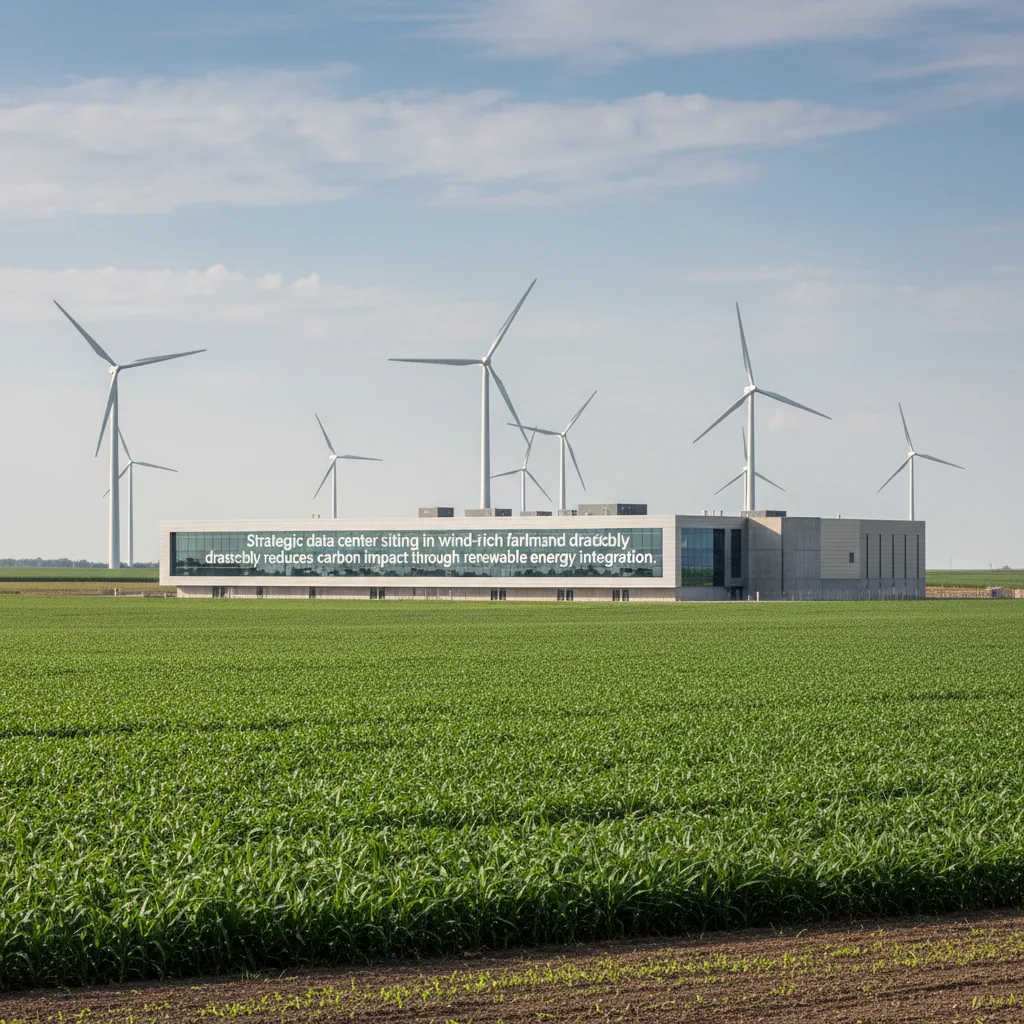
Data centers reached 415 TWh of electricity consumption in 2024, accounting for 1.5% of global use. This industrial expansion demands vast acreage for biodiversity offsets and billions of gallons of water. The physical toll of AI infrastructure is now a critical national security and environmental concern.
AI infrastructure strains the physical world through massive land use, aging electrical grids, and a cooling-driven water crisis that forces a trade-off between digital growth and local resources. Meta manages 4,000 acres of its data center footprint for biodiversity to offset land loss. It is a concrete, verifiable attempt to balance industrial expansion with ecological health.
This moves beyond digital promises into actual soil and habitat restoration. The question is whether this acreage is a gesture or a true lever for the entire industry. We are witnessing a transition where the vague concept of the cloud is replaced by a heavy-duty industrial burden.
Between 2024 and 2026, this industrial build-out began to reshape global energy and land maps. The World Economic Forum now views compute as critical national infrastructure. Governments must treat these sites with the same legal and security architecture as traditional power plants to manage the physical backbone of a new economy.
Energy Demand and the Physical Toll of AI Infrastructure
Global data center electricity consumption reached 415 TWh in 2024, which is roughly what a mid-sized country consumes in a year. The International Energy Agency expects this demand to reach 945 TWh by 2030. In the United States, projections show data centers consuming 12.0% of domestic electricity by 2028.
The real story is the surge in power density within the racks themselves. Between 2020 and 2025, the intensity of AI servers increased 11-fold. By 2027, a single AI server rack will require the electricity equivalent of 65 ordinary households.
Your entire annual energy needs are now dwarfed by what a few silicon chips consume on a single shelf. We are building a new industrial era on a fragile, aging foundation. Over 30% of U.S. generation capacity is over 40 years old, meaning we are plugging a high-speed future into a mid-century grid.
We are plugging a high-speed future into a mid-century grid, which is why the cost of AI is now measured in volts, not just bits.
Grid Fragility and the $712 Billion Toll
The U.S. electrical grid is a physical machine facing elevated retirement risk just as AI server power density spikes. This mismatch creates massive economic friction that affects every ratepayer. U.S. power outages now impose an estimated $712.66 billion in annual economic losses.
The industrial sector absorbs 59.1% of these economic costs. This digital transition acts as a cost-shifting exercise from tech companies to local manufacturing. The honest scorecard shows that local producers often subsidize the grid stability required by hyperscale data centers.
Thousands of miles of new high-voltage transmission lines are being built via eminent domain to bridge the energy gap. Modernizing the grid is what actually moves the needle for sustainability. Modernizing the physical grid is the only lever that prevents total infrastructure failure.
Liquid Compute: Why AI is Moving into the Water Business
In Council Bluffs, Iowa, the Google facility consumes 2.8 million gallons of water every day to prevent processor overheating. In 2024, Google reported withdrawing 7.8 billion gallons of water globally for its operations. This is the physical weight of the cloud manifesting as a thirsty industrial utility.
Researchers at UC Riverside found that a single session of 20 queries with an AI chat tool consumes approximately 500 ml of freshwater. That is a standard plastic bottle of water poured out for every short conversation. When scaled to millions of users, software becomes a massive consumer of local water tables.
Data centers in Texas are projected to consume 49 billion gallons of water in 2025. This creates a direct conflict with agricultural water security in drought-prone regions. To move the needle, we must prioritize closed-loop systems that recycle every drop of cooling water.
The Obsolescence Engine: Carbon Spikes and Three-Year Hardware
A traditional power plant aims for a forty-year lifespan, but high-performance AI chips are often obsolete in just three to five years. This rapid replacement cycle creates a relentless industrial metabolism. Between 2020 and 2025, Microsoft’s total carbon emissions rose by 23.4% because the build-out outpaced grid decarbonization.
The hardware waste stream is undeniably concrete. In the U.S. alone, up to 70 million hard disk drives reach their end-of-life every single year. This byproduct of data demand requires a specialized, large-scale recycling infrastructure that does not yet exist.
In Northern Virginia, thousands of on-site diesel generators stand ready to provide emergency backup power. These machines emit nitrogen oxides, creating a mechanical solution for a software revolution. The honest scorecard says that decoupling compute growth from this physical churn is the next great engineering hurdle.
The Honest Scorecard: From Space Dreams to Edge AI Levers
Industry voices are exploring space-based infrastructure to solve the terrestrial footprint, but the data says this is a high-cost dream. The real lever for resource efficiency is happening on the ground through Edge AI. Decentralized processing reduces the constant strain on hyperscale centers.
Grid fragility costs the U.S. economy $712.66 billion annually. With 30.5% of generation capacity over 40 years old, decentralized efficiency is a matter of economic survival. We must stop treating data centers as optional software hubs and regulate them as critical national infrastructure.
The most productive next step is for regulators to mandate high-efficiency hardware standards. We should prioritize the builders who integrate Edge AI to shorten the resource chain. This is the most effective way to mitigate the physical toll of AI infrastructure.