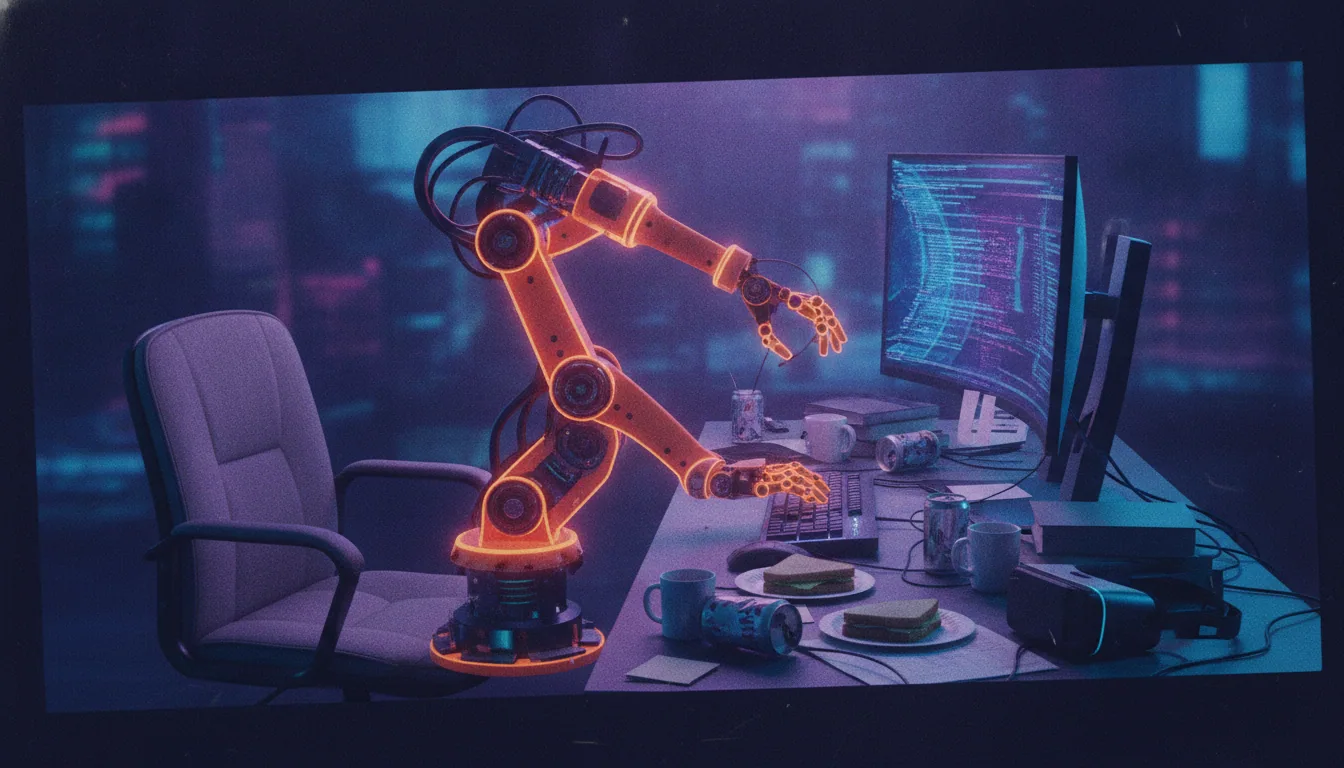
The debate over vocational training vs. AI automation centers on the "Great Skills Reset" where 44% of core worker skills are expected to change by 2030. While AI automates cognitive tasks, demand for skilled trades like HVAC and robotics has increased by over 67%.
When comparing vocational training vs. AI automation, the evidence suggests that the physical complexity of manual trades offers a structural "moat" against digital disruption that white-collar roles currently lack.
My younger daughter wants to be a "digital creator." She is seven years old. She sees the world through a screen that promises her she can be anything if she just has the right lighting.
I look at her and then I look at the bill for our kitchen sink repair. The plumber charged 45 euros for forty minutes of work. He didn't use an algorithm; he used a wrench and twenty years of knowing exactly where the pressure was failing.
In Riga, 45 euros is nearly a week’s worth of groceries for us if I am careful with the butter. We are living through a moment where the physical world is suddenly becoming more expensive than the digital one.
Global labor markets are shifting as generative AI automates cognitive tasks while increasing demand for physical trade workers. To address this, vocational training is integrating AI and VR tools to prepare a new generation for specialized infrastructure.
The White-Collar Mirage
For thirty years, we told our children that the only way out of poverty was a desk and a degree. We believed that if you worked with your mind, you were safe from the machines.
The Brookings Institution has released data that turns this belief on its head. They found that over 30% of all workers could see at least 50% of their tasks disrupted by generative AI.
This isn't happening to the people picking berries or fixing pipes. It is the middle-to-high-paid clerical and professional roles that face the highest exposure to disruption.
At Sookmyung Women’s University in South Korea, the business dean has been analyzing these threats to white-collar roles. The class of 2025 is already feeling the chill.
According to Handshake, 62% of university seniors expressed concern about how AI will impact their professional careers before they’ve even started them.
Evaluating Vocational Training vs. AI Automation in the Modern Workshop
While the desks are shaking, the workshop floor is booming. Randstad reports that demand for skilled trade workers has more than doubled compared to knowledge employees since 2022.
The people who build the world are finally being valued more than the people who move spreadsheets around it. This isn't just about traditional carpentry; it is about the physical infrastructure that AI itself requires.
Demand for robotics technicians grew by 107% recently. HVAC engineer demand rose by 67% because the data centers running the "cloud" generate a heat that no software can fix.
Automation is not a monster coming for every job, but it is a filter that rewards the tangible.
| Role or Category | Growth / Impact Metric | Source |
|---|---|---|
| Robotics Technician | +107% Demand Increase | Randstad |
| HVAC Engineer | +67% Demand Increase | Randstad |
| Student Confidence | 275% Increase via VR Training | PwC / CITB |
| Task Disruption | 50% of tasks for 30% of workers | Brookings |
| Manufacturing Gap | 102 departures for every 100 entries | Randstad |
The Great Skills Reset
The World Economic Forum (WEF) notes that 44% of workers’ core skills are expected to transform by 2030. Analytical thinking remains the most sought-after skill for 7 out of 10 companies.
The WEF projects that 170 million new jobs will be created by 2030, while 92 million jobs will be displaced. For a single mother in Riga, these millions are just abstractions until they land on the kitchen table.
The problem is that we are losing trade workers faster than we can train them. For every 100 young people entering manufacturing, 102 are leaving.
We are facing a critical labor gap at the exact moment our physical world needs the most repair.
If a job requires a human hand to touch a unique physical object in an unpredictable environment, that job is safe.
Learning with New Tools
Vocational training is no longer just about grease and grit; it is becoming high-tech. Institutions are now using Virtual Reality (VR) to train workers in safety-critical procedures.
According to PwC and the CITB, learners trained with VR report 275% higher confidence in their skills. In China, the government is introducing new vocational majors specifically for the "low-altitude economy" and high-end manufacturing.
They are treating the labor gap as a national emergency rather than a market quirk. Jeffrey Lam, Chairman of the Vocational Training Council in Hong Kong, notes that vocational graduates are often spared the brunt of AI impact.
The Infrastructure Paradox
The more we move our lives into the digital "cloud," the more we depend on the ground. Every AI model requires a physical server, and those servers need electricity, cooling, and housing.
The growth of the intangible digital economy is entirely dependent on a shrinking pool of tangible trade labor. If we do not fix the vocational pipeline, the "cloud" will eventually overheat and fail.
Research published by MDPI shows that integrating AI into Technical and Vocational Education and Training (TVET) led to a 20% improvement in student engagement. It also reduced training costs by 15%.
Even the way we train these systems is becoming more precise. A technology called SkillOpt can improve large language model accuracy by up to 24.8 points by optimizing agent skills.
The Human Cost of Disparity
There is a widening wage disparity that we must address. We spent decades telling trade workers their work was "lesser," and now we cannot find technicians to fix hospital generators.
Poverty in a rich union is a policy choice, not an inevitability. The International Labour Organization (ILO) suggests that most jobs are likely to be transformed rather than made redundant, provided there is "social dialogue."
We need to ensure that the 30% higher employment rate seen by students trained with AI-powered tools is available to everyone. We cannot let the digital divide become a physical one where only the wealthy can afford a functioning roof.
Physicality as a Moat
I think about my daughters' futures often. I don't want them to spend their lives staring at a screen that can do their job faster than they can blink.
The physical complexity of trades creates a buffer against automation that cognitive roles no longer possess. McKinsey projects that 70% of current trade skills will be augmented by AI and robotics by 2030.
A robot can help a plumber find a leak using sensors, but it cannot navigate the rusted crawlspace of a 19th-century Riga apartment building. Do the arithmetic.
Practical Steps Forward
We need to stop treating vocational training as a "plan B" for students. According to the OECD, adult literacy and numeracy are declining in many places.
We need to ground our education in things that matter—both analytical thinking and manual dexterity. Today, we must support local TVET institutions that are integrating digital fluency into trade curriculums.
I write so that my daughters understand that work has dignity, whether it is done with a keyboard or a welding torch. The EU promised us a closing of the gap between the rich and the poor.
That promise is only kept when we value the labor that keeps the lights on. Tomorrow morning, I will tell my daughters about the people who built the stove we use to cook our porridge.
In a world of shifting algorithms, a warm home is the only metric that truly matters. We are still here, we are still working, and as we navigate the choice of vocational training vs. AI automation, there is a way forward for those who keep the world running.