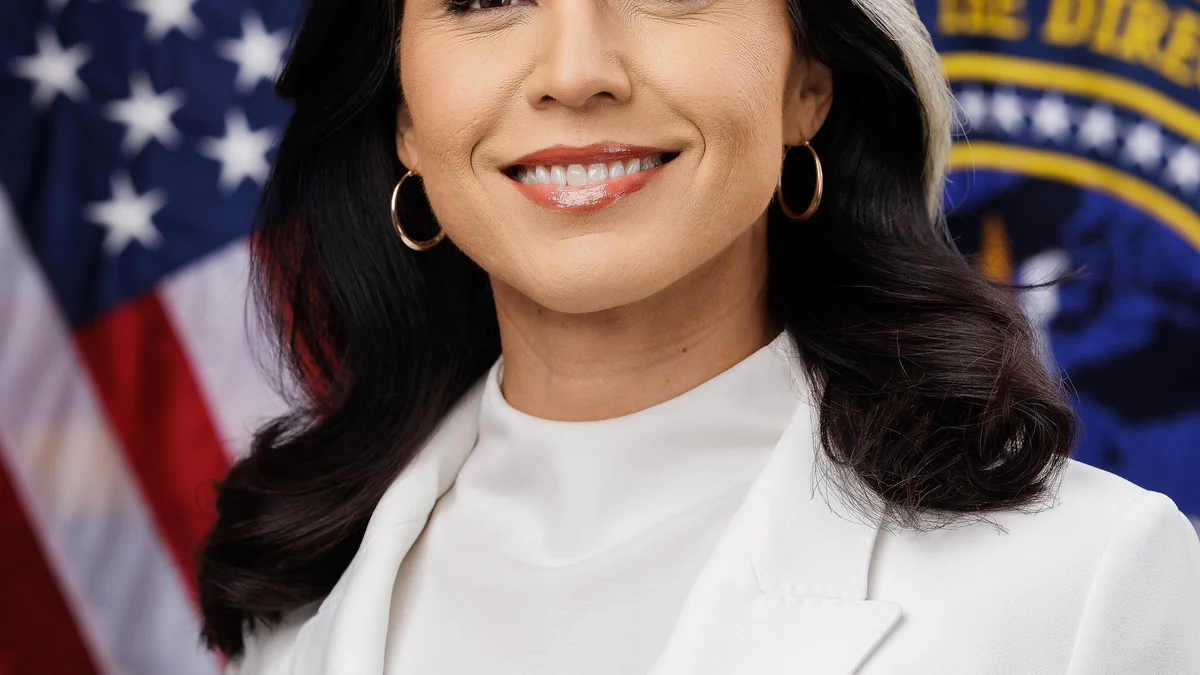
Tulsi Gabbard's departure from her role as Director of National Intelligence marks a significant shift in the American security landscape, driven by both personal tragedy and deep-seated policy friction. She currently sits in her home in Leander, Texas, a space she purchased in March 2024. Inside, there is the quiet, clinical hum of a household rearranged to accommodate her husband, Abraham Williams, who is facing a diagnosis of rare bone cancer.
Tulsi Gabbard announced her resignation as Director of National Intelligence on May 22, 2026, citing her husband's bone cancer diagnosis. Her departure, effective June 30, 2026, follows reported policy disagreements regarding Iran and Venezuela. Aaron Lukas will serve as the Acting Director during the transition period.
The Narrow Margin of Power
The distance between a successful cabinet and a fractured one is often measured in votes. When Gabbard was confirmed, the tally was 52–48. It was a razor-thin margin that left her with almost no room for error or political maneuverability.
Mitch McConnell was the only Republican senator to vote against her confirmation. He stood alone, a quiet signal that the traditional intelligence establishment remained wary of the woman chosen to oversee the 17 agencies of the Intelligence Community.
The tension within the Republican party manifested as a permanent friction between the populist wing and the old guard, leaving the DNI in a precarious position.
I asked a former staffer about the atmosphere in the hallways during those final weeks. They spoke about a sense of "directional motion blindness," where the administration's long-term goals and the immediate needs of the agencies were no longer in sync.
The Internal Friction Behind Tulsi Gabbard's Departure
In Washington, a personal crisis is often the only acceptable way to mask a political divorce. While the diagnosis of Abraham Williams is a heavy, human reality, reports of internal intelligence community friction have been circulating for months.
Trump publicly expressed frustration with Gabbard's leadership in the weeks prior to her resignation on his Truth Social platform. The friction was not merely about personality, but about the very map of American influence and strategic priorities.
Reports from within the National Security Council suggest Gabbard was increasingly marginalized from decisions regarding Venezuela and Iran. She reportedly diverged from the administration’s hardline positions on Iran’s nuclear activities, placing her at odds with more hawkish Cabinet elements.
The transition from the Director of National Intelligence to a private citizen is a journey from the macro-analysis of the world to the micro-focus of a hospital room.
| Metric | Detail |
|---|---|
| Resignation Announced | May 22, 2026 |
| Effective Departure | June 30, 2026 |
| Confirmation Vote | 52–48 |
| GOP Dissenters | 1 (Mitch McConnell) |
| Acting Successor | Aaron Lukas |
The India Connection and Regional Intelligence
To understand Gabbard’s tenure, one must look toward New Delhi. She was a bridge to the government of Prime Minister Narendra Modi, a relationship she nurtured with a focus that often bypassed traditional State Department channels.
She discussed intelligence sharing with Modi and Michael Waltz as if it were a brotherhood of necessity. For the Indian government, Gabbard represented a version of America that understood their specific security anxieties without Western lectures on domestic policy.
Her exit leaves a vacuum in the high-level intelligence cooperation that had become a priority for both Washington and New Delhi.
The Shadow of the Whistleblower
Behind the public accolades and the somber news of her husband's health, a darker narrative persists. There are allegations of a whistleblower report being blocked by the administration to avoid what sources on r/news described as a "national embarrassment."
The content of this report remains hidden behind the heavy curtain of classification. In the world of intelligence, the things we are not told are often more significant than the press releases we receive.
During her Senate testimony, fact-checkers were forced to deny that she had confirmed the existence of US-funded biolabs in Ukraine. It was a moment that highlighted the constant blur between verified fact and political narrative that defined her time in office.
The Transition of Power
The machinery of the state does not stop for a sickroom. Even as Gabbard prepares to move her life back to the private sphere, the names of her successors are already being circulated.
Senator Jim Banks has already suggested Representative Elise Stefanik as a possible permanent successor. The transition to an Acting Director, Aaron Lukas, is intended to project stability to an intelligence community that feels increasingly untethered.
Trump's public statement was characteristically brief: "Tulsi has done a great job, and we will miss her." It was a polite dismissal, the kind given to a general who has lost a battle but is still respected for the attempt.
The Human Cost of National Policy
In the digital world, the reaction was less refined. On Reddit, one user noted, "The rats are leaving the sinking ship." Another was more caustic: "Welp, my job is done here! I have removed all intelligence!"
These comments ignore the 121,649 people who watched the CNN coverage of her resignation, looking for answers about the stability of their government. To the public, these are names on a screen; to the families involved, these are lives being uprooted.
The 4 million people displaced by conflicts that these agencies monitor do not care who sits in the DNI's office. They care about whether the decisions made in that office will allow them to return home safely.
The Final Circle
In Leander, the sun begins to set over the Texas scrubland. The home Gabbard bought in 2024 was meant to be a sanctuary, a place far removed from the residency disputes that dogged her Hawaii voting records.
She is no longer the woman in the Senate hearing, defending her record against 48 votes of no confidence. She is a wife in a quiet house, facing a "rare and aggressive" reality that no satellite imagery can track.
The resignation is effective June 30. Until then, the files will continue to land on her desk, and the world will continue to burn in the places she once monitored. But her eyes are already elsewhere, marking the final stage of Tulsi Gabbard's departure.