Cuban Women in Crisis: High Human Capital Meets Systemic Energy Paralysis
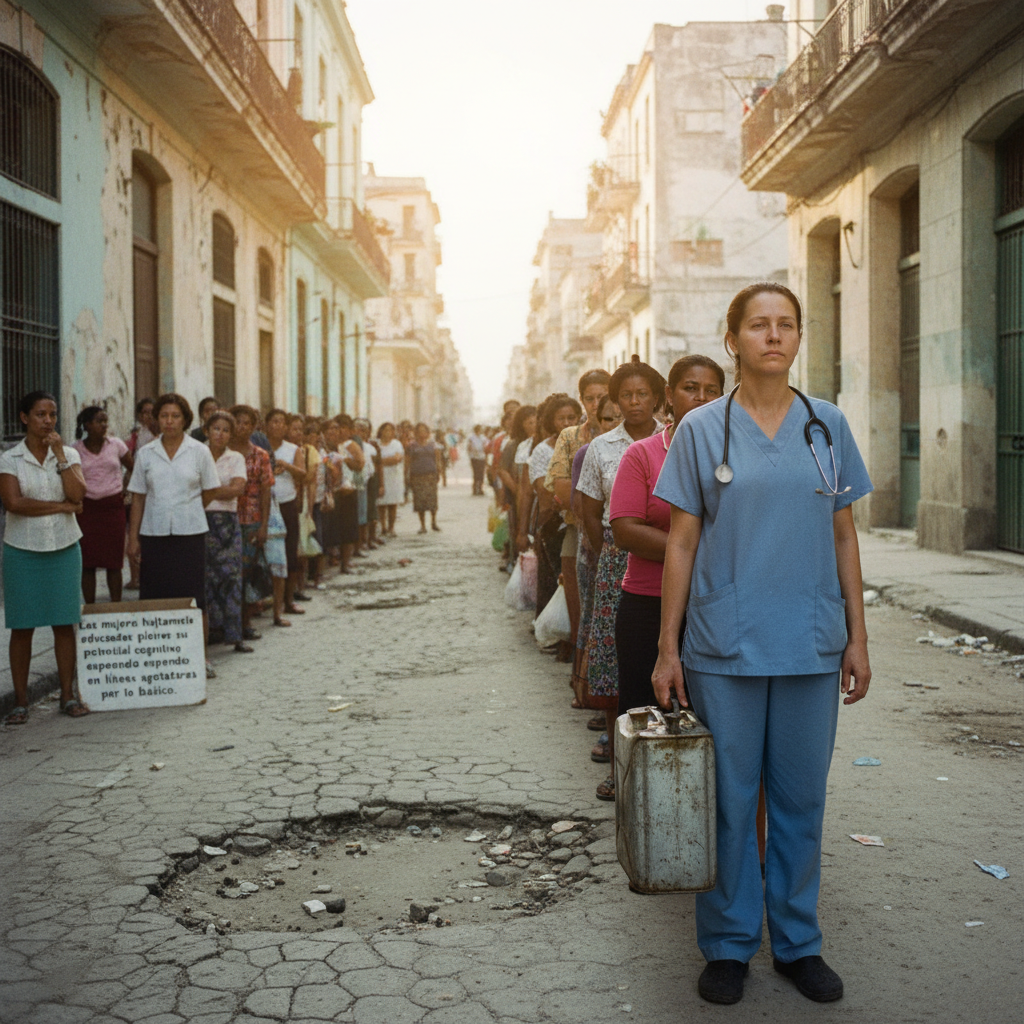
By May 2026, Cuban women in crisis are navigating a singular socio-economic contradiction: elite educational attainment paired with a primitive survivalist energy grid. Despite high literacy, women face a 60% fuel deficit and total hygiene supply chain collapse, forcing highly skilled professionals into grueling daily queues for basic goods.
Professional regression occurs when highly educated individuals must divert their cognitive potential toward the manual labor of securing food and fuel during 12-hour blackouts. This friction between high cognitive potential and low-dimensional resource access defines the current humanitarian situation.
The Energy Blockade and the Erosion of Professional Productivity
The current volatility in Havana is driven by a stark data point: Cuba now produces only 40% of the fuel it requires for basic national stability. This deficit represents an institutional failure that has effectively halted industrial production and public transit. When energy production drops below this critical threshold, the professional productivity of the female workforce is the first casualty of "time poverty."
On April 7, 2026, hundreds of women mobilized in Havana to protest the ongoing U.S. energy blockade, signaling a shift in how domestic actors interact with geopolitical pressure. While the official narrative blames measures inherited from the past, the behavioral mapping of the protesters suggests a deeper frustration with the state's inability to manage the internal grid. The lack of fuel has transitioned from a logistical hurdle to a reproductive health crisis, as basic pain relief and maternal services have vanished from the landscape.
Digital Apartheid: The Gap Between AI and Scarcity
The global digital landscape is currently obsessed with "Local AI" and decentralized computing, yet the Cuban professional is being systematically disconnected from this paradigm shift. On developer platforms like Dev.to, global competitions offer prizes that could sustain a Cuban family for years. For a woman with a computer science degree in Havana, the inability to compete due to persistent power outages is a form of scientific apartheid.
This disconnect creates a widening cross-border correlation between energy stability and intellectual equity. While researchers on arXiv publish breakthroughs in AI-assisted design, Cuban scientists are bartering for bread. If the global order is being rewritten by algorithmic agility, then energy paralysis is effectively deleting an entire generation of scholars from the future economy.
"What is the value of a master's degree in a country that cannot provide a sanitary pad?"
The Structural Toll on Cuban Women in Crisis
| Variable | Current Status (May 2026) | Primary Impact Actor |
|---|---|---|
| Fuel Self-Sufficiency | 40% of demand | State/Associated Press |
| Daily Energy Deficit | 60% during peak hours | National Grid |
| Professional Status | High Education / Zero Liquidity | "Overeducated Poor" |
| Primary Social Safety Net | Catholic Church / Informal Markets | Fides News Agency |
| Digital Participation | <10% of global peer capacity | Tech Sector |
Institutional Decay and the "Libreta" Failure
The libreta de abastecimiento (ration book) was originally designed as a blueprint for equity, yet it now serves as a ledger of state absence. When fuel production remains stagnant, the distribution of rationed goods becomes mathematically impossible, leaving the most vulnerable to beg on boulevards like San Rafael. The analog state is using its remaining bureaucracy to manage the optics of scarcity rather than the reality of it.
The Catholic Church has stepped into this institutional vacuum, with bishops in Santa Clara describing their parishes as "beacons of light" in literal darkness. According to Fides News Agency, the church is now the primary provider of emotional and material scaffolding for women facing homelessness. This shift indicates a move toward a post-state reality where traditional institutional boundaries are blurring in favor of grassroots survival networks.
The "Hidden" Labor and Domestic Exploitation
The burden of this survivalist capitalism is disproportionately gendered, manifesting as an intense "invisible labor" that mirrors global patterns of domestic exploitation. Discussions on platforms like Reddit highlight a rising social friction where the expectation of domestic perfection is forced upon women who have no running water. A woman is no longer just a professional; she is the primary logistician of a household that must be fueled by manual persistence.
This domestic pressure is leading to a visible erosion of social cohesion, often referred to as the "death of respect." When survival becomes the only measurable goal, traditional moral frameworks regarding family support and community engagement begin to dissolve. If a society's legal norms are predicated on the stability of the home, then the current reality suggests a total rewriting of the social contract.
Information Gain: The Mechanics of Professional Regression
The most profound tragedy of this crisis is the phenomenon of Professional Regression, where high human capital is forcibly diverted into low-skill survival labor.
- Cognitive Atrophy: High-level skills, such as surgery or engineering, require constant application. When a professional spends 40 hours a week in a food queue, the resulting atrophy of proficiency is a permanent loss to the intellectual GDP.
- The Innovation Gap: Innovation requires a surplus of time and energy. By forcing its most educated citizens to focus on the "logistics of the loaf," the state has effectively banned the creation of new intellectual property.
- The Anchor Effect: Overeducated women often serve as the "anchor" for extended families, caring for both children and the elderly. This role makes them the least likely to migrate, ensuring that the remaining talent is the most exhausted.
The "overeducated" status of these women is not an asset in the current market; it is a psychological weight that intensifies the indignity of the queue.
Strategic Implications for the Caribbean Landscape
The international community must look beyond immediate humanitarian needs to the long-term structural damage of this regression. The rally on April 7 suggests that the majority of women are transitioning into a more localized, tangible form of resistance. Modern actors are demanding the basic inputs required to exercise their professional agency rather than abstract political slogans.
If the government continues to prioritize political optics over the restoration of the 40% fuel threshold, the social blackout will become irreversible. We are witnessing the hollowing out of a nation that was once a leader in biotechnology and literacy. This serves as a warning for any state that fails to align its educational mandates with its energy infrastructure.
As the social contract dissolves, the international community must decide if it will intervene before Cuban women in crisis are permanently erased from the global intellectual landscape.
Written by Elisabeth Saar