Three Hours and Thirty-Eight Minutes
On 25 November 2026, Shenzhou 24 carried Pakistan's first astronaut — Muhammad Zeeshan Ali — to the Tiangong space station, making him the first Pakistani citizen to reach orbit and the first foreign national ever to board China's space station.
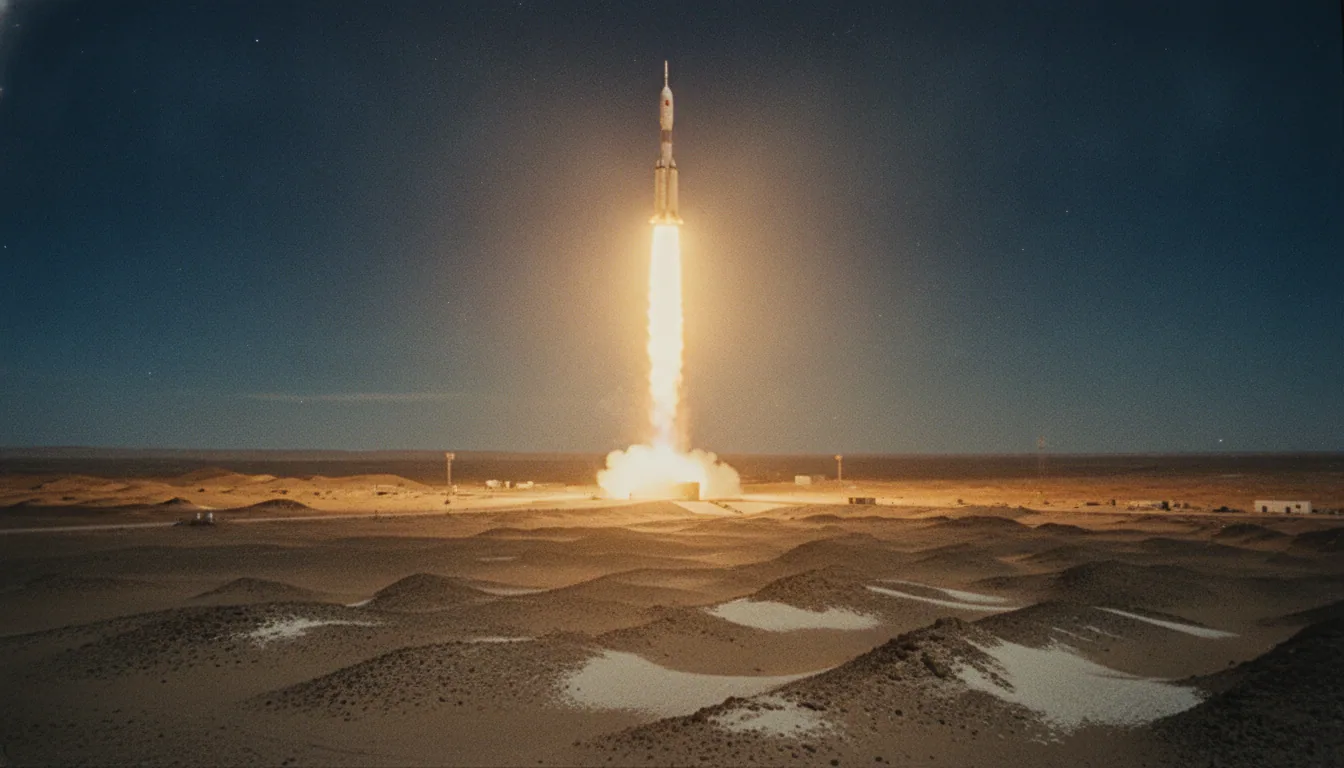
At 08:18 on a Wednesday morning in Beijing, a Long March 2-F rocket left the ground. That is the simple version. The more accurate version is that it hauled a column of fire sixty stories tall up through the desert air above Jiuquan, turned northwest China briefly into a second sun, and placed three human beings on a path to a space station four hundred kilometres overhead. One of those three human beings had never been in orbit before. His country had never sent anyone there.
Three hours and 38 minutes after liftoff, Shenzhou 24 docked with the Tiangong space station. The elapsed time is worth pausing on. A person can drive from Tallinn to Tartu in two hours; a transatlantic flight takes eight. The gap between "standing on Earth" and "living aboard an orbiting laboratory" was shorter than most long-haul delays. When the connection confirmed, an official at Jiuquan read the verdict aloud with the calm of someone announcing a train arrival: "The spacecraft is functioning well. I declare the Shenzhou-24 launch mission a complete success."
The launch had happened early enough that in Pakistan it was still 05:18 in the morning, the sky still dark. That detail is small and not small at all. Somewhere in that darkness, a nation of 240 million people woke up to find one of its own already above the clouds, moving at 28,000 kilometres per hour, beginning the first week any Pakistani has ever spent in space.
The Pilot Who Became a Payload Specialist
Muhammad Zeeshan Ali is 40 years old, a former Pakistani Air Force pilot, and now the first Pakistani citizen to reach orbit. The transition from combat aviation to space mission sounds dramatic until you understand the logic: jet pilots are selected for exactly the qualities orbital flight demands, the tolerance for sustained physiological stress, rapid instrument-reading, and calm decision-making when the margin for error is thin. What changed for Ali was not the toolkit. It was the destination.
His designated role on the mission is payload specialist. That title has a precise meaning. Where a commander controls the spacecraft and a flight engineer manages its systems, a payload specialist is there for the science: designing, running, and monitoring experiments that require a human presence a robot cannot replicate. Ali joins mission commander Tang Hongbo, 51, a veteran of Tiangong's earliest crewed visits, and flight engineer Wu Yi, 39, who handles the station's operational systems. Each role is load-bearing. Ali's is the one that justifies his particular presence on the station.
Nothing happens without a backup. Khurram Daud completed the full astronaut training program in China and was ready to fly in Ali's place if medical or technical circumstances required it. That depth matters: it signals that Pakistan's commitment to this mission was structural, not ceremonial. Two men trained for the same seat.
The mission logo carries one more quietly deliberate detail. Among its design elements is the jasmine flower, Pakistan's national flower. It is a small thing to notice and an intentional one. Somewhere between the engineering specifications and the geopolitical calculation, someone took a moment to put a flower on the rocket.
Pakistan's First Astronaut Boards a Station Built for Everyone — Almost
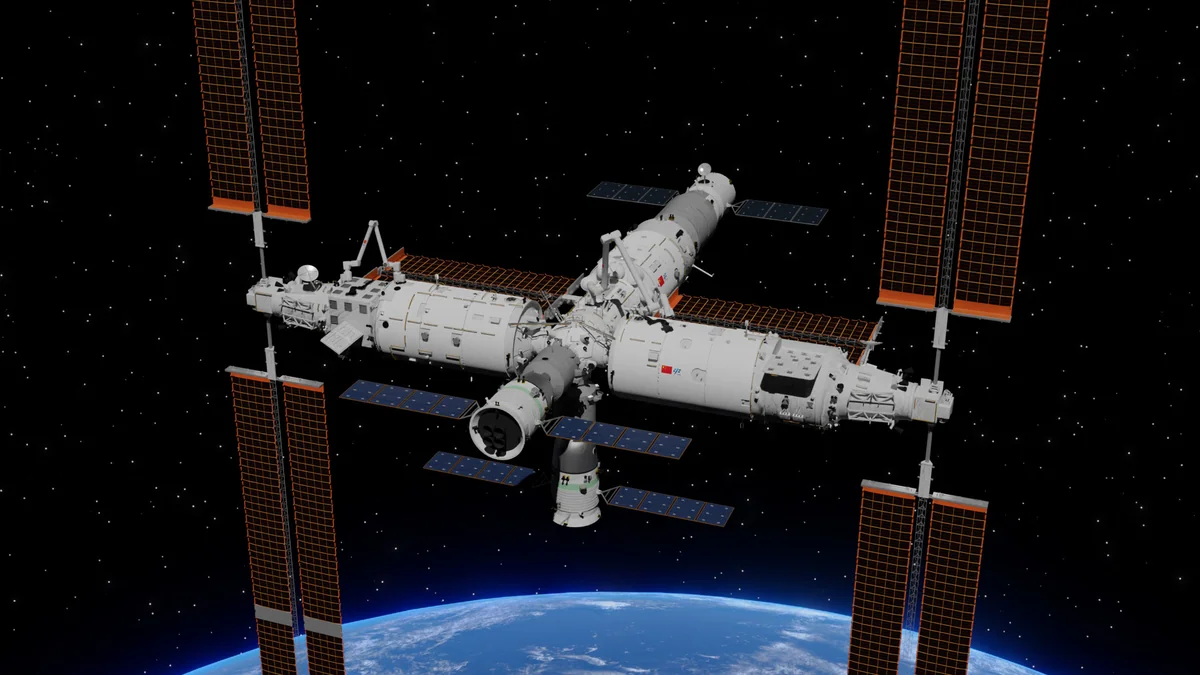
Before Ali could carry any science into orbit, someone had to open the door. That door had, until now, been opened only by Chinese nationals. The Tiangong space station, China's modular outpost in low Earth orbit, completed its core construction in 2022. Every crew member who had ever floated through its hatch held a Chinese passport. Ali changed that on November 25, 2026 — the first foreign astronaut ever to board the station.
This is deliberate architecture, not a happy accident. China has been positioning Tiangong as the international alternative to the ISS, a destination for partner nations who want a seat at the table of human spaceflight but are not in the club of traditional space powers. The agreement between Pakistan and China, signed in February 2025, was the first visible brick in that structure. Ali is its proof of concept.
Here is the practical reality: his stay is approximately one week. That is not a full crew rotation of six months. It is a short-stay mission, structured so that Ali works as a payload specialist alongside commander Tang Hongbo and flight engineer Wu Yi, conducts his experiments, and then departs. The return trip adds its own wrinkle. He will not leave on the same spacecraft that brought him. Shenzhou 24 stays docked at the station for the incoming crew. Ali will return to Earth aboard Shenzhou 23, with the crew that was already on Tiangong when he arrived. The logic is straightforward, like a ferry system where the boats never turn around — but it underlines how precisely choreographed orbital rotation has to be.
One week, one foreign national, one station. The variables are small. The implications are not.
What You Grow When Gravity Lets Go
Picture a small transparent vessel clipped to a rack inside Tiangong's laboratory module. Inside it, something is trying to live. Microalgae, single-celled and green, suspended in a liquid medium, reaching for light in a room where up and down have lost their meaning. This is one of four experiments Muhammad Zeeshan Ali carried to the station, and it is probably the strangest garden ever tended by a Pakistani farmer.
The microalgae work is not about scenery. If long-duration missions are ever going to leave low Earth orbit behind, crews cannot haul all their food and oxygen from the ground. These organisms photosynthesize, consuming carbon dioxide and exhaling oxygen. They grow fast, they are dense in protein, and in microgravity they behave in ways they simply cannot on Earth, because convection — that slow stirring driven by warm fluid rising and cool fluid sinking — stops working when weight is irrelevant. Ali's job is to observe and document what changes when that background hum of gravity goes quiet.
The second experiment is quieter. Quinoa seeds, sitting in a container, waiting to germinate. Quinoa is drought-tolerant, nutritionally complete, and already growing in Pakistan's highland regions. How spaceflight stresses or reshapes the germination process could eventually feed agricultural decisions far below, in fields that have never seen a rocket. These are small seeds carrying a very large question.
His four experiments are a sliver of a larger enterprise. Shenzhou 24 carries roughly 90 experiments in total, covering materials science, biology, and fluid physics. Ali's contribution is modest in number, specific in purpose, and pointed — in the most literal sense — at what a nation with food security concerns might want to know about growing things beyond Earth.
Seventy-Five Years and Four Hundred Kilometres
There is a date tucked quietly into the official announcements: February 2025. That is when Pakistan and China signed the agreement for astronaut selection and training, the formal document that put Zeeshan Ali on a path to Tiangong. Eighteen months from signature to orbit is a remarkable pace — but then, this mission was carrying more than one deadline.
2026 is the 75th anniversary of China-Pakistan diplomatic relations. That number is not incidental. Pakistani Deputy Prime Minister Ishaq Dar said it plainly: the mission marks "a significant milestone in our all-weather strategic cooperative partnership as we commemorate 75 years of diplomatic relations." Strip away the diplomatic cadence and the meaning is still there. A friendship that began with handshakes in 1951 has now sent a man into low Earth orbit together. That is not a coincidence of scheduling.
Compare this to how space partnerships have traditionally been built. For decades, the architecture was essentially bilateral between superpowers: Soviet cosmonauts rode American shuttles, American astronauts trained in Star City, and everyone else queued at the door of the ISS under terms largely set in Washington or Moscow. China is writing a different kind of invitation letter. Tiangong is being positioned as the station for Belt and Road partners, a place where alignment is expressed in rocket fuel rather than ribbon-cutting ceremonies. Pakistan is the first to walk through that door.
Here is the strange part: seventy-five years of diplomacy, thousands of kilometres of road and pipeline built together under the China-Pakistan Economic Corridor, and the most visible symbol of all that effort turns out to be one man, weightless, four hundred kilometres above all of it.
Pakistan, which has historically trailed India in every measurable index of space capability, just put a man on a space station first.
240 Million People Looking Up
When Prime Minister Shehbaz Sharif addressed the nation after docking, he did not describe a pilot completing a mission. He said the journey belonged to 240 million Pakistanis, "particularly the younger generation, scientists, and their dreams." That framing is deliberate, and it lands differently when you hold it next to the numbers: one astronaut, one week, four experiments out of ninety total conducted aboard Tiangong. Pakistan's footprint in orbit is currently very small. The ambition it signals is not.
Deputy Prime Minister Ishaq Dar called the flight "a significant milestone in our all-weather strategic cooperative partnership," timed precisely to the 75th anniversary of China-Pakistan diplomatic relations. South Asia noticed. India's Gaganyaan program, which aims to place Indian astronauts in orbit, has not yet launched a crewed mission. Pakistan, which has historically trailed India in every measurable index of space capability, just put a man on a space station first.
The unanswered questions now do as much work as the answered ones. What did the seat cost? No figure has been disclosed. When will backup astronaut Khurram Daud fly? No timeline. Why one week instead of a full rotation? No explanation given. These gaps are not oversights — they are the next chapter waiting to be written. The Shenzhou 24 mission and Pakistan's first orbital flight have changed what a country of 240 million people knows, for certain, about the sky above them: it is not the limit.