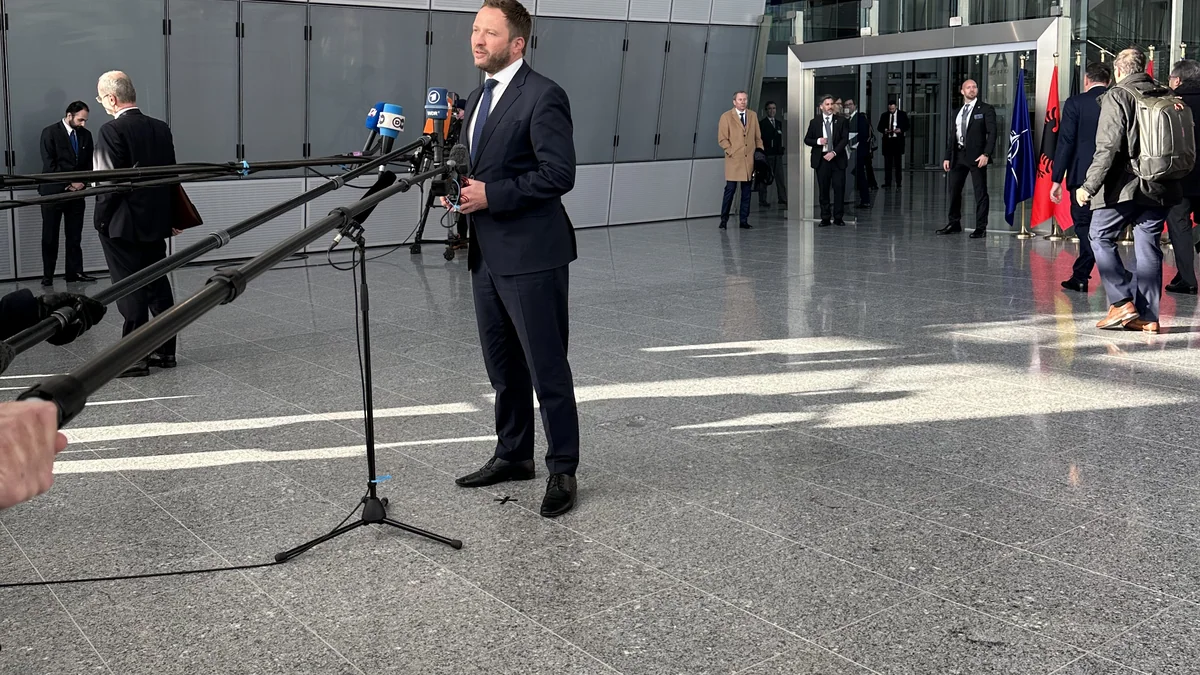
On November 20, 2026, two Kh-101 cruise missiles and a jet-powered drone came down in southeastern Poland during active Russian strikes on Ukrainian infrastructure across the border. Poland's Prime Minister Donald Tusk called the intrusions intentional. NATO condemned the airspace violations. The gap between those two statements is the story.
The Last Time a Missile Killed Someone in Poland
A grain dryer in Przewodów. Six kilometres from the Ukrainian border. On November 15, 2022, that was the structure that stopped a missile, and it was where Bogusław Wos and Bogdan Ciupek died - two men working a harvest site, unremarkable until the wire ran their names across the world. The comparison to November 20, 2026 is obvious, and it is precisely wrong.
The Przewodów comparison flatters the present incident by making 2026 look like a continuation of an accident. Polish prosecutors closed that question in September 2023: the missile that killed Wos and Ciupek was a Ukrainian S-300 air-defence round, gone off course during a massive Russian strike. The hardware was Soviet-era, the trajectory was deflected, the killing was unintended. Volodymyr Zelenskyy's initial reaction - "I have no doubt that it was not our missile" - was wrong, and the Ukrainian Air Force eventually conceded that debris hitting Polish territory during large-scale attacks could come from either side. It was an accident nested inside a war, which is a different category of event from what Donald Tusk named on November 20.
That categorical difference is the load-bearing point. The 2022 deaths were the product of a system under saturation pressure, not of a decision. Tusk did not use the word "accident" in 2026. He used the word "intentional." The two words do not inhabit the same legal or political universe, and the alliance's response will turn - entirely - on which one the evidence forces it to accept.
Three Objects Over Poland, No Deaths
On November 20, 2026, two Kh-101 cruise missiles and one jet-powered drone came down in southeastern Poland. The crash sites - Nowy Lipowiec, Rudnik nad Sanem, Mołodycz - are villages, not military installations. One object ignited a field fire; Defence Minister Władysław Kosiniak-Kamysz confirmed no injuries, no deaths.
The bare inventory matters. Three objects, three locations, zero casualties. The absence of a body this time is not evidence of a lesser event - it is evidence of a different kind of event, one calibrated precisely to produce impact without the obligation that a corpse would impose on the alliance.
The same day, Russian strikes on Ukrainian infrastructure killed three people and damaged bridges across the border. That simultaneity is the operational context the inventory alone cannot convey. The Polish intrusions and the Ukrainian bombardment are one picture, not two separate items for two separate wire services.
A Kh-101 is not a stray round. It is a stealthy, long-range cruise missile, the kind of platform a military selects when it wants the object to arrive. The question of whether these three arrived by design or by navigation failure is precisely the question that Polish and NATO statements have so far declined to answer with the specificity the hardware demands. Tusk used the word "intentional." The alliance's formal language has been more careful. That distance between a prime minister's word and a secretary general's communiqué is itself data - read it as the load-bearing wall and everything else as moulding.
A Pattern Invisible in Any Single Incident
Pull the incidents apart and each one has a plausible single-event explanation. Put them in sequence and something else emerges.
December 2022: a Kh-55 cruise missile came down in a forest near Bydgoszcz. Polish authorities knew. They did not say so publicly for four months. When the disclosure finally came, in April 2023, the scandal attached itself to the delay - to the politics of silence - and the missile itself receded from the story. A piece of Russian ordnance had crossed NATO airspace, landed on NATO soil, and the operative question became who failed to issue a press release.
December 29, 2023: a Russian missile entered Polish airspace and spent three minutes there before exiting back toward Ukraine. Three minutes is not an accidental overshoot corrected in seconds. It is a transit.
July 2026: a Kh-101 came down in a Polish field near residential homes. Four months before November's triple violation. The hardware was the same as what landed at Nowy Lipowiec and Mołodycz in November - same airframe, same flight profile, same NATO member's soil.
Each incident considered alone looks like an operational overshoot at the edge of a congested air-defence corridor. The sequence, laid flat, looks like cartography. Someone has been learning the geometry of Polish airspace - what enters, what is intercepted, what lands quietly and waits four months for a press release. That is the load-bearing wall. The outrage cycle every time is the moulding.
Repetition, at some point, stops being a provocation and becomes a precedent.
What the Kh-101 Is, and What It Was Not Used For
The Kh-101 is a long-range, stealthy cruise missile - designed, among other things, to carry a nuclear warhead. That second clause is not incidental. Estonian Reserve Major General Neeme Väli noted the distinction plainly: this specific missile carried approximately 400 kilograms of conventional explosive. A very large conventional explosive. The nuclear-capable designation was left intact, unretracted, sitting in the design specification like a sentence that does not need to be finished aloud.
The choice of delivery vehicle is itself a message. Russia did not send a stray artillery shell across a river. It sent a weapon whose full capability envelope includes the destruction of cities - loaded, on this occasion, with something less. The gap between what the Kh-101 can carry and what it carried on November 20 is precisely the space in which the signal lives.
Alongside the two Kh-101s came a jet-powered drone - not a loitering munition of the cheap, expendable variety, but a powered airframe requiring deliberate routing. NATO Secretary General Mark Rutte condemned the airspace violations. The condemnation was prompt and attributed. Read it for what it names and what it does not: "violations" is the operative word, carrying no clause about proportionate response, no threshold, no trigger. That is the load-bearing response from the alliance - everything else around it, the expressions of solidarity, the emergency consultations, is moulding. The hardware that crossed into Poland was selected to hold two meanings at once. Rutte's statement was not.
The Word 'Intentional' and What It Changed
Compare the registers. After Przewodów in November 2022, President Duda and Secretary General Stoltenberg moved carefully into the passive voice: investigation underway, preliminary findings, no evidence of a deliberate attack. The language was engineered to leave the author unnamed. Tusk on November 20, 2026 used no such engineering. His word was "intentional," and he attached a cause: the missiles arrived while European allied military exercises were underway in Poland.
That framing does specific legal and political work. "Intentional" names an author and assigns a purpose - which is precisely what the 2022 vocabulary was built to avoid. Duda and Stoltenberg were managing the acute risk of a collective-defence clause being dragged onto the table by accident. Tusk was not managing that risk. He was naming it.
The timing he cited is not incidental to his reading. Scheduled NATO exercises in Poland make the country's airspace politically sensitive, and two Kh-101s plus a drone arriving during those exercises is not a configuration that lends itself to the stray-missile explanation. The soft signal embedded in the pattern is legible enough: test the alliance's response threshold, stay below the casualty line that would force Article 5 onto the agenda, and watch what language the condemnation takes.
What "intentional provocation" does, once a serving prime minister says it on the record, is foreclose the neutral framing for the next incident. Somewhere in Brussels, that word has been logged. Whether it has been acted upon is a different question, and the answer is not yet visible in anything NATO has published.
The Question the Alliance's Condemnation Language Is Built to Avoid
Ask the small question first: who is the borderland here, and who is living six kilometres from someone else's war. The residents of Nowy Lipowiec and Mołodycz did not choose that geography. The alliance that guarantees their sovereignty chose its language carefully after each incident, and the language is the tell.
Article 5 is a collective-defence obligation, not an automatic trigger. Four documented airspace violations across four years have produced four rounds of condemnation and no structural change in the alliance's threshold for action. Mark Rutte condemned the November 2026 violations. The condemnation was prompt and firm and changed nothing about the calculus that produced the incident.
Donald Tusk's word "intentional" is the most significant diplomatic data point in the November 2026 record. It was spoken while European allies were conducting scheduled military exercises on Polish soil, which means the provocation, if that is what it was, was timed for maximum political visibility. Moscow has demonstrated across four years that it understands the arithmetic of no casualties, and has stayed within it.
The watch-marker is narrow and checkable. Read NATO's formal post-incident language in the coming days. If the text uses "shall" on the question of response obligations, the alliance has moved. If it uses "should," it has not, and the missiles over Poland will be back on your screen. Repetition, at some point, stops being a provocation and becomes a precedent. The verb will tell you which side of that line the alliance believes it is standing on.