The Drone, the Whale, and the Genome Inside a Breath
Non-invasive genomics — the science of reading DNA from breath, blood, and bodily fluids without surgical intervention — has moved from laboratory curiosity to clinical standard faster than almost anyone predicted. Researchers at the University of St Andrews collected 58 blow samples from 26 individual humpback whales in Gitga'at First Nation territory without a single dart fired, without a boat closing in, without the animals knowing anything unusual had happened.
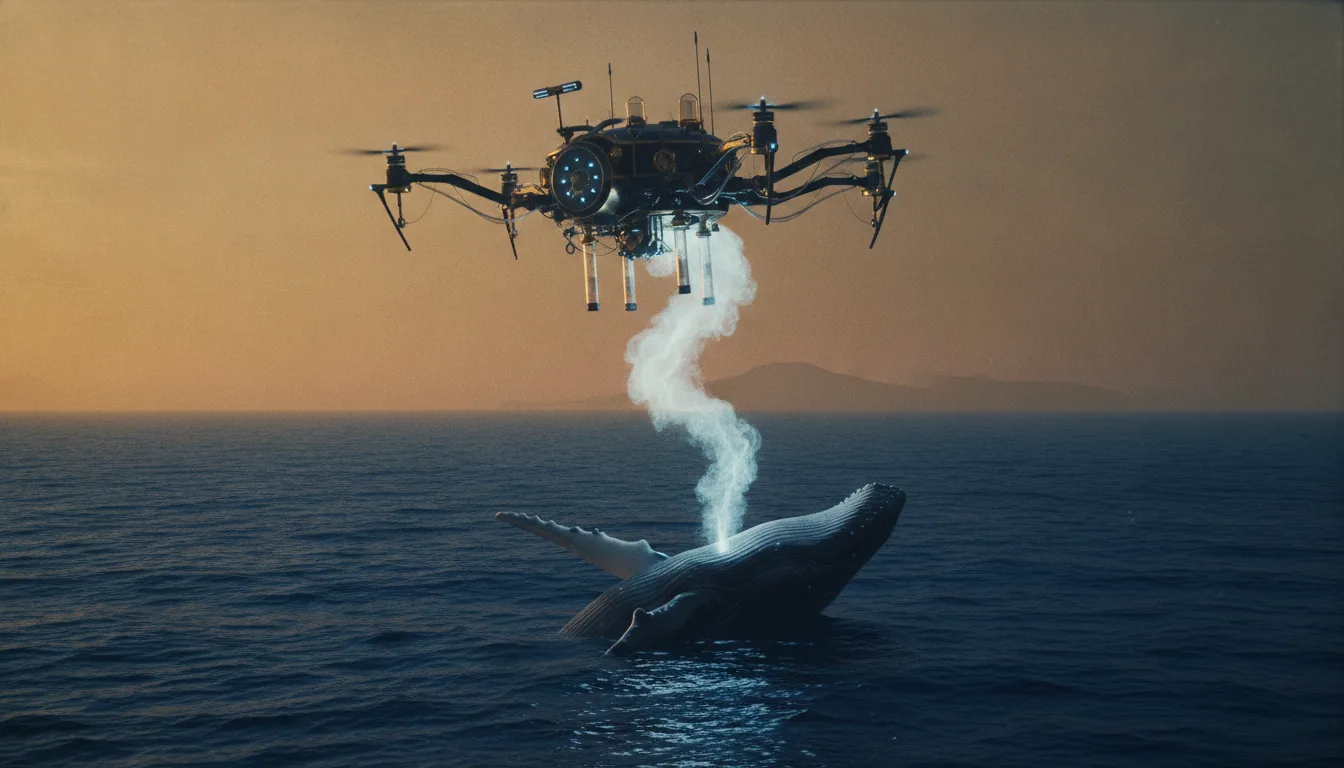
Picture a drone hovering over open water off the coast of British Columbia, waiting. Below it, a humpback whale surfaces and exhales. The drone dips, intercepts the cloud of warm misted air, and flies back to the boat with its invisible cargo: a smear of respiratory condensate barely worth noticing. Inside that smear is a whole genome.
That is not a metaphor. The sampling was conducted entirely without physical intervention or close approach. And yet from those misty exhalations, the team sequenced the first complete whale genomes derived from breath alone.
Here is the part that makes you stop. Approximately 84% of the DNA recovered from whale blow originates from the whale itself; most of the remainder comes from resident microbes. That is a remarkably clean signal from what is essentially a sneeze caught by a flying machine. The genomes matched the accuracy of traditional biopsies taken by shooting dart tips into skin and blubber.
Think about what that means for anyone trying to study wild cetaceans. The old method was physically intrusive, logistically demanding, and tightly restricted for some species. This one requires a drone, a collection vessel, and patience.
Dr. Éadin O'Mahony, the lead researcher at the Scottish Oceans Institute, described the ambition clearly: population structure, individual health, and family kinship all recoverable from a single exhaled sample. One breath, and you know who the whale is, who it is related to, and something of how it is faring.
What makes this more than a conservation curiosity is the logic underneath it. The whale story and a cancer blood test drawn from a patient's arm in an oncology clinic share the same molecular premise, and that is where this gets genuinely interesting.
What Floats in Blood — and Why We Can Finally Read It
Every time a cell divides, dies, or simply does its daily work, it sheds small fragments of its DNA into surrounding fluids. Not the full double helix coiled neatly in a nucleus, but broken pieces, typically 150 to 200 base pairs long, drifting free in the bloodstream. These are called cell-free DNA, or cfDNA. The body produces them constantly, and until recently, we mostly could not read them.
The historical alternative was blunt by comparison. To understand what a tumor was doing, surgeons cut into it. To check a fetus for chromosomal abnormalities, clinicians threaded a needle into the amniotic sac, a procedure carrying a small but real risk of miscarriage. These methods worked. They were also the only option, which is different from saying they were good options.
What changed was sequencing speed and price. Next-generation sequencing platforms could read cfDNA, but the volume of fragments in a blood sample is enormous, and separating meaningful signal from biological noise required processing power that was expensive and slow. Then Illumina's NovaSeq X platform cut sequencing costs while raising data yield by 30 to 40 percent. That is not a marginal improvement. That is the difference between a tool that lives in a research institute and one that fits into a clinical workflow a family doctor can order.
The logic connecting the whale drone to the cancer blood test runs through this same mechanism. Fluids carry DNA. Sequencers can now read it quickly and cheaply enough to matter. That combination — biological fact plus engineering threshold — is what moved cell-free DNA analysis from curiosity to medicine.
Catching Cancer Before It Announces Itself
The cruelest thing about cancer is not what it does, but when we find it. Most tumors announce themselves only after they have been quietly growing for years, spreading before anyone had reason to look. Liquid biopsy changes that arithmetic.
In July 2024, the FDA approved Guardant Health's Shield test as the first blood-based primary screening option for colorectal cancer, detecting the disease with 83% sensitivity before symptoms appear. Three months later, Exact Sciences received approval for Cologuard Plus, a stool-based test hitting 95% sensitivity for the same cancer. Two different bodily fluids, the same underlying logic: shed DNA tells the story before the patient knows there is one.
The ambition did not stop at a single cancer type. GRAIL's Galleri test scans for more than fifty cancers from a single blood draw by reading the methylation signatures on cell-free DNA, the chemical flags that mark which tissue a fragment came from. In September 2026, an FDA advisory panel voted 7-2 in its favor for multi-cancer early detection. A trial involving 142,250 NHS participants found a 14% reduction in Stage IV diagnoses among people screened with Galleri — meaning fewer patients first discovered their cancer when it had already traveled somewhere it should not be.
Then there is the question of what happens after treatment ends. In May 2026, Natera's Signatera CDx became the first personalized molecular residual disease test approved as a companion diagnostic, designed to detect whether cancer cells remain circulating in the blood after surgery or chemotherapy. The test is built from a patient's own tumor genetics, so it looks for exactly that cancer's specific mutations. A clean scan is not a guarantee; a rising signal is a warning that the clinical eye cannot yet see.
Taken together, these approvals mark something genuinely new: a tier of surveillance that runs continuously in the bloodstream, watching quietly for the earliest molecular whisper of disease.
Taken together, these approvals mark something genuinely new: a tier of surveillance that runs continuously in the bloodstream, watching quietly for the earliest molecular whisper of disease.
Before the First Heartbeat, the Genome Is Already Speaking
A needle into amniotic fluid. That was once the bargain a pregnant woman had to accept if she wanted to know whether her fetus carried an extra chromosome. The procedure worked, but it carried a small, real risk of miscarriage, and the anxiety of waiting made the days feel very long.
Then someone asked a quieter question: what if the blood already knew?
It does. From around the tenth week of pregnancy, fragments of fetal DNA circulate freely in the mother's bloodstream, shed from placental cells doing their ordinary work. A blood draw, a sequencer, a careful count of chromosomal fragments, and the answer is there, without a needle going anywhere it shouldn't. Non-invasive prenatal testing, NIPT, reads those fragments the way a librarian reads call numbers, sorting signal from noise until a pattern declares itself.
The stakes are real enough to explain a market projected to grow from $7.2 billion in 2024 to $14.1 billion by 2029 — a 14.5% annual growth rate powered not by hype but by parents choosing a safer screen. And the technology is sharpening. In cases where fetuses showed restricted growth for no obvious reason, multimodal genetic testing resolved conditions as subtle as paternal disomy, where a child inherits both copies of a chromosome from one parent alone, and placental mosaicism, where the placenta carries a chromosomal pattern different from the fetus itself. These are the edge cases that older methods often missed entirely.
NIPT matters beyond obstetrics, though. It is the proof-of-concept that the whole field is built on: that a living body, going about its business, leaves its molecular autobiography in the fluids around it, and that we have finally learned to read it.
The Same Trick, Applied Everywhere — That Is the Promise of Non-Invasive Genetic Analysis
The logic that lets a blood test find a tumor's shed DNA is not special to cancer. It is not even special to medicine. It is a logic about proximity: biological processes leave molecular traces in whatever fluid, breath, or tissue they touch, and if you can read those traces, you no longer need to reach inside.
Watch where it goes. In February 2026, Helix partnered with Mawi DNA Technologies to broaden access to non-invasive genomic sample collection, pushing the technology further into routine clinical settings. Meanwhile, researchers tracking global patterns of antibiotic resistance in invasive Salmonella are now using non-invasive environmental sampling to map how resistant strains spread across borders, no hospital ward required. The same conceptual move, different continent, different pathogen.
Then there is radio-genomics, which is perhaps the strangest extension of all. Radiologists developed imaging biomarkers capable of predicting epidermal growth factor receptor (EGFR) mutations in non-small cell lung cancer — meaning a scan can suggest what a gene is doing before anyone has collected a blood sample. Here the "non-invasive sample" is light itself.
The whale blow is not an outlier. It is the clearest illustration of what the whole field is reaching toward: a single exhaled sample that simultaneously profiles the host genome and the respiratory microbiome, two answers from one breath, without a needle, a dart, or a surgery. Each of these — the scan, the sewage, the snot — is the same trick in a different costume.
What the Genome Still Isn't Telling Us
The numbers are genuinely impressive. Cologuard Plus detects cancer with 95% sensitivity. The NHS-Galleri trial, with 142,250 participants, reduced Stage IV diagnoses by 14%. A $27.34 billion liquid biopsy market is projected by 2035. Read those figures in sequence and the story sounds finished.
It isn't. The critical question — whether catching more cancers earlier actually reduces how many people die overall — remains unanswered. Detecting a Stage IV cancer at Stage II is valuable only if treatment at that stage changes the final outcome, and long-term mortality data from MCED trials simply does not exist yet. Market projections and clinical proof are not the same document.
The uncertainties run wider. Drone blow-collection works beautifully for humpbacks, whose exhalations are forceful enough to fill a petri dish from several meters away. Whether the same technique scales to smaller cetaceans, species with shallower breath and quieter lungs, is unresolved. And the cost-effectiveness of radio-genomic biomarkers versus liquid biopsy in real clinical workflows, where budget and time per patient both matter, has no clear answer. Non-invasive genomics is speaking more clearly than ever about what our bodies carry. We are still learning, with appropriate humility, how to listen.