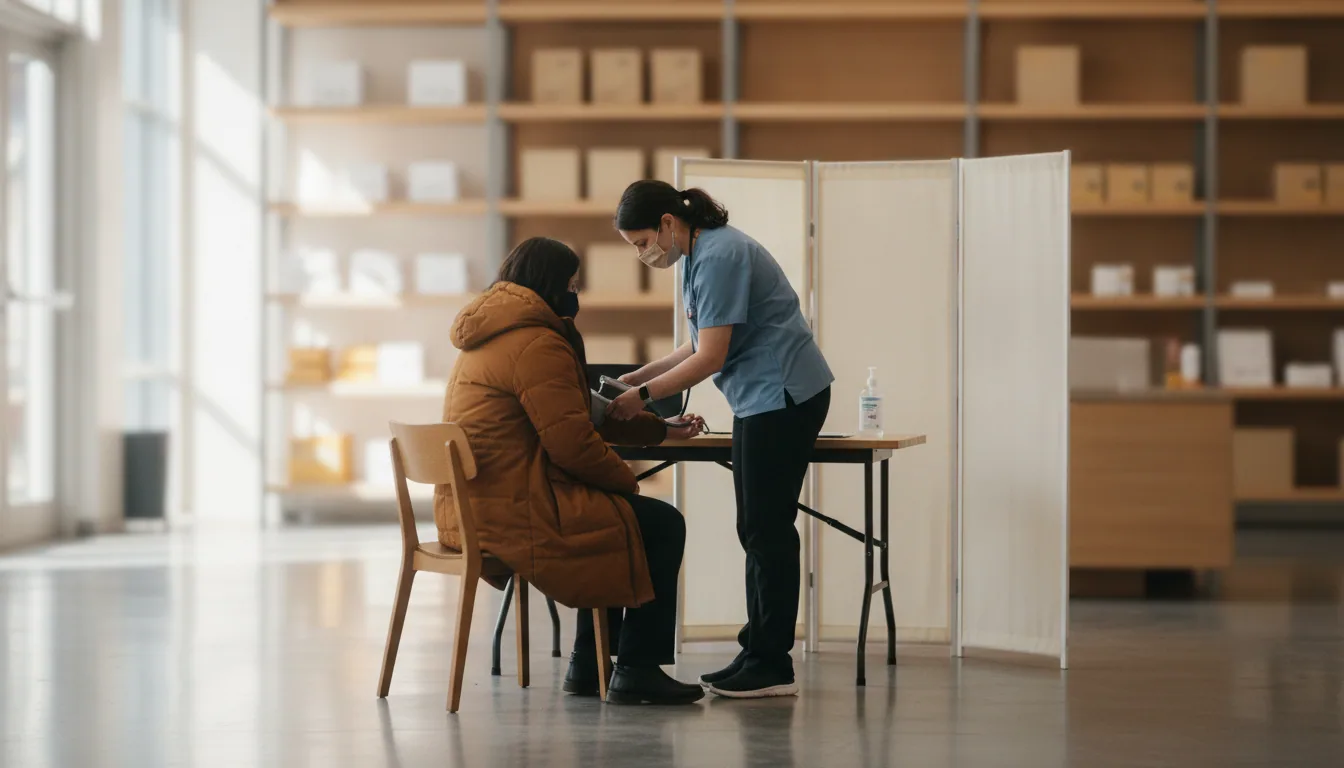
In November 2026, health points set up in Tallinn hardware stores as part of the "Longer Friendship Day" (Pikema Sõpruse Päev) revealed a massive demand for quick preventive care. These low-threshold services are filling a gap created by a 100 million euro deficit in the healthcare system and a shortage of more than 700 nurses in the national network. When the system is missing that many professionals, people start looking for answers in the same places they buy lightbulbs and paint.
People are choosing shopping center health points because they are more accessible than a weeks-long wait for a family doctor. On Friday, November 16, 2026, a line of people stood in a Tallinn hardware store. They were not waiting for discounted screwdrivers. They were waiting for a health check.
The idea behind the campaign was simple: people are going to the shop anyway, so they can step aside for a moment and have their body composition measured. The consultation took a few minutes, was free, and required no referral. This brought in an unexpectedly large crowd. Some people even had to go home disappointed because the time simply ran out.
This is not a story about an organizational failure. It is a sign of how much people want to deal with their health. A body composition analysis does not replace a medical examination, but it is something that can be done right here and right now. People stayed in that queue because, quite often, they have nowhere else to get quick answers to their concerns.
The pharmacy as a primary diagnostic center
Pharmacies like Apotheka, BENU, and Südameapteek have been quietly changing their role in Estonian society. They no longer just sell medicines. They measure cholesterol, blood sugar, and blood pressure. This is primary diagnostics that, only a decade ago, belonged exclusively in a doctor's office.
A high service quality rating for Apotheka in September 2026 shows that people trust pharmacists with their health questions. This trust means the pharmacy is filling a void that the state system can no longer fully carry. The private sector is taking on this responsibility because Tervisekassa reserves are projected to be exhausted between 2029 and 2030.
A pharmacy is a low-threshold location where you go without a referral and often without planning ahead. When getting to a family doctor takes weeks, a blood sugar measurement taken in a pharmacy can be a critical moment. It can direct a person to further help at the right time, before their health condition gets worse.
Why health points in Estonia have become so popular
Getting an appointment with a family doctor is a daily ordeal for many people that requires immense patience. When a health check is located on the way between work and home, one of the main reasons for postponing a check-up disappears. A hardware store or a shopping center is a place that lacks the psychological barrier associated with a hospital.
A white coat and an official consulting room can keep people away, but a pop-up point feels like a natural activity. Preventive counseling has turned from a luxury into a necessity that the system cannot provide to everyone. The shortage of 700 nurses in the healthcare system means that family doctors simply do not have enough time for every preventive conversation.
Bringing preventive services to where people already are makes maintaining health socially normal. People's natural behavior is to find the path to where help is available. This is not a criticism of doctors, but a result of the arithmetic of the system. Moving preventive work into an everyday environment makes staying healthy an ordinary part of life, not an exception.
System arithmetic: Deficits and the personnel crisis
The 100 million euro annual deficit in Tervisekassa is not just a figure in a budget table. It is expressed in the reality of a person waiting weeks for help. According to forecasts by Arenguseire Keskus, there are only a few years left until the health insurance reserves are empty. Do the arithmetic; that is what policy feels like when the reserves run dry.
Today, about 700 nurses are missing from the Estonian healthcare system, and according to data from Tervise Arengu Instituut, this gap is growing. Every missing specialist means a longer waiting time and a greater load on the remaining workers. This is why patients head to the pharmacy or the shopping center instead of the doctor's office.
Employers have noticed how long it takes for employees to get diagnoses and are demanding systemic reforms. The queue in the hardware store in November 2026 was a kind of measuring instrument itself. People voted with their feet: if the system does not come to them, they go where the service is available.
The role of remote services and digital diagnostics
To alleviate the personnel shortage, Tervisekassa is testing remote services such as Eelvisiit and OnKontakt. Telemedicine is one possible answer to the question of how to reach a person before they need hospital treatment. In Finland and Sweden, remote consultation is already a standard first step in the healthcare system.
Estonian digital health is developed, but the movement of data from health points to the information system is still fragmented. Currently, it is not always clear whether a measurement taken in a hardware store even reaches the view of a family doctor. Remote services and pop-up points could together form a valuable first line of defense if data began to move without obstacles.
The core of prevention does not always have to be expensive equipment, but timely and relevant advice. When the national system is overloaded, new technologies and locations must provide the necessary support. The phenomenon of health points shows that the readiness for this actually exists in society.
Will the health points remain?
No one knows for sure if the hardware store health points will return next year, as the private sector has not promised permanent solutions. However, the mathematics of funding suggests that voluntary solutions are currently one of the few ways that actually work.
An undetected chronic disease costs health insurance many times more than a single minute of measurement in a shopping center. The logic of food safety and preventive work is the same: warnings and checks are only expensive if they are not done. Whether responsibility and funding will catch up with the trust offered by pharmacies and health points is a political choice.
As a reader and a consumer, you can use the health points and demand that healthcare be on the first page of national budget discussions. The health points in Estonia showed clearly that interest in prevention is high—now the system must find a way to turn that interest into a permanent solution.