
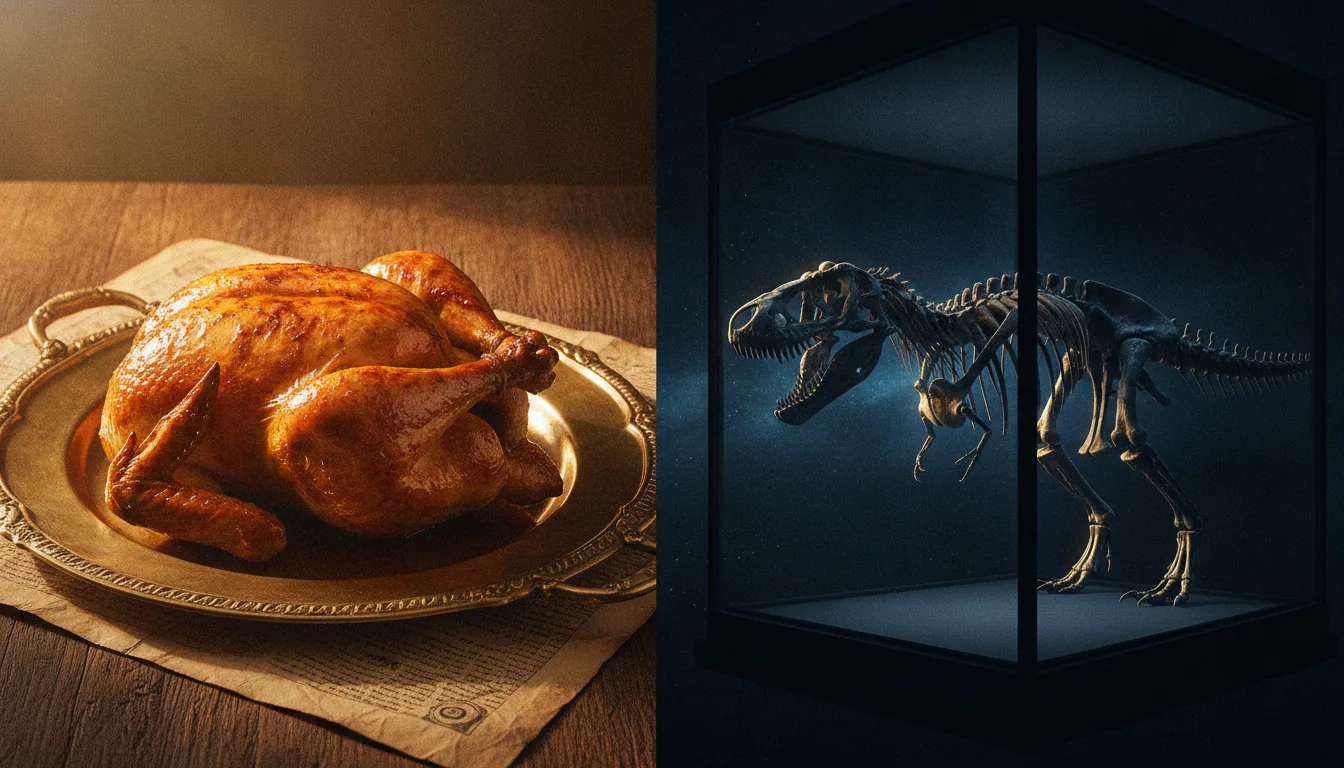
The legacy of the dinosaurs on our dinner table is more concrete than most of us realize: the chicken on your plate is biologically a dinosaur, the patterns on an eggshell are a 66-million-year-old design, and the grasses that make your morning toast were already growing in Cretaceous landscapes.
Take a plate, put a piece of roasted chicken on it, and look at it for a moment. Think about who you are actually eating. I don't mean this metaphorically or poetically. I mean it biologically. A chicken is not a descendant of dinosaurs in the same vague way that humans are descendants of ancient primates. A chicken is a dinosaur, in exactly the same way that a bat is a mammal.
Here is the strange part. We tend to think of birds as something that came after the age of giants, but birds belong to the theropods, an evolutionary branch of predatory dinosaurs. This isn't a creative exaggeration; it is a fact of systematics. When biologists draw the tree of life, mother hens and male ostriches sit on the very same branch where predators known for their jaws and claws once resided.
Now hold that thought, because it gets even more specific. Tyrannosaurus rex, that nine-meter-long fossilized nightmare, is genetically and molecularly closer to a chicken or an ostrich than it is to a crocodile or a Komodo dragon. Laboratory analyses have confirmed this at the level of protein groups, where fossilized tissue traces allow for a molecular comparison.
This means something very concrete for your kitchen. When you roast a chicken, you are preparing a meal from the meat of a descendant of a sauropod. When you peel a boiled egg in the morning, you are working with a structure inherited directly from the dinosaurs. The end of the Cretaceous period, 66 million years ago, didn't actually extinguish the dinosaur lineage; it simply squeezed it through the narrow eye of a needle during a global catastrophe. What came out on the other side was plumage and the ability to sing. The evolutionary branch of the theropods survived. And today, it lives on your dinner table.
The Hell Chicken and the Botanical Pompeii
Imagine a bird that weighs exactly 11.3 kilograms, reaches a length of a meter and a half, and eats fruit. Not grass, not meat—fruit. This is Infernogallus jamesi, the "Hell Chicken," whose fossils were discovered in the Hell Creek Formation. It lived approximately 66 million years ago, and it represents a shift in how we understand the ancient world.
It is the first scientifically identified fruit-eating dinosaur, and this discovery changes the picture we've carried of how theropods lived. But where did those fruits come from? James Saulsbury from the University of Kansas called the location a "botanical Pompeii." Fruits from 74 million years ago were preserved there so perfectly that scientists could describe them in minute detail.
To give you a sense of scale, these fruits were roughly the size of a grape. That is a concrete measurement you can feel in your hand, not just an abstract number in a paleontological table. The existence of these fruits 74 million years ago tells a much larger story. Flowering plants, known technically as angiosperms, appeared on Earth about 136 million years ago and began slowly displacing the gymnosperms that had previously ruled the planet. Their spread brought about something revolutionary: juicy, seed-filled fruits as a brand-new food source.
Thomas Dudgeon of the Royal Ontario Museum has put it precisely—the evolution of flowering plants introduced a completely new energy source to the world, with consequences for every animal living alongside them. The connection was more symbiotic than it first appears. The dinosaurs got a meal, and the plants got something in return: mobility. The seeds passed through the dinosaurs' digestive tracts and were spread to new locations. James Saulsbury suggests this mechanism might have accelerated the development of large, juicy fruits much earlier than we used to think. Perhaps big, succulent fruits didn't just appear after the dinosaurs vanished; perhaps the dinosaurs themselves helped shape them. The Hell Chicken ate, the forest spread, and that forest is the ancestor of the woods where we pick berries today.
What Fossilized Waste Tells Us
There are objects found in India's Lameta Formation called coprolites. They look like stones. In a way, they are stones: fossils created when dinosaur digestive remains turned into hard rock through mineralization. But inside these greyish-brown lumps lies something more valuable than any mineral—direct evidence of what a living creature ate for its final meal.
Chemical analysis of these coprolites showed that their creators were consuming rice-like plants and grasses. These are the same plants we grind into flour for bread, boil for porridge, and use to brew beer. Their roots reach back to the time when dinosaurs still walked.
Then Jasmina Wiemann, a researcher at Yale University, adds another layer to this story. She studied 66-million-year-old egg fossils and found two specific pigments: protoporphyrin and biliverdin. These names might sound technical, but they are old friends—they are the exact same substances that color a wild bird's egg green or a farm chicken's egg brown today.
Egg coloring patterns didn't start with birds. They appeared earlier, in the eumaniraptors, the group of predatory dinosaurs from which birds descend. This coloring evolved only once in history and was passed down directly. Every morning when you crack an egg into a bowl, you are handling the heritage of the saurian age. The color on the shell isn't a coincidence. It is a 66-million-year-old solution that is still working.
Then there is Aratasaurus. In the 115-million-year-old bones of this dinosaur, researchers identified traces of heme and hemoglobin—the biochemical signatures of blood that have survived unexpectedly long. The exact mechanism of how these molecules lasted for so many millions of years is still a mystery to science. This is one of those places where we have to be honest: we don't know yet.
The Estonian Table: A Living Museum
In Estonia, the connection to the deep past is even more visible if you know where to look. Fish smokers in Narva-Jõesuu know the lamprey well. This eel-like creature with a sucker-mouth has been climbing up into our rivers every autumn for the last 360 million years. Not 36 million. 360 million. The lamprey was already an ancient lineage when the first dinosaurs were just beginning to walk, and it has the same shape today that it had then. A smoked lamprey on a plate in Narva-Jõesuu is more than a local delicacy; it is an edible link to a time before any large land mammals existed.
Nearby, the sturgeon raised in Karilats, South Estonia, come from a slightly younger mold, but their body plan clearly bears the stamp of the Cretaceous. They have a cartilaginous-bony skeleton, shield-like bone plates on their sides, and that distinct, elongated snout. Sturgeons have kept their mid-Carboniferous proportions through the eons because their design simply worked. Caviar from a sturgeon is a luxury humans have prized for centuries, but the sturgeon itself knows nothing of that—it has simply endured.
Then there are the plants. The Ginkgo—Ginkgo biloba—is a living organism straight out of the Triassic. Its leaves are the same shape and its wood has the same scent as it did 200 million years ago. Today, gourmet chefs use ginkgo nuts in Japanese cuisine, and the young shoots of the ostrich fern are found on spring menus in Nordic restaurants. These aren't just "retro" dishes; these are plants that survived mass extinctions, ice ages, and everything in between. They are back in fashion because their taste is original in the deepest sense of the word. Our dinner table is much older than we think.
What We Still Don't Know
From the "botanical Pompeii" in New Mexico, we found those 74-million-year-old fruits. But who exactly was eating them? The fossils show us the fruits and they show us the bones, but rarely do we find both together. Which specific large herbivores tasted those fruits is a question that remains unanswered.
Infernogallus jamesi, that 11.3-kilogram Hell Chicken, earned its place in history through its bones. But feathers are not preserved in these fossils, and soft tissues rarely survive in rock. Whether it was as richly feathered as its relatives is something we can only guess at.
As for the 115-million-year-old hemoglobin found in Aratasaurus bones, it is like finding a photograph in a house that should have crumbled to dust ages ago. The chemistry that kept those molecules together is still a puzzle. And we still don't know exactly what percentage of dinosaurs actually ate fruits and grains; the picture we have is still blurry. Every new fossil rewrites the menu slightly. That is not a failure of science; it is the engine of it.
Every meal is a form of time travel. The chicken on your plate, the yolk in your morning foam, the ginkgo leaves in your tea—all these lines lead back to a world no human ever saw. The dinosaur legacy is daily and living. What we still don't know is far greater than what we do. And that, honestly, is the best part.