The Script Was Already Running
Europe's bomb threat wave of November 2026 follows a pattern rehearsed three years earlier: in October 2023, thousands of schools across Estonia, Latvia, and Lithuania received coordinated Russian-language threat emails in a single sweep. The evacuation machinery ground into motion, children stood in car parks, police worked through the night, and the devices, naturally, did not exist. A suspect was eventually detained in Dnipro, which told investigators something about routing and something about deniability, but left the question of who gave the order precisely where it had always been.
The November 2026 wave, roughly thirty European flights targeted in a single day, is not a novelty. It is an iteration. The 2023 Baltic school campaign had already established the template: volume over credibility, the email as the weapon, the response system as the target.
France added its own chapter in the same year, when landmarks from the Louvre outward cycled through evacuations and 130 flights were cancelled in a cascade that exhausted the security services visibly and publicly. French law offered up to three years in prison and a 45,000-euro fine for a false report. The sequel came anyway.
The legal penalty existed, was well publicised, and deterred nothing. Because the calculus is not the criminal's calculus - it is the state's.
Ask the small question first: who is the borderland here, and who is the empire? The tactic has a biography, and the biography narrows the list of plausible authors to a short column.
Thirty Flights, One Afternoon, No Device
On 5 November 2026, between roughly twenty-seven and thirty European flights received bomb threat emails within a single operational window. The selection of carriers was not random. Aer Lingus, Ryanair, LOT Polish Airlines, Finnair, Wizz Air, KLM, Iberia: the list traces a deliberate arc from the Atlantic seaboard to the Nordic rim, touching every tier of European aviation from flag carrier to low-cost operator.
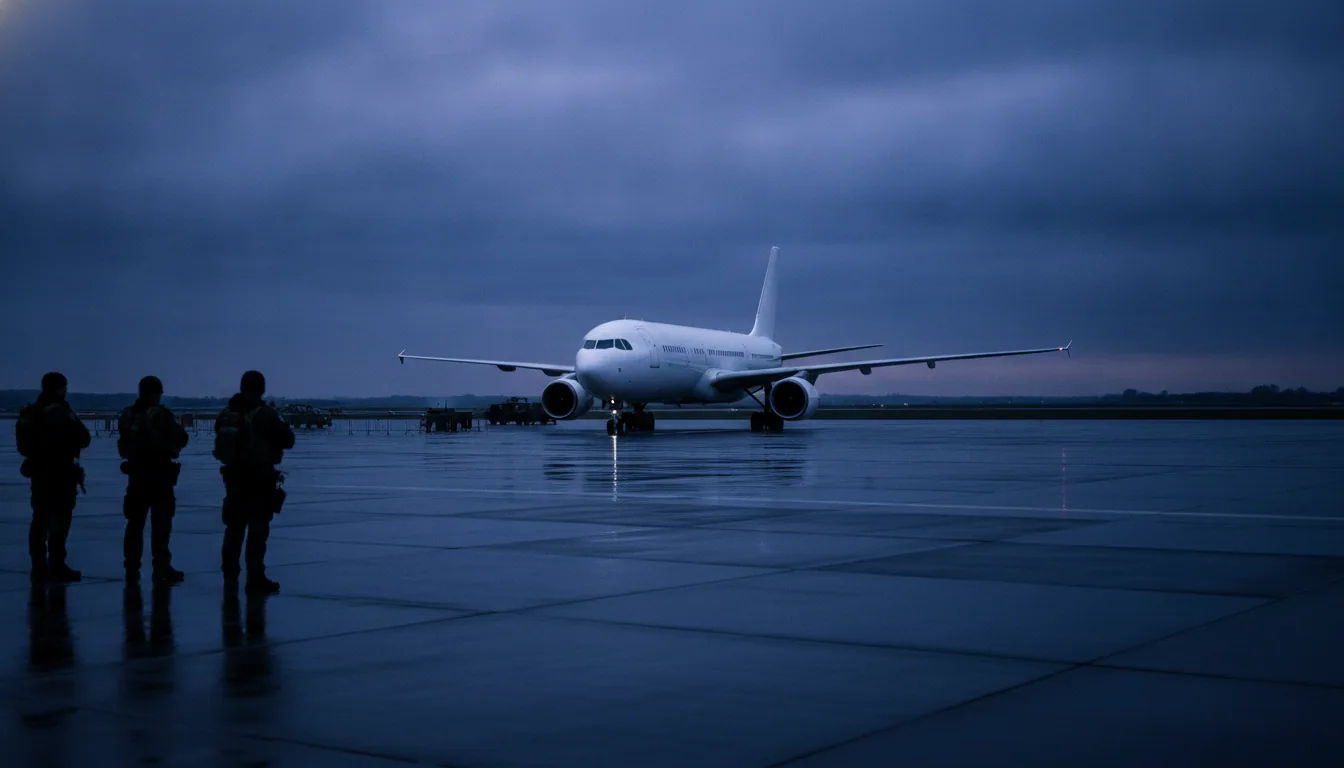
The emblem case was an Aer Lingus flight out of Dublin, bound for Rome with 151 passengers aboard. French fighter jets intercepted it and escorted it down to Evreux military airbase. No device was found.
The 151 passengers waited on a military tarmac while security teams worked the aircraft, and then the flight was over in every sense that mattered for that day's schedule.
Bulgaria scrambled air force jets to escort three passenger flights into Sofia and Plovdiv. Poland diverted a LOT flight from London to Warsaw, putting it down at Modlin instead, and Modlin closed temporarily while the aircraft was cleared.
Each diversion required military assets, ground security teams, and coordination across at least two national authorities. Each produced nothing.
Finnair confirmed two of its aircraft were among the targeted flights, placing the Nordic edge of the wave above the Baltic. The geographic logic, once mapped, is consistent: the threats stretched across nine countries and at least seven carriers in a single afternoon. That consistency is itself the operational signature.
A genuinely random actor looking for maximum disruption would not have achieved this coverage so evenly. A coordinated one would.
No explosive device was found on any aircraft. That fact is stated here not as reassurance but as the structural point: the absence of a device is the entire mechanism, not an accident of luck.
By Morning, the Bomb Threat Wave Had Reached the Newsrooms
The aviation wave crested on 5 November. By the morning of 6 November, it had moved ashore. Irish media organisations received bomb threat emails and evacuated their premises - editorial offices joining flight decks in the target register.
This was not an escalation in sophistication. It was an extension of the same argument by the same cheap means.
The Italian airports Fiumicino and Malpensa received emails with the subject line "Threat report" - the phrasing clipped, bureaucratic, designed to read like an internal security bulletin rather than a provocation. The body claimed devices would explode within sixty minutes. Both airports serve as primary international hubs; the choice was not random, and the sixty-minute window was precise enough to force a response without allowing time for deliberate assessment.
Copenhagen's Kastrup deployed police units the same day. The northern land-side echo of a southern aviation threat, same 24-hour window, different jurisdiction.
Read the target selection as a single sentence. Airlines, airports on the ground, newsrooms. What connects them is not symbolic weight but operational vulnerability: each depends on a duty-of-care obligation that cannot be suspended, each mobilises expensive state or institutional resources the moment a credible-looking email arrives, and each normalises the emergency posture a little further with every false alarm.
The cost to the sender is the price of an anonymous account. The cost to the receiver is fuel, personnel, delayed departures, and one more increment of fatigue in the people who must eventually decide whether the next one is real.
A Signature No One Is Meant to Believe
One of the emails carried a name at the bottom: Male State. The group is a Russian anti-feminist organisation, banned inside Russia itself since 2023.
Signing a threat with the name of an organisation your own government has outlawed is not carelessness. It is a statement about the value of signatures - which is to say, none.
What the name establishes is narrow and should be kept that way. It confirms that someone with knowledge of the Russian extremist landscape, or access to its branding, composed at least one message in this wave. It does not establish a chain of command.
Eric Schouten, a security analyst at Dyami, has classified the operation as hybrid warfare and placed the attribution range at Russian or Iranian involvement. That range is precisely as wide as the evidence permits. No narrower claim would be honest.
The operational constant beneath the competing attributions is this: no device was found. Not on the Aer Lingus flight diverted to Evreux with 151 passengers aboard, not on any of the three aircraft the Bulgarian Air Force escorted to Sofia and Plovdiv, not at Fiumicino or Malpensa, not at Kastrup, not at Modlin after the LOT flight from London came down and the airport temporarily closed.
Thirty flights. Zero devices. The absence is not a failure of the operation. It is the operation.
The absence is not a failure of the operation. It is the operation.
In hybrid warfare, attribution ambiguity is load-bearing, not decorative. The deniability is structural - it must hold, because the moment a clear signature resolves into a clear sender, the operation converts from a harassment campaign into an act of war requiring a response.
The Male State label offers just enough suggestion to unsettle, and just enough distance to retreat behind. That is not a bug in the design.
One Anonymous Email; One Scrambled Interceptor
The arithmetic is not complicated. An anonymous email costs nothing: a free account, a proxy server, a subject line reading "Threat report." Against that, set the documented bill for a single fighter jet scramble - fuel burn, crew hours, ground support, the administrative trail of a military incident.
The Bulgarian Air Force ran that calculation three times in two days. France ran it repeatedly in late 2023, when a wave of coordinated threats forced the cancellation of roughly 130 flights.
The 2026 wave reached 30 aircraft in a single afternoon. That is not random variation; it is a measurable escalation curve, and someone is reading the same arithmetic.
The second-order goal is quieter and takes longer to achieve. Repeat the false alarm often enough and the response threshold shifts. Dispatchers begin to grade the inbox.
Security coordinators weigh the cost of mobilisation against historical hit rates. The boy-who-cried-wolf effect is not a metaphor here; it is a named operational outcome, and hybrid warfare planners have named it.
The first-order goal is resource exhaustion. The second is the erosion of the reflex that follows a real device.
What remains technically unresolved is how dozens of high-security aviation and media inboxes - filtered, monitored, professionally maintained - received simultaneous threat emails without triggering automated blocks. That gap is not a footnote. It is the part of the mechanism that the publicly available record does not yet explain.
Watch the Detention Order
The marker to track is simple: whether any European jurisdiction produces a traceable arrest and an extradition request before the end of November. The 2023 Baltic school wave offers the template.
A suspect was detained in Dnipro; the detention clarified probable origin without resolving command structure, and the command structure was never publicly named. Expect the same sequence here, and expect the same gap at the end of it.
The scale of this bomb threat wave is wider than the 2023 precedent. Approximately 30 flights in a single day, 151 passengers on one Aer Lingus aircraft alone, diverted to a French military base under fighter escort. That figure, 151, is the human unit of cost the eventual arrest warrant will need to account for - the newsroom staff standing in car parks in Dublin, the treasuries that funded the jet fuel, the crews who ran the same emergency drill for the third time in a week.
No explosive device was found on any aircraft. The cost was paid anyway. If a detention order does emerge, the question is whether it names an operator or only a sender - and whether the jurisdictions involved pursue extradition or file the case and move on.
The absence of a request by December would not prove state direction. It would simply confirm that whoever sent thirty emails achieved thirty scrambles at no legal risk to themselves, which is the only result that matters to whoever authorised the email.