The Election Night Paradox: When a Democratic Sweep Triggered the AI Market Correction
A party wins control of both houses of Congress, and the market punishes the future. That contradiction sat at the heart of November 5, 2026, when Wall Street's response to a Democratic sweep was not cautious optimism but outright panic. The Nasdaq fell 5.5% in a single session - its worst performance since April 2025 - while the S&P 500 shed 4.4% and the Dow Jones Industrial Average collapsed by 1,833 points, a 3.44% drop that wiped trillions from portfolio valuations in hours.
The logic, though counterintuitive on its surface, was coldly structural. Investors did not fear the election result itself; they feared its regulatory shadow. A Democratic-controlled Congress raised immediate expectations of stricter oversight on data center energy consumption, tighter infrastructure permitting, and renewed environmental scrutiny of the hyperscalers' construction ambitions. If those ambitions slow, the entire AI capital expenditure thesis - already questioned by Goldman Sachs analysts over its $600 billion annual price tag - begins to look precarious.
Analysts reached quickly for a phrase that proved more accurate than dramatic: a 'perfect storm.' Political shift met pre-existing structural anxiety over power bottlenecks, crowded semiconductor trades, and an industry that had been absorbing debt faster than it was generating returns. The election did not create these fragilities. It exposed them. What the new Congress produced, in one night, was the spark that a tinder-dry market had been quietly waiting for - and the resulting fire moved faster than most institutional actors were positioned to handle.
Anatomy of a Collapse: Mapping the $2.5 Trillion Single-Day Rout
The numbers arrived before the explanations could. By the close of trading on November 5, the Nasdaq Composite had fallen 5.5% in a single session, pushing its total decline to 12% from the record high set on October 6 - formally crossing the threshold into correction territory. The sheer velocity of the move demanded structural explanation, not just political narrative.
Nvidia became the correction's most legible data point. A 9.2% single-session drop erased approximately $440 billion in market capitalisation, a figure that exceeds the GDP of most European nation-states. That one company's daily loss could register at that scale reflects not irrationality but concentration: when a stock becomes the backbone of an entire investment thesis, its unwinding is never proportional.
The Magnificent Seven as a group lost over $1 trillion in value that day. These are not speculative penny stocks; they are the most capitalised, most institutionally held equities in the world. Their simultaneous collapse revealed a structural fragility beneath the surface of apparent market strength.
That fragility had a name: crowded positioning. Semiconductor stocks had become the most concentrated trade on Wall Street, with institutional and retail capital piling into the same names, the same sector, the same narrative of AI-driven infinite demand. When a crowded trade unwinds, it does not drift - it fractures. This is the mechanism behind the asymmetric violence of November 5.
Analysts had flagged the conditions for months. What Goldman Sachs and others characterised as irrational exuberance in AI-linked equities was not simply a valuation concern - it was a behavioural one. If capital allocators systematically price in future returns that the underlying infrastructure has not yet demonstrated, then the correction is not an event. It is an inevitability waiting for a catalyst.
The Power Bottleneck: How Grid Constraints and Regulatory Risk Became AI Infrastructure's Structural Ceiling
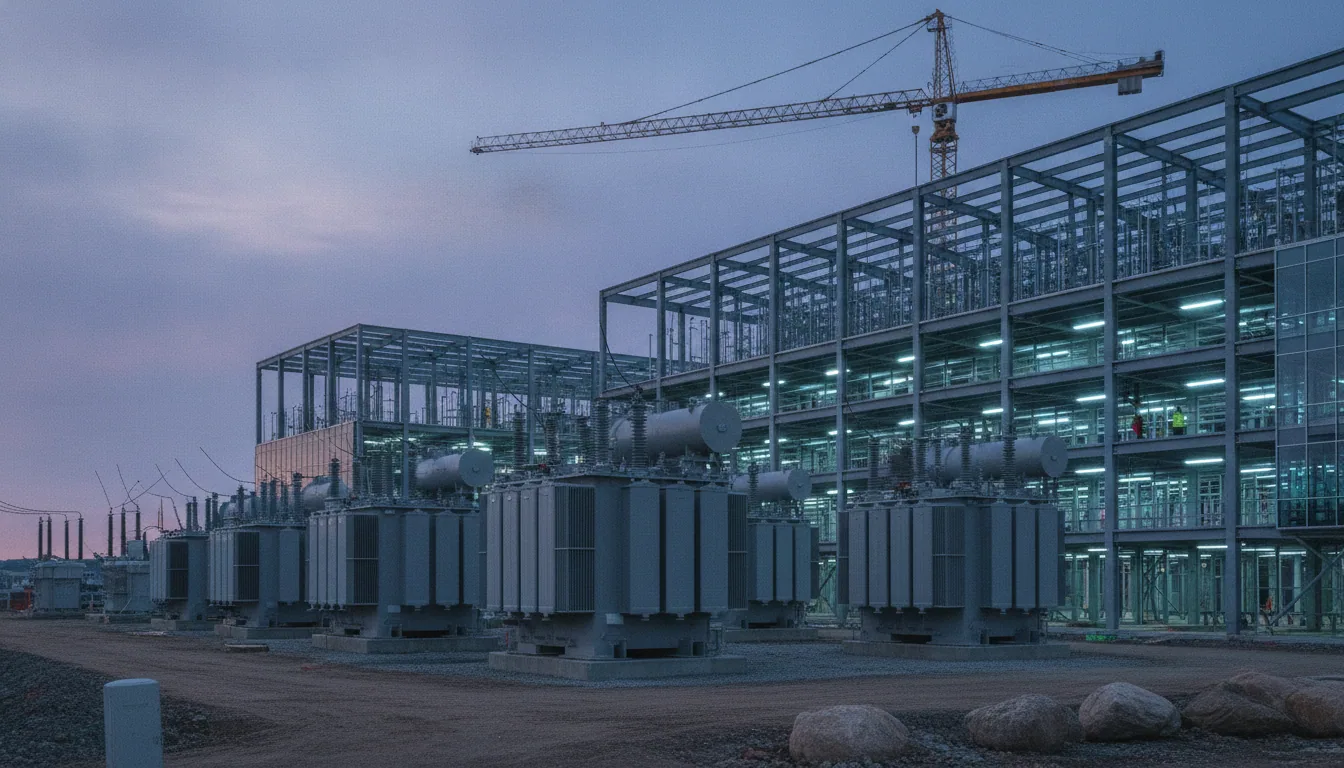
Before the first vote was counted on election night, the AI infrastructure buildout was already under structural strain. At least 47 major data-center projects had been delayed or cancelled in 2026 - not because capital dried up, but because the physical electricity grid could not absorb the demand. Power, not chips, had become the binding constraint on expansion.
This is a practical reality with direct consequences. If you are a capital allocator with positions in hyperscalers or neocloud providers, you are no longer pricing only compute risk. You are pricing utility risk, permitting timelines, and now - with a Democratic Congress seated - the credible threat of environmental scrutiny applied directly to data center energy consumption. As one analyst framed it plainly: "Power is the real bottleneck in AI today, more than chips, and it deserves investor focus."
The incoming Congress is expected to tighten oversight of data center power use and its broader environmental footprint. Infrastructure permitting slowdowns and rising utility costs compound an already constrained pipeline. For entrepreneurs and policy architects operating in the Estonian context, this signals a potential redistribution of data infrastructure development toward jurisdictions with available grid capacity and lighter regulatory overhead.
What stabilises or deepens this tech sector downturn may ultimately be determined not by tech earnings, but by labour market data. Upcoming payroll figures are positioned as the leading indicator for how the Federal Reserve calibrates its response to the rout. If labour markets hold firm, the Fed has less cover to intervene. The structural ceiling, then, is not just physical - it is monetary and political, all at once.
Circular Financing and the Semiconductor Spiral: When Chipmakers Became Their Own Customers' Creditors
Picture a chipmaker's boardroom in late October 2026: the quarterly numbers look strong, the order books are full, and the equity stakes in a dozen cloud customers sit quietly on the balance sheet like insurance policies that nobody expects to claim. Then November 5 arrives. The Philadelphia Semiconductor Index loses more than 13% across the first week of November, and those insurance policies begin to look like loaded traps.
The numbers that followed told a story of contagion, not just correction. AMD shares fell 17%; Micron fell 20%. These were not Nvidia adjacents caught in peripheral shrapnel - they were foundational suppliers to the entire AI stack, and their collapse confirmed that the sell-off had moved well past a single-company reckoning.
CoreWeave illustrated the structural logic most viscerally. The specialised cloud provider saw its shares drop 24% in one week, with investors suddenly scrutinising debt loads they had previously treated as routine infrastructure financing. High leverage works until sentiment shifts. Then it becomes the story.
What analysts began naming "circular financing" is the mechanism underneath all of this. Chipmakers had been investing equity in their own customers, sustaining the demand that justified their own valuations. The logic is elegant until it isn't: if the customer weakens, the creditor weakens with it. Analysts reached for the Cisco parallel instinctively, recalling how late-1990s vendor financing amplified rather than cushioned the eventual collapse.
The semiconductor sector had been the most crowded trade in the market. When the exit doors narrowed, the spiral was not incidental. It was structural, and it had been assembling itself for years.
If capital allocators systematically price in future returns that the underlying infrastructure has not yet demonstrated, then the correction is not an event. It is an inevitability waiting for a catalyst.
Beyond Wall Street: Global Contagion and the $600 Billion Return-on-Investment Question
Wall Street exported its panic with remarkable efficiency. South Korea's KOSPI fell 6% and Taiwan's benchmark declined 4.5% within days of the November rout, a transmission speed that reveals just how deeply Asian semiconductor supply chains are woven into the American AI trade. Where the dot-com collapse of 2000 spread slowly, like a tide retreating from a beach, this correction moved like a pressure wave.
The mechanism is structural, not incidental. Asian chipmakers and component manufacturers are not passive suppliers; they are load-bearing pillars of the entire AI capex story. When the Philadelphia Semiconductor Index tumbled more than 13% in a single week, the damage did not stay at the border.
Goldman Sachs analyst David Cahn had already posed the central question before the correction accelerated it: will $600 billion in annual AI infrastructure spend ever generate equivalent revenue? That question, once a footnote in research notes, is now the axis around which capital allocation decisions rotate. If the answer is no, the repricing is not a correction. It is a reclassification.
Here lies the sharpest contrast with prior tech cycles. The late 1990s buildout collapsed when revenues failed to materialise after the fact. This time, the ROI debate is happening in real time, while the concrete is still being poured. The strategic question for regulators and institutional investors alike: at what point does a $600 billion bet become a liability that no single jurisdiction can absorb alone?
The IPO Freeze: How a Single Week Recalibrated Private AI Valuations
Anthropic entered 2026 as the AI sector's most coveted pre-public asset, its valuation narrative built on the assumption that public markets would absorb AI risk indefinitely. That assumption collapsed in one week. Reuters reported that Anthropic's valuation target has been cut from $2 trillion to $1.5 trillion, with its anticipated IPO now facing an uncertain timeline - a $500 billion markdown that no internal revenue projection can easily explain away.
The mechanism here is structural, not incidental. Private-market valuations are benchmarked against public-market multiples; when those multiples compress by 12%, the repricing bleeds upstream into every term sheet and funding round still in negotiation. If Anthropic's bankers cannot anchor a credible public comparator, the IPO window does not simply narrow - it closes.
The downstream consequence is a potential freeze across the entire 2027 AI IPO pipeline. Debt-laden neocloud providers face the most acute pressure: CoreWeave's 24% weekly share drop signals that markets are now pricing refinancing risk explicitly. The strategic question is no longer when these companies go public - it is whether the capital structure they built during the exuberance phase can survive long enough to find out.
After the AI Market Correction: What Policymakers, Investors, and Infrastructure Builders Must Decide Next
Three distinct actors now face a single, unforgiving trilemma: regulate data center energy consumption, absorb the debt burden of overbuilt infrastructure, or watch capital quietly relocate to jurisdictions where the lights stay on and permits move faster. The correction has not changed the underlying demand for AI capacity. It has exposed who bears the cost of building it.
The capacity relocation risk is structural, not speculative. If U.S. permitting becomes prohibitive and power grid bottlenecks persist, hyperscalers will follow the electricity. Regions with available renewable capacity and lighter regulatory frameworks will inherit infrastructure investments that American political gridlock refused to accommodate.
The IPO pipeline freeze compounds this. Anthropic's valuation target, reportedly cut from $2 trillion to $1.5 trillion, is a data point, not an outlier. It signals that private market assumptions are being recalibrated against a harsher public market reality, one that now demands proof of return before it rewards ambition.
The Cisco warning, meanwhile, refuses to stay historical. Circular financing - where chipmakers invest in their own customers to sustain demand - is not a growth strategy. It is a closed loop that magnifies the collapse when sentiment turns.
The European and Estonian contexts present a narrower but genuine window. If the question is whether democratic governance can be reconciled with exponential infrastructure ambition, the answer depends entirely on who moves first - and who is still waiting for a committee report when the data centers are already being built elsewhere. The AI market correction of November 2026 did not kill the infrastructure thesis. It forced everyone still holding it to prove they understood the terms.