
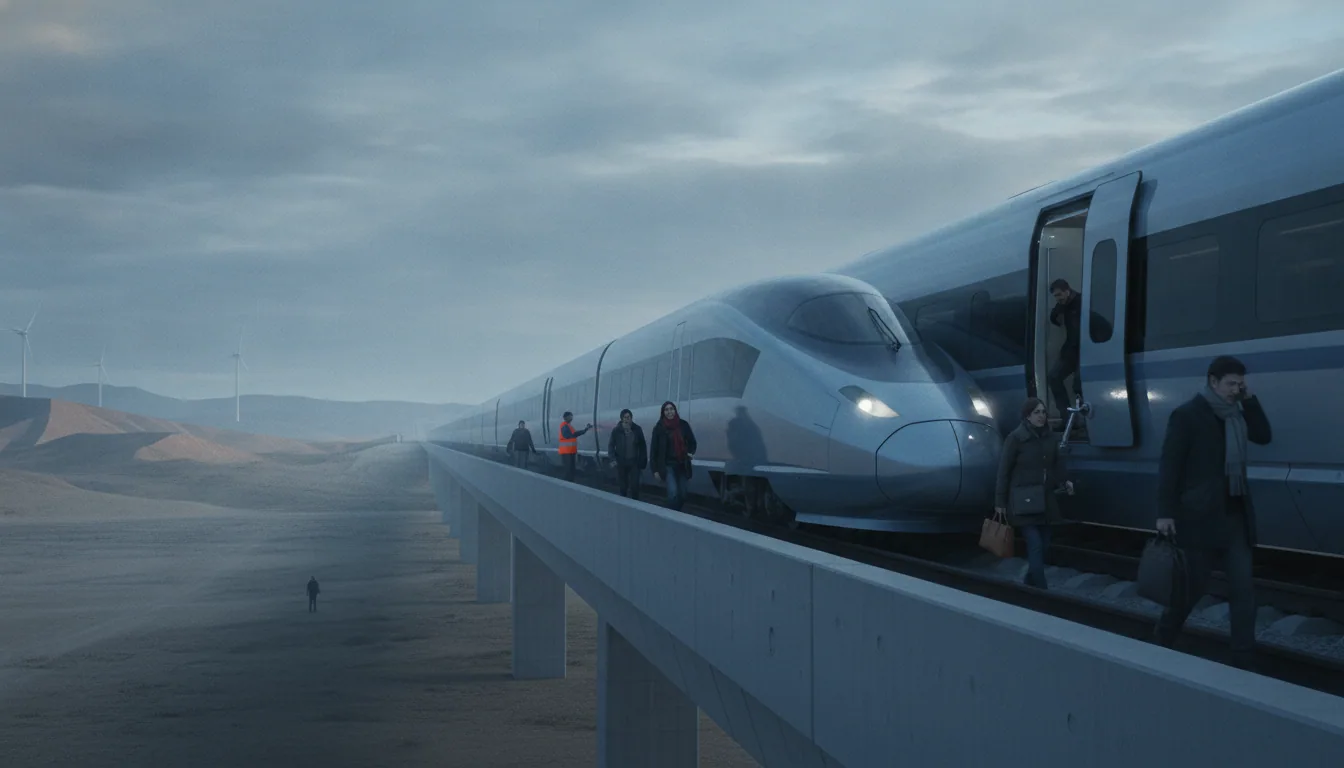
High-level technological automation meets the devastating friction of human cognitive limits. On the morning of October 28, a collision in the Spanish province of Toledo involving over 500 passengers exposed a critical flaw in the emerging paradigm of high-speed rail: the systemic fragility that occurs when 'fail-safe' digital protocols regress to manual operation. When a Renfe AVE high-speed train struck a stationary Iryo composition at 100 km/h, the resulting kinetic impact shattered more than just carbon-fiber hulls; it dismantled the institutional assumption that elite technology can entirely negate human error.
The Toledo Collision: Where Precision Meets Material Failure
One of the world’s most technologically sophisticated high-speed rail networks found itself suddenly paralyzed on October 28, rendered helpless by an intersection of systemic malfunction and the inherent variability of the human factor. At 9:15 AM in the province of Toledo, the collision served as a sobering reminder that peak automation does not equate to absolute safety if the system is forced to default to manual control. Near the town of Urda, a train operated by the state-owned Renfe collided with a stationary unit from the private operator Iryo, inflicting irreparable damage on both the physical infrastructure and the public’s sense of technological security.
This was not merely a physical catastrophe; it was a critical juncture where the technological potential of elite locomotives collided with deep-seated issues in infrastructure management. The kinetic energy was catastrophic, derailing at least two carriages and leaving a massive field of wreckage on the embankment. When an automatic signaling system fails, the operator is thrust into a decision-making void—a high-stakes environment where, in this instance, over 500 unsuspecting passengers were caught in the crossfire of a technological blackout.
The scale of the rescue operation required an immediate national response, including the deployment of the Military Emergencies Unit (UME). Urda’s mayor, Manuel Galan, was forced to mobilize the local sports hall as a logistical hub for the injured and those in shock. It has become increasingly clear that our current systems have reached a level of complexity that is becoming unmanageable for human operators during a crisis. If the interface between man and machine is not fundamentally redesigned, then we are merely waiting for the next systemic rupture. This necessitates a profound paradigm shift in how we calculate rail safety, moving away from a blind reliance on software toward a more resilient socio-economic blueprint.
The Automation Paradox: The Dangerous Regression to Manual Mode
In theory, the billions of euros invested in modern rail infrastructure should eliminate the unpredictability of human chance. However, the analysis by Spain’s Railway Accident Investigation Commission (CIAF) suggests that the disaster was precipitated by a human error during manual navigation, triggered by a primary signaling failure. This exposes the 'automation paradox': when top-tier technology fails, the burden of responsibility is shifted back to the individual, often in conditions where the individual is least equipped to handle it. This regression reveals the inherent fragility of our modern industrial behavior.
When the European Rail Traffic Management System (ERTMS/ETCS) ceases to function, operators are often forced to revert to the ASFA (Anuncio de Señales y Frenado Automático) mode—a technologically limited system. This is a high-risk regression. The inability of ASFA to automatically enforce speed limits was a central lesson of the 2013 Santiago de Compostela tragedy. Yet, over a decade later, this institutional security loophole remains unpatched. The retreat of automation creates a vacuum in the safety architecture that neither the state nor the private sector has successfully addressed.
In the immediate aftermath, the infrastructure manager Adif suspended all traffic on the strategic corridor between Madrid and Andalusia. This drastic measure reflects an institutional state of crisis. As the rail market liberalizes and private operators increase the density of traffic, the load on the existing physical and digital infrastructure is reaching a breaking point. Institutional control is wavering at the exact moment when traffic volume is projected to grow, creating a cross-border correlation between market expansion and systemic risk.
The ongoing CIAF investigation must now determine why the redundant systems failed and how two compositions ended up on the same track. This is not just a technical query; it is a legal analysis of the liability frameworks that govern a liberalized rail market. For the public to maintain faith in high-speed travel, there must be total transparency regarding how these systems interact. If national transport strategies are built on the 'black box' logic that automation is infallible, every systemic glitch becomes an existential threat. We must ask: is it responsible to expect a human to fill the void left by a software crash at these speeds? Future infrastructure must maintain safety independent of algorithms—a lesson that is particularly pertinent for the developers of Rail Baltic.
High-speed rail and direct human control are no longer compatible variables in the modern safety equation.
The Dark Pattern of 2026: A Systemic Fatigue
While the image of modern rail is one of unbreakable progress, the reality on the ground shows dangerous signs of fatigue. For the transport sector, 2026 is becoming a year of brutal lessons. The Toledo collision is the second major catastrophe on the Madrid-Andalusia line in just ten months. There is an emerging pattern where systemic failure is outpacing technological capability, suggesting that safety mechanisms are failing to keep pace with the increasing operational load.
Transport Minister Oscar Puente previously noted that a January tragedy was rooted in a rail breakage on a recently renovated section. If high-cost modernization and physical infrastructure failure are occurring in such close correlation, we must scrutinize whether construction quality has fallen below a critical safety threshold. The addition of private operators exerts a strain on existing materials that standard predictive models may not have accounted for. We are witnessing a rewriting of the old order, where infrastructure was built for state monopolies, not the high-frequency demands of a liberalized market.
This crisis is further exacerbated by an extreme uncertainty in the information landscape. Official reports have fluctuated wildly, with death toll estimates ranging from 10 confirmed victims to as many as 39. This systemic inability to manage high-pressure data in real-time points to a deeper crisis of trust in the operational communication chain. When the state cannot provide consistent data during a disaster, the social contract between the citizen and the infrastructure provider begins to erode.
The Legacy of Santiago de Compostela and the Dynamics of Responsibility
High-tech engineering promises us infallibility, yet it frequently collides with the cognitive limits of the individual. In the 2013 Santiago de Compostela disaster, 80 people lost their lives when the driver, Francisco Jose Garzon Amo, entered a curve at twice the allowed speed. That event proved that blaming the driver is often a political convenience rather than a systemic solution. It allows institutions to bypass the harder work of addressing architectural flaws in safety protocols.
In Spain, the memory of those mangled carriages is written in blood. The investigation into the 2013 crash confirmed that when an outdated system like ASFA provides only a warning signal rather than an intervention, human error becomes statistically inevitable in high-stress scenarios. Systemic architecture must not leave safety gaps that depend entirely on the sustained attention of a single human being. To do so is to design for failure.
The recent accident in Toledo proves that the painful lessons of a decade ago were only partially integrated. While billions of euros have been funneled into new technology, the transition to manual mode recreates the exact risk environment that led to the tragedy in Galicia. We are seeing a dangerous regression where the reliability of elite technology evaporates the moment a single technical fault occurs, leaving the operator and passengers in a precarious limbo.
Market Liberalization and Political Triage
Spain possesses one of the most liberalized rail markets in Europe, a model intended to drive efficiency. However, at the moment of a massacre, the line between private property and state responsibility becomes dangerously thin. While Iryo’s market entry was meant to end state monopolies, the October 28 collision physically forced these two corporate entities into a single pile of wreckage. Market logic was replaced in seconds by a state-led rescue operation, turning competition into a shared catastrophe.
Interestingly, the usual noise of pre-election campaigning was replaced by an ethical silence—a rare phenomenon in Spain’s polarized political landscape. Both Prime Minister Pedro Sanchez and opposition leader Alberto Nunez Feijoo suspended their campaign events to focus on the crisis. This tactical unity underscores the importance of institutional stability when a nation must function as a single unit during a technological breakdown.
Nevertheless, vocal criticism has shifted to the systemic level, with the government being accused of neglecting fundamental infrastructure maintenance. If Adif cannot guarantee safety in a liberalized market, technical failures quickly become fuel for populist narratives of national decline. A system is only as robust as its weakest link, especially when responsibility is diffused across multiple operators.
Lessons for European Corridors: The Estonian Context
The ambition of a unified European market often hits the hard reality of physical wear and technological discord. The collision in Toledo demonstrates that even on the continent’s most expensive tracks, catastrophic failure is possible. The opening of rail markets has led to a surge in traffic density, putting safety protocols under unprecedented pressure. This is a cross-border correlation that cannot be ignored.
In the Estonian context, the Spanish experience is a critical case study for the planning of Rail Baltic’s safety architecture and operating model. We are not just building a concrete track; we are creating a complex legal and technical ecosystem. Safety must be integrated at the procurement stage to prevent fragmented responsibility between various market participants during a crisis. We must move beyond the 'simple solution' of buying high-end tech and focus on the behavioral mapping of how that tech fails.
Estonian infrastructure developers must view the Spanish rail disaster not as a distant tragedy, but as a warning of systemic risk. Is Estonia prepared to enforce standards rigorous enough to manage increasing traffic loads and prevent technical errors from becoming statistics? Our future infrastructure must be resilient enough to maintain safety even when the algorithms fail. The question for our policy makers is strategic: how do we build a system where the failure of the 'new world' order doesn't result in a 'traditional' catastrophe?