The Lame-Duck Window: A Structural Mechanism, Not a Surprise
The Iran war warning now circulating through Gulf capitals is not improvised — it is the latest activation of a mechanism with a documented history. In January 1991, the first Bush administration launched Desert Storm three days after the Soviet Union's foreign ministry released a last-minute peace proposal that nobody in Washington was reading. The timing was not accidental.
The post-election window — the weeks between a popular verdict and the next Congress taking its seats — has always been where executive latitude quietly expands. That mechanism is operating again.
The Wall Street Journal reported this week that the United States formally warned Saudi Arabia, Qatar, and the UAE of a possible short, intense renewal of the Iran war following the November 3 midterms. The period between November 3 and the January 2027 seating of Congress has been identified as the most volatile stretch of the conflict. Electoral accountability shrinks to its narrowest point.
A president who has just survived or absorbed a midterm verdict has roughly ten weeks in which the next election is still abstract and the current one is already settled.
Trump said it plainly at a rally in Lubbock on October 27: "You'll see Iran in a couple of weeks." Read that as deliberate pressure, not a slip. The public statement directed at Gulf capitals carries the same function as moving twenty warships into range — it is part of the posture, not separate from it.
The 1973 comparison to Nixon using the Yom Kippur crisis as a pressure valve during Watergate is tempting but breaks almost immediately: Nixon was contracting, not expanding. What is not in dispute is the structure. The lame-duck window has produced consequential military decisions before, and every government in the region knows how to read a calendar.
What the Hardware Tells You
The USS George Washington is rearming in the Arabian Sea with bunker-buster bombs and long-range standoff missiles. That specific munition load is not routine. It is an admission.
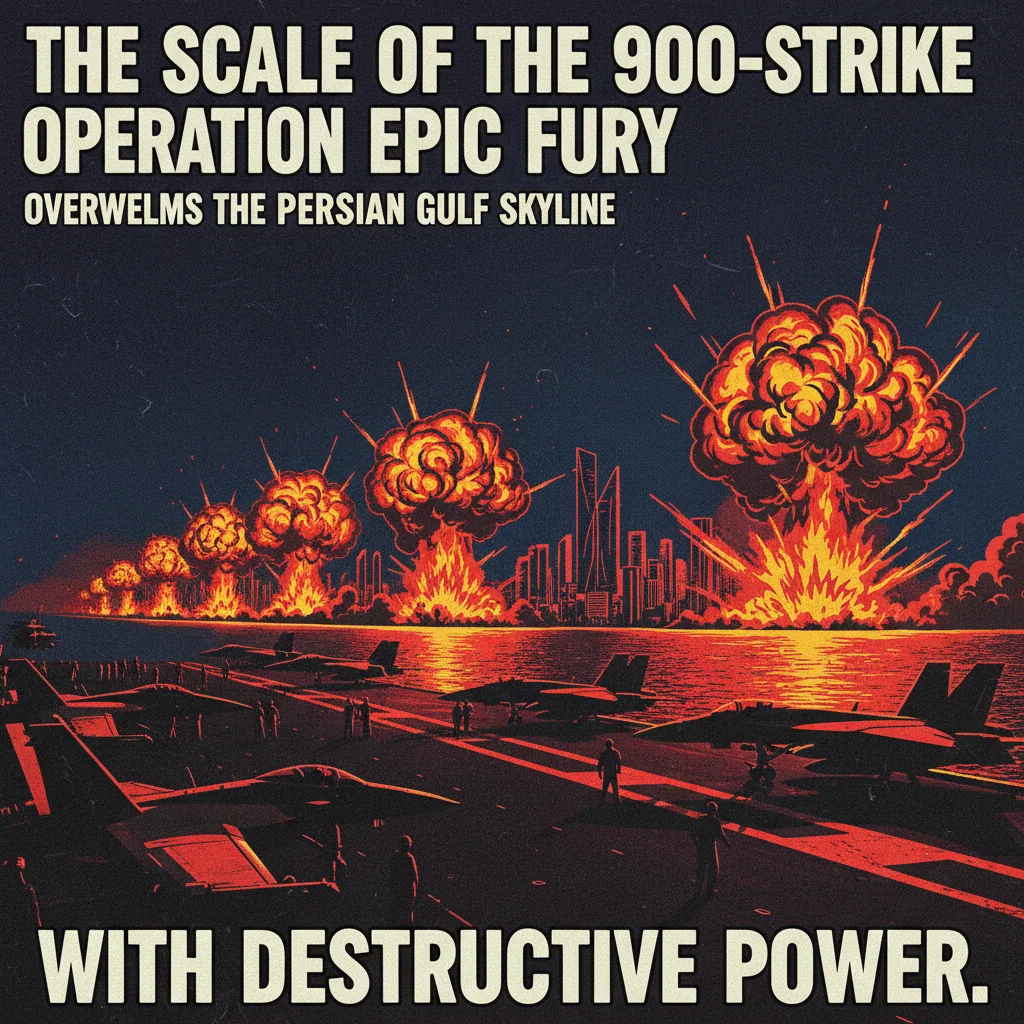
Operations Midnight Hammer and Epic Fury, executed from February 2026 onward, degraded Iranian enrichment capacity. Pickaxe Mountain remains the primary target on the strike list. The reload of penetrating ordnance on a carrier strike group is the Pentagon acknowledging, in the language of logistics, that previous strikes did not finish the job.
The readiness posture sharpens that picture. U.S. military units in the region are positioned to execute a major offensive within 96 hours of a presidential order, according to CNN. Twenty warships are in theater.
U.S. and Israeli military officials have conducted joint exercises over Iraqi airspace, specifically rehearsing the strike corridors and timing required for hardened underground targets.
The defensive movement is worth reading as carefully as the offensive one. The Pentagon has relocated a Patriot missile defense battery from Lubbock, Texas, to the Middle East. Defensive systems travel ahead of offensive ones — that is the sequence a planner follows when preparing an attack that will generate a response.
The Patriot battery is the bracket around the bunker-buster: you do not move it unless you expect something incoming.
Read the inventory as an argument: the standoff missiles extend the strike perimeter beyond Iranian air defenses, the bunker-busters address depth, the Patriot addresses retaliation. Each system answers a specific problem identified in the after-action reviews from the February strikes. Somewhere between those reviews and the current carrier manifest, a decision was made — not announced, not confirmed, but made visible in steel and ordnance moving across open water toward a known target.
That is the load-bearing wall. Everything else is moulding — pull it and nothing falls.
The Official Pretext Architecture: Assassination Plots and Empty Embassies
A DNI memo dated October 23 states that Iranian plots to assassinate U.S. officials have reached advanced stages. That is Jay Clayton's characterisation. What the public record shows is the claim itself, not the evidence behind it — the specific targets named, the operational cells identified, the intercepts grounding the phrase "advanced stages."
The gap between the two is the space where pretext is manufactured or confirmed, and the public cannot yet tell which.
The State Department's order departing nonessential personnel from Riyadh, Jeddah, and Dhahran is a different category of signal. It is bureaucratic, procedural, and nearly without exception precedes kinetic action. Embassies do not thin out for diplomatic negotiations.
The sequence is standard and its meaning is not ambiguous: someone in Washington has decided that the next step carries a probability high enough to justify the drawdown cost.
The architecture of an official pretext follows a recognisable sequence: an intelligence claim licenses the threat condition; the threat condition triggers the personnel order; the personnel order becomes the public-facing evidence that action is justified. Each step is real. Each step also does work that the underlying evidence may or may not support.
The DNI claim may be entirely accurate. It may also be doing the work that the WMD dossier did in 2002 — not fabricated, not confirmed, and structurally necessary. The practical question is which it is, and the answer is not yet in the available record.
If the answer does not come before the polls close, the evidence forces a single conclusion: the decision has already been made, and the paperwork is following.
The Ledger: $47 Billion, Four Dollars a Gallon, and the Midterm Arithmetic
Consider a number that does not appear on any readiness briefing: $4.07, the average American price for a gallon of regular gasoline in July 2026, a figure that had not dropped below four dollars since June. Wars in the Gulf have a habit of announcing themselves at the pump before they announce themselves in the headlines. This one was no different.
The total bill for eight months of operations — strikes, logistics, carrier rotations, munitions replaced and munitions expended — had passed $47 billion by October. That is not a rounding error; it is roughly the annual GDP of Estonia or Bolivia, spent in less than a year on a campaign the administration has not yet formally named as a war.
The money is real. The pain at the forecourt is real.
What changed on November 3 is not the cost. It is who bears the political weight of it. A president facing a midterm electorate on a day when gasoline averages above four dollars is a president with a constraint.
A president the morning after that electorate has voted is a president without one. The lame-duck window does not reduce the $47 billion already spent; it removes the mechanism by which the voter signals, in the most direct way available to her, that she has noticed. The arithmetic of exposure shifts overnight. The ledger stays open.
The Mecca Pact and the Borderland Question
On October 26, senior officials from Saudi Arabia, Turkey, and Pakistan met in Tehran under the Mecca Pact — three governments that Washington has spent decades treating as allies, opening a direct channel to the government Washington is preparing to bomb. That is not defection. It is the oldest hedging manoeuvre in the small-nation repertoire: when a great power's war moves toward your infrastructure, you talk to both sides and call it mediation.
Pezeshkian offered the regional frame himself, stating that the Middle East can solve its own issues without U.S. involvement. The sovereignty claim is a negotiating posture, not a strategic reality — but it is the posture Tehran must maintain to give the Mecca Pact countries something to carry home. The gap between the communiqué and the map is where the real bargaining sits.
The map is messy. Saudi Arabia conducted strikes on Houthi oil storage in Yemen on October 13, two weeks before its delegation landed in Tehran — a reminder that Riyadh is running its own war-within-a-war, and that its mediation offer coexists with active military operations in the same theatre.
The historical comparison to the Gulf states' 1990 alignment is tempting and wrong: then the threat was conventional and Iraqi; now it is nuclear, dispersed, and aimed at civilian infrastructure. Iran has threatened to target Israeli desalination and power plants if a new offensive begins — that is not a battlefield threat, it is an address to a population.
The Strait of Hormuz proposal, conditioning reopening on a seven-day plan presented to Washington, is the one lever Tehran still holds that costs everyone the same regardless of alliance. The Mecca Pact nations know this. That is why they flew to Tehran and not to Washington.
The Marker to Watch: Iran's Strike Window Closes November 3
Iran's seven-day Strait of Hormuz proposal now sits, unanswered, somewhere in the State Department's in-tray. That single administrative silence is the most consequential data point in the current file. Washington can respond, ignore, or counter-propose; each answer recalibrates the November-to-January window differently.
A formal counter-proposal extends the diplomatic clock. Silence, or rejection, removes the last structural argument against action before the new Congress is seated in January 2027.
Abbas Araghchi has stated that Iranian retaliation would reach "beyond the enemy's imagination." Deterrent language of that register works only if Tehran believes the strike is not already decided. If SOFT-16 is accurate and Trump is leaning toward a large-scale attack without a final order, then Araghchi's warning is aimed at a decision still in motion — that is the one condition under which it might function.
What remains unknown is whether Washington reads the seven-day plan as a negotiating entry point or a stalling tactic. Watch the State Department's response, or the shape of its silence, by November 3 — the effective deadline of this Iran war warning. If the answer does not come before the polls close, the evidence forces a single conclusion: the decision has already been made, and the paperwork is following.