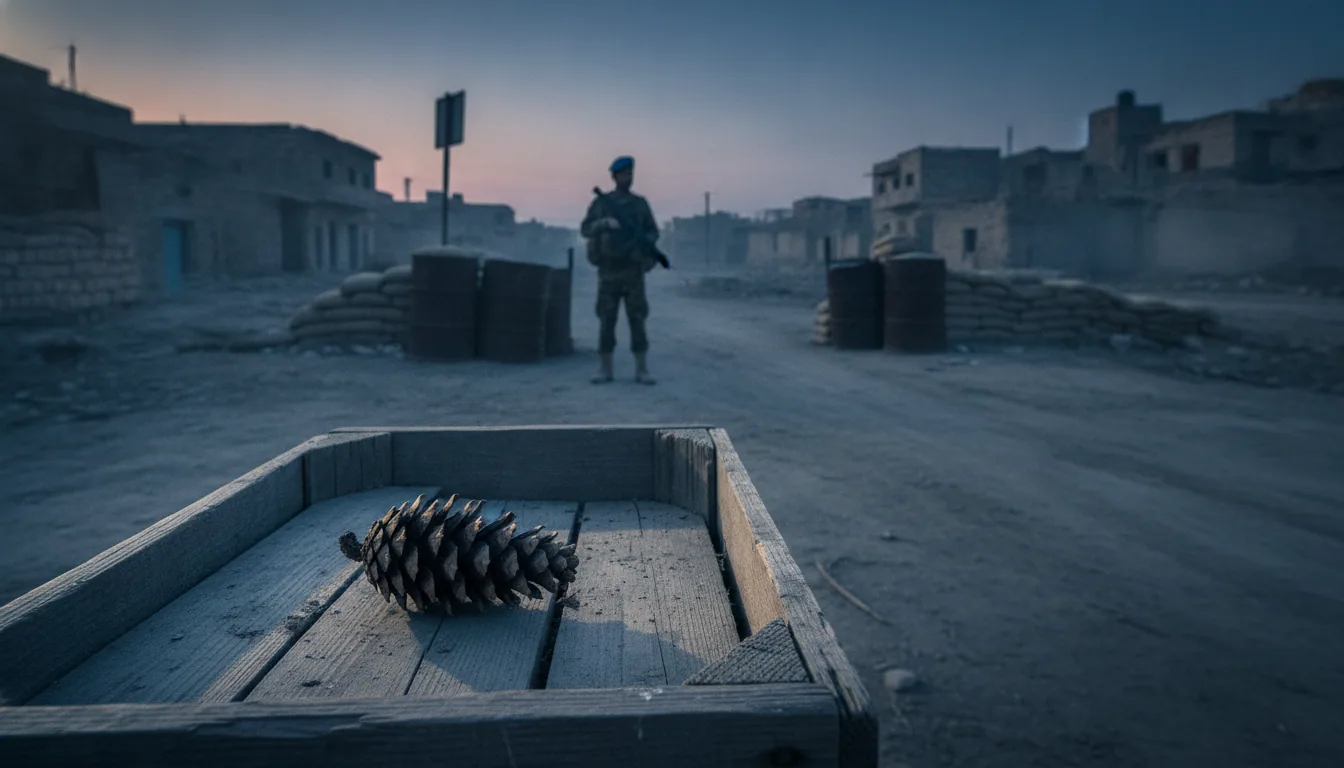
A Bargain Made in 1948, Payable on Demand in 2024
The roots of Israel's conscription crisis run to the spring of 1948, when David Ben-Gurion struck a deal with the leaders of a community that had survived the European catastrophe with its seminaries and its suspicion of secular authority largely intact. The arrangement was provisional: a few hundred Haredi scholars would be deferred from conscription while the new state found its footing. Provisional arrangements, in the right political climate, have a way of calcifying into permanent furniture.
For nearly eight decades that furniture stood. Governments fell, wars were fought on multiple fronts, and the deferment regime expanded steadily alongside the Haredi population — not because any parliament voted to make it permanent, but because no coalition could survive without the parties who demanded it. The legal scaffolding was always thin. Everyone in the building knew it.
On June 25, 2024, the Israeli Supreme Court said so, unanimously. There was no legal basis, the justices held, for the blanket exemption. Not a procedural deficiency, not a technical gap — no basis. The ruling did not create a crisis; it named one that had been accumulating since the founding. That distinction matters enormously for understanding what Benjamin Netanyahu is now managing, because the problem on his desk in October 2026 is not a judicial surprise. It is a deferred debt come due, with compound interest.
Ask the small question first: who absorbed the cost of the deferral across eight decades, and who is being asked to absorb it now? The answer has not changed. It has only become harder to print in a communiqué.
Israel's Conscription Crisis Is Not a Policy Failure — It Is a Structural Outcome
By September 8, 2026, the IDF had 67,230 Haredi men on its registers as draft dodgers or refusers. That figure represents roughly 80 percent of the 110,000 individuals currently failing to report for duty. These are not marginal rounding errors in a large conscript army — they are the arithmetic consequence of a founding bargain described in the previous section, compounded annually for nearly eight decades.
The IDF reported a shortfall of 12,000 troops in May 2026, a number projected to reach 17,000 by January 2027. Both figures were generated under active multi-front operational pressure, not the comfortable abstraction of peacetime planning. The burden falls disproportionately on secular and national-religious reservists who are being cycled back into service precisely because the eligible pool has a structural hole in it.
Yoav Gallant's departure from the Defence Ministry is the clearest single piece of evidence that the military logic and the political logic no longer occupy the same building. Gallant insisted, on the record, that manpower needs required a broader draft. The coalition could not survive that insistence and survive simultaneously. So Gallant went. The shortage did not.
Ask the small question first: who is the borderland here, and who is the empire? The answer, inside Israel's own political geography, is the IDF and the secular reservist — the people absorbing the operational cost of a bargain they were never party to. The 65 percent year-on-year increase in Haredi enlistment, from 2,811 in 2024 to 4,298 in 2025, is real. Against a projected gap of 17,000, it is also insufficient by any arithmetic that is not political.
The Court Closes the Exits, One Ruling at a Time
Netanyahu's coalition had one legislative valve left: an amendment that froze arrest and enforcement proceedings against Haredi draft evaders, relieving coalition pressure without resolving anything. In September 2026, the Supreme Court struck it down. The exit was closed.
The Court did not stop there. It ordered the cessation of state subsidies to yeshivas whose students refuse to comply with draft orders, converting a legal dispute into a direct funding cut. This is not a procedural nudge. Yeshiva funding is the material infrastructure of the Haredi community's entire arrangement with the state, and the Court has now made continued non-compliance expensive in a way that the Knesset cannot quietly reverse with a budget line.
Then came the Attorney General. In October 2026, Gali Baharav-Miara placed on the public record her finding that the government lacks a "coherent policy" on draft implementation. That phrase sounds bureaucratic. It is not. When a state's own chief legal officer formally disowns the executive's conduct, she is not filing a complaint — she is building a record. Courts read records. Future rulings will cite this one.
What the three moves add up to is a systematic closure of the spaces Netanyahu had used to hold the coalition together without deciding anything. The frozen enforcement amendment bought time; gone. The subsidy channel absorbed Haredi political costs; cut. The Attorney General's public finding strips the government of the claim that its inaction was a considered policy choice rather than a failure of governance. Each ruling removes one more instrument Netanyahu could use to tell his Haredi partners that protection was still possible. The arithmetic, not the rhetoric, is what has changed.
Netanyahu's Coalition Arithmetic and the Corner It Built
On the morning of October 20, 2026, military police arrested at least forty Haredi men at Ben Gurion Airport — men stopped at departure gates, bags in hand, on their way out of the country while registered as draft evaders. The images were stark and unambiguous. Netanyahu responded the same day, calling the arrests a "deliberate attempt to harm recruitment."
A prime minister had publicly condemned his own enforcement apparatus, two weeks before a national election.
Read that sentence once more without softening it. The enforcement apparatus was his government's; the policy it was executing was the Supreme Court's mandate; the criticism was for following it.
The corner had been built over years. Shas leader Aryeh Deri stated flatly that his party would not support any future government unless yeshiva student exemptions were legally protected. That condition was now, after the court's September 2026 ruling striking down the enforcement freeze, practically unsatisfiable by ordinary legislation. Deri was not demanding the impossible as a provocation; he was simply describing what his constituency required.
The Knesset had tried one more door. In July 2026 it gave preliminary approval to the Torah Study Bill, which would designate religious study a constitutional value — designed, transparently, to pre-empt judicial review of any future exemption scheme. Whether the court will accept that framing remains undecided. The bill is a structural bet: that a constitutional designation can hold where every ordinary statute has collapsed. Courts in comparable democracies have not been generous with that bet, and Israel's court has shown, repeatedly, that it knows the difference between a load-bearing wall and a coat of paint.
The Street, the Spreadsheet, and the 65 Percent
In October 2026, Haredi protesters blocked the Yavne Interchange and rallied outside military prisons. The road blockades were not spontaneous. They were organised civil pressure, the kind that signals a community has concluded that parliamentary negotiation is not working.
Against that image, set the spreadsheet. Haredi enlistment rose 65 percent year-on-year, from 2,811 in 2024 to 4,298 in 2025. That number is real, and it is simultaneously an argument for two irreconcilable positions: incrementalists cite it as proof that integration, handled carefully, moves forward; critics note that 4,298 against 67,230 registered dodgers is not a solution, it is a rounding error.
The comparison between these two data points — the street and the figure — is exactly the space Netanyahu is trying to govern. Each number is genuine. Each one is also a weapon in someone else's hand. The 65 percent rise gives the coalition a defensible answer when secular reservists ask why yeshiva students are still at home; the raw gap between 4,298 and 67,230 gives the Supreme Court, the opposition, and the street their counter-answer.
History offers no tidy parallel here. The Northern Ireland analogy — gradual civic integration buying political time — breaks immediately against the arithmetic: Belfast's figures were never this lopsided, and no Belfast faction was simultaneously blocking a motorway and supplying four thousand recruits. Netanyahu has one number to show as progress and another that erases it.
Watch October 27 — and One Word After That
The election on October 27, 2026 is the immediate reckoning. Whether Netanyahu's coalition survives or falls will determine who holds the mandate to resolve the conscription question — or to defer it again, which is the more historically probable outcome. Every Israeli government since 1948 has found a reason to defer it.
The structural deadline, however, belongs to no politician. The IDF reported a shortfall of 12,000 troops in May 2026; the projection for January 2027 is 17,000. Armies do not pause for coalition arithmetic. That number will arrive regardless of what the ballot returns.
The marker beyond the election is the Torah Study Bill's final text, and one word in it. If the bill says religious study shall be protected from conscription, someone has won a constitutional argument — one the Supreme Court may yet unmake, but won nonetheless. If it says should, the deferral continues, and this crisis will be back on your screen before the winter is out. The distinction between those two words is the entire argument in miniature: obligation versus aspiration, law versus gesture.
Sixty-seven thousand draft-classified men, a shrinking army, and a court that has already ruled once — Israel's conscription crisis does not pause for coalition arithmetic. Read the bill's operative verb. That is the sentence that carries the weight.