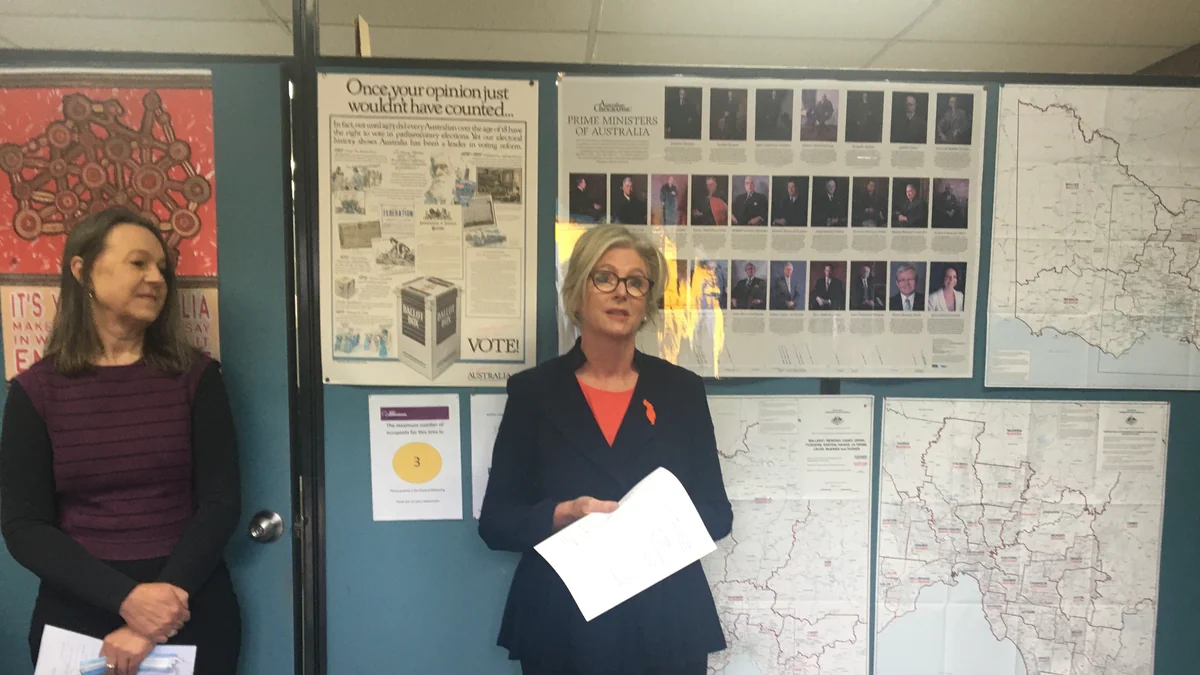
The Helen Haines attack occurred on 19 October 2026, when the Independent Federal Member for Indi was struck twice by a vehicle outside her Wangaratta electorate office. The driver, Brendan Nugent, 43, was apprehended at the scene by a bystander. Haines was airlifted to The Alfred in Melbourne in critical condition; surgeons amputated one leg.
Murphy Street, 3:35 p.m.: What the Record Shows
The Sarajevo comparison is tempting and wrong. In June 1914, the mechanism was a cavalcade, a missed turn, a pistol drawn in an open street. What happened to Helen Haines on Murphy Street, Wangaratta, on the afternoon of 19 October 2026 was different in every structural particular - and precisely that difference is worth holding before the analysis begins.
Dr. Helen Haines, Independent Federal Member for Indi, was at the trunk of her car outside her regional electorate office. The hour was ordinary. The errand was ordinary.
Then a white Toyota LandCruiser performed a U-turn - Prime Minister Albanese's word, confirmed publicly, used here because it forecloses the accident reading before it starts - and struck her twice. She was airlifted to The Alfred hospital in Melbourne in critical condition. Surgeons amputated one leg.
Brendan Nugent, 43, of Tarrawingee, was apprehended at the scene. Not by police. By a bystander, unnamed in every account, who held him until authorities arrived.
That single fact - the institutional gap it reveals - belongs in the ledger alongside everything else.
A knife was recovered from Nugent's vehicle. It was not used. That detail sharpens rather than resolves the picture: a weapon carried but withheld, or a weapon carried for a purpose the vehicle itself made unnecessary.
The investigation has not yet answered that question, and any analyst who claims otherwise is working ahead of the record.
What the record shows, stripped to its structure, is this: a deliberate act, a public official in a public place, and a mechanism - two impacts from a turning vehicle - that required forethought. The motive remains formally undetermined. Everything after this point is inference, and inference should be labelled as such.
The Investigation and Its Architecture
Three agencies, two questions. Victoria Police's Security Investigation Unit and the Victoria Joint Counter Terrorism Team are jointly leading the inquiry into motive and political context, while the Major Collision Investigation Unit handles the criminal mechanics - the geometry of the U-turn, the force of the impact, the knife recovered from the vehicle and not used. The division of labour is deliberate.
It reflects an understanding that what happened on Murphy Street was simultaneously a road crime and a potential act of politically motivated violence, and that treating it as only one of those would misread the architecture of the event.
AFP Commissioner Krissy Barrett named the potential charge quickly: causing harm to a Commonwealth public official, carrying a maximum of ten years. The naming matters. That provision exists precisely to elevate attacks on officeholders above ordinary assault, encoding in statute the principle that a blow against a representative carries a different weight than a blow against a private citizen.
Whether the facts sustain it will be for the courts. What Barrett's framing established on day one is the investigative register - this is not a traffic matter with political adjacency.
Barrett also characterised the incident as isolated, with no known ongoing threats. That statement functions as a working hypothesis, not a verdict. The investigators themselves would say no less at this stage.
Brendan Nugent, 43, of Tarrawingee, was interviewed with the assistance of the Major Collision Investigation Unit - the mechanics question and the motive question run in parallel, not in sequence. How they converge will determine whether "isolated" holds.
The Political Radicalization Hypothesis and the Friendship That Complicates It
The suspect's father called it "devastating and unfathomable." He also offered one detail that does not fit the standard template: the Haines and Nugent families have known each other for over twenty years. That is not the profile of a radicalized stranger who fixated on a symbol.
It is something harder to categorize, and therefore harder to use.
One source - the Daily Mail, which is worth naming precisely because it is - describes Nugent as a radical anti-Israel climate campaigner. The label is soft, the sourcing is thin, and the characterization should be held loosely. No manifesto has entered the public record.
No statement from the suspect has been released. What investigators are working with, at this stage, is a pattern of reported grievances and a vehicle that made a deliberate U-turn.
Stochastic radicalization as a category is useful here, up to a point. It describes how known grievances - political, ideological, personal - can incubate over time in a person who consumes an increasingly extreme information diet, until some threshold, unannounced and invisible to observers, breaks. The framework fits many lone-actor cases.
What it cannot explain is the specific trigger, and in this case that trigger remains unknown.
The friendship detail matters, but not as exculpation. Long acquaintance between two families does not preclude grievance; it can, in some profiles, sharpen it. A stranger projects an ideology onto a symbol.
Someone who knows the target has a different relationship to the act. Whether Nugent falls into the first category, the second, or something the existing taxonomy does not cleanly cover - that is the question investigators have not yet answered publicly, and the answer will determine whether what happened on Murphy Street is understood correctly or filed under a convenient label.
The Numbers That Were Already on the Table
Someone had already done the counting. In the 2025-26 financial year, 1,067 harassment and threat reports were filed against federal politicians. The year before, the figure was 951.
A ten percent rise, documented, filed, forwarded to the relevant desks.
Forty-one individuals had been charged with offences involving threats to high office holders since October 2025 alone. That number sat in a briefing somewhere. It was not a secret.
Home Affairs Minister Tony Burke had the figures; the BBC had the figures; anyone who wanted the figures had the figures.
In October 2025, the AFP established National Security Investigations Teams specifically to address politically motivated violence. The institutional architecture, in other words, preceded the attack on Helen Haines by exactly twelve months. The apparatus was built.
It was running.
What happened on Murphy Street at 3:35 p.m. is therefore not a story about the absence of data. The data was present. A white LandCruiser performed a U-turn on a regional street and struck a member of parliament twice, and somewhere a spreadsheet was quietly updated.
This is the gap that matters: between a documented, measurable escalation and the single act that the apparatus, for all its new architecture, did not stop.
That gap is not unusual. It is the permanent condition of threat assessment against lone actors, where the signal and the noise occupy the same column and no algorithm distinguishes them cleanly.
The ten percent rise told us the environment was worsening. It could not tell us which of the 1,067 reports was the one to watch.
The Open Door and What It Cost
The electorate office on Murphy Street was not an accident of architecture. Regional offices are built to be found - on ordinary streets, with ordinary doors, staffed by one or two people who know their constituents by name. That accessibility is the product of a theory of representation: that democracy in a dispersed rural electorate depends on physical proximity, on the MP reachable by anyone who walks in off the pavement.
The security argument against this model is old and has never won the argument, because the democratic cost of winning it is obvious. A locked door is also a message. In Indi, where Helen Haines built her political practice on the idea that an independent without a party machine must compensate with presence, the open office was not incidental to the model - it was the model.
October 19 has now resolved the tension badly, in one direction. The BBC reported that MP offices have begun locking doors and scanning crowds since the attack; the informal security culture that assumed good faith is hardening overnight into something more defensive. The shift is understandable.
It is also a cost, and the cost falls unevenly.
Large-party MPs in capital cities absorb new protocols without structural damage. For a regional independent whose mandate rests on being reachable, the calculus is different. The constituent who once walked in with a land-use grievance or a Medicare problem now meets a locked door and a scanning eye.
That is not a minor administrative adjustment. It is a change in what the office is for - and who bears that change did not choose it.
The Marker to Watch
Watch the charge formulation. AFP Commissioner Krissy Barrett has named "causing harm to a Commonwealth public official" as the likely vehicle, a provision carrying a ten-year maximum. That framing is prosecutorially narrower than a politically motivated violence designation, and the gap between those two descriptions is not semantic.
If prosecutors fold the Victoria Joint Counter Terrorism Team's findings into the charge sheet and pursue a PMV framing, the state has formally decided this was an attack on a function, not merely a person. Every open-door regional office in the country then operates under a different threat calculus.
The counter-terrorism finding on motive is the second indicator. The Daily Mail's "radical anti-Israel climate campaigner" tag is sourced softly and sits unverified against the suspect's father's account of a 20-year family friendship. A manifesto or communications trail establishing ideological targeting would resolve that contradiction.
Without it, the political radicalization hypothesis remains probable but unconfirmed, and the policy response to 1,067 annual threat reports rests on a foundation that has not yet been fully examined.
The small-nation question inside the larger story is simpler. Indi has one representative. She is at The Alfred without a prognosis on record.
Watch whether her electorate is formally represented in the interim, and how long that takes. That interval, more than any security review, will tell us whether the institution understood what the Helen Haines attack on Murphy Street was actually about.