An Island, 161 Crews, and a Championship That Ends Here
Picture a Baltic island of roughly 40,000 people. One weekend each autumn, 322 of them - plus visitors from as far away as Japan - arrive to drive very fast on its gravel roads, and whoever survives the weekend wins the whole Estonian rally year. That is not a local quirk. That is how a national championship actually works.
The 59th Saaremaa Rally, running October 9 and 10, 2026, is the sixth and final round of the Terminal Estonian Rally Championship. Not a penultimate round, not a points-trim formality. The title fight ends here, on this island, in the limestone-road dust. One hundred and sixty-one crews from seven countries have registered, stretching the competitor list from Finland down to Japan. The logistics alone are striking: Saaremaa's roads will carry a field that spans half the globe.
Here is the strange part. One in four of those 161 crews is from Saaremaa itself. Twenty-five percent. A quarter of a multi-national championship field lives on the very island hosting the final round. That kind of local density does not happen by accident. It tells you something about how deep motorsport runs in the island's culture, the kind of thing you build in generations rather than grant applications.
The opening act arrived the evening before the main competition. At 20:25 on October 9, the Kuressaare City stage - SS3 in the official sequence - lit up the administrative centre of the island under floodlights. Spectacle first, stopwatches second. The championship itself would have to wait one more night.
The Invisible Architecture: How Saaremaa Rally 2026 Tracks Every Car in Real Time
Consider the logistical weight hiding inside a number: 161 crews, 322 people, seven nations, one island, two days. Every one of those vehicles must be located, timed, and tracked continuously across 115 competitive kilometres of gravel and asphalt. That is not a scheduling problem. It is a distributed sensing problem, and the organisers of the 59th Saaremaa Rally are treating it as such.
The event's stated technological centrepiece is "support for further development of the timing system" - a phrase that sounds administrative until you understand what it actually means. The backbone is RallyLynx, a platform that provides real-time GPS positioning and live timing for all 161 vehicles simultaneously. Think of it as a live state vector for the entire event: not a periodic snapshot, but a continuous feed of where each car is, how fast it got there, and what the gap to the next car looks like at this exact second.
Layered on top of that tracking infrastructure is Rallirahvas.ee, a single integrated app consolidating what used to require a physical stack of papers: maps, schedules, results, official documents, all in one place. The old approach - printed bulletins posted to a physical notice board, updated as conditions changed - has been replaced by a Virtual Notice Board pushing official communications digitally. No paper, no delay, no crew member missing a revised stage cut-off time because they arrived at the board five minutes late.
The spectator layer completes the system. The RallyPin App routes fans to designated safe viewing points in real time, which matters considerably when the cars outside those points are travelling at 200 km/h, covering 55 metres every single second. Each of these tools - RallyLynx, Rallirahvas.ee, the Virtual Notice Board, RallyPin - is a separate technical solution. Together, they form something more interesting: a fully instrumented event, aware of itself from the start ramp to the grandstand rail.
Fifty-Five Metres: The Number That Explains Everything
At 200 kilometres per hour, a car covers 55 metres in one second. Not in a blink - in the time it takes you to read "fifty-five metres." That single safety figure, published on the official rally site, is the quiet justification for everything: why timing must be precise to the millisecond, why GPS positions update in real time, why the entire digital infrastructure exists at all. The physics don't negotiate.
Now hold that number against the route. The 59th Saaremaa Rally spans 491.10 kilometres of total distance, of which only 115.09 kilometres are actual competitive special stages. That means roughly 376 kilometres are liaison roads, service transfers, and the grinding logistics of moving 161 crews across an island between each timed burst. The spectacle you see is the tip; the iceberg underneath is organisational.
The surface of that iceberg is mostly gravel - 86% of it, with just 14% asphalt. That ratio matters technically. Gravel is unpredictable: grip shifts with moisture, loose stone accumulates at corners, and the line that was fastest on stage one may be treacherous on stage two. Predictive data, then, becomes more valuable here than on a sealed circuit, not less. A timing system that tracks position and split times in real time gives crews and engineers something to think with, not just a leaderboard to read.
The public-facing layer of that same infrastructure is EAL TV, which broadcasts live from the start and finish podiums and covers specific stages - Karala (SS4) among them. The broadcast and the telemetry run on the same logic: information that arrives after the moment is just history.
Information that arrives after the moment is just history.
Factory Floor vs. Garage Floor: The Full Spectrum of Rally Engineering
Open the bonnet of Karl Jalakas's 2004 BMW and you encounter a philosophy. Every single component has been replaced, rebuilt, or reinvented - every component except the taillights, which glow at the back of the car like the last signatures of a previous life. The car shares a birth certificate with a factory saloon and almost nothing else. It is a thought experiment on wheels: at what point does a ship of Theseus become something entirely new, and is that new thing better?
That question runs all the way up the entry list. In the Proto class, Egon Kaur pilots a Ford Fiesta KMS Proto, a car designed and built by Estonian engineers specifically for competition. No manufacturer specification sheet exists for it. The engineers who made it also had to imagine it first. That is a different kind of problem-solving than following a manual, and Saaremaa's gravel stages are where the answer gets graded.
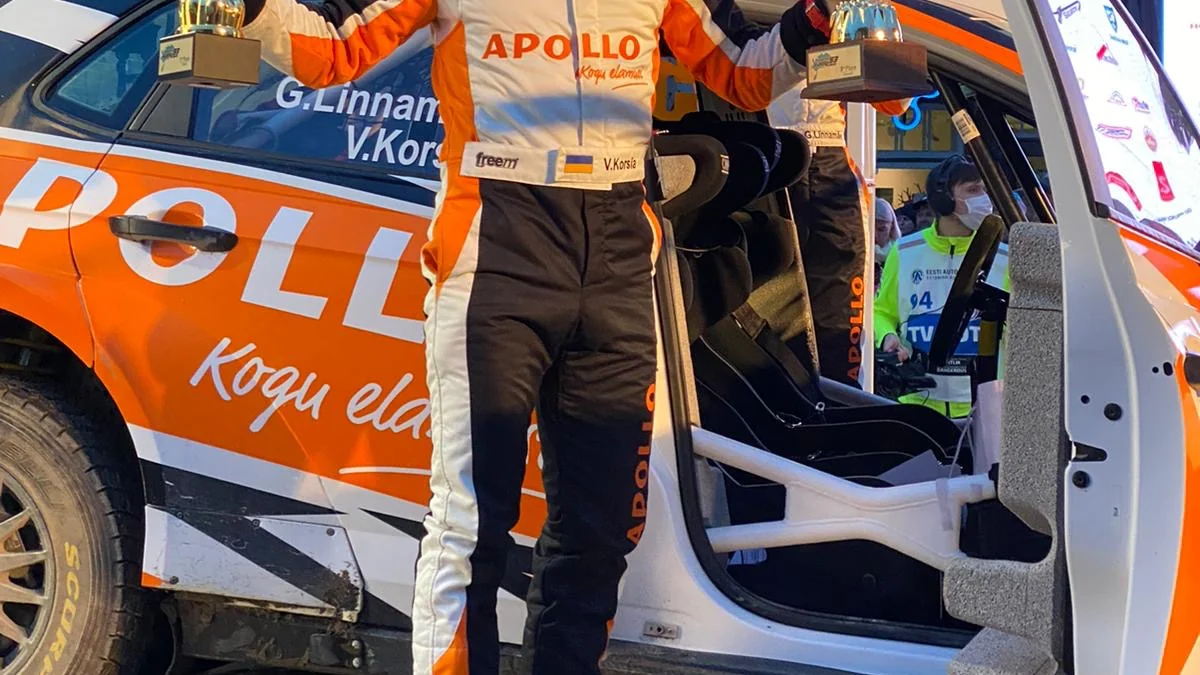
Then there is the other end of the spectrum. Karl Martin Volver and co-driver Annika Sõna led the rally after the first day in a Škoda Fabia RS Rally2, a car produced to exacting FIA homologation standards in a factory built for exactly this purpose. Volver noted the day was "quite okay," though a brush with a kerb on the town stage gave him something to think about overnight. Factory precision, human imprecision, the gap closed by experience.
And somewhere between garage philosophy and factory certainty sits the Toyota Gazoo Racing youth pipeline, which placed Hiroya Minowa and Juho Koski-Lammi on these same Saaremaa stages. Toyota's global development programme scouts young drivers across continents and drops them into exactly these regional championship rounds to learn under pressure. An island rally finishes a national championship and simultaneously auditions talent for a world stage. Not bad for a weekend on a small Baltic island.
The Robot in the Co-Driver's Seat: When Rally Data Meets World Models
While cars were throwing gravel across Saaremaa this October, a different competition was running in parallel: the AgiBot World Challenge 2026, whose stated problem is robotic world models and action-faithful prediction. The coincidence is almost too neat. Both fields are wrestling with the same core difficulty - how do you build a system that predicts what happens next in a physical environment that refuses to behave like a controlled laboratory?
The structural echo is genuine. RallyLynx's predictive timing logic must infer a car's position and trajectory from sparse GPS pulses and historical stage data, then commit to a number in near real-time. Robotics researchers call the equivalent challenge zero-shot transfer: training a model on known terrain, then deploying it somewhere the system has never seen. Both problems hinge on the gap between what the model learned and what the world actually does.
Gravel is the honest adversary here. Eighty-six percent of Saaremaa's competitive surface is loose stone, and no two passes over the same stretch are identical - a rut deepens, a rock migrates, grip changes by the run. That irreducible unpredictability is exactly the domain gap that humbles autonomous systems in robotics research.
The honest caveat is this: parallel does not mean convergent. Rally telemetry and robotic world models may be rhyming from a distance rather than genuinely merging. But the rhyme is close enough to be worth listening to carefully.
What Saaremaa Still Doesn't Know - and Why That's the Best Part
The technical architecture of the RallyLynx timing system remains unpublished. The engineers who built it know what it does; the rest of us can measure the outputs but not the interior. That is not a failure of transparency. The experiment is still running.
This matters because the real question is scalability. Can infrastructure stress-tested across 115.09 km of Baltic gravel and asphalt, serving 161 crews from seven countries, transfer cleanly to a larger FIA international calendar event? The variables compound quickly: more stages, more officials, more broadcast feeds, more languages, more jurisdictions. A Baltic island, small enough to manage and complex enough to break things, is exactly the right place to find out. Nobody knows the answer yet.
There is a quieter unknown too. The EMV classes, which channel Estonian talent directly into the championship, have not seen a fully electric or hybrid entry in 2026. Whether that changes next year is an open question - one that depends on battery weight, range math across gravel stages, and whether homologated hardware arrives in time.
Every era of science, and of engineering, has believed the hard problems were nearly solved. They were always wrong in the best possible way. Saaremaa Rally 2026 has been running for 59 editions and it is still generating unanswered questions. That is not a sign the work is incomplete. That is the sign of a living laboratory.