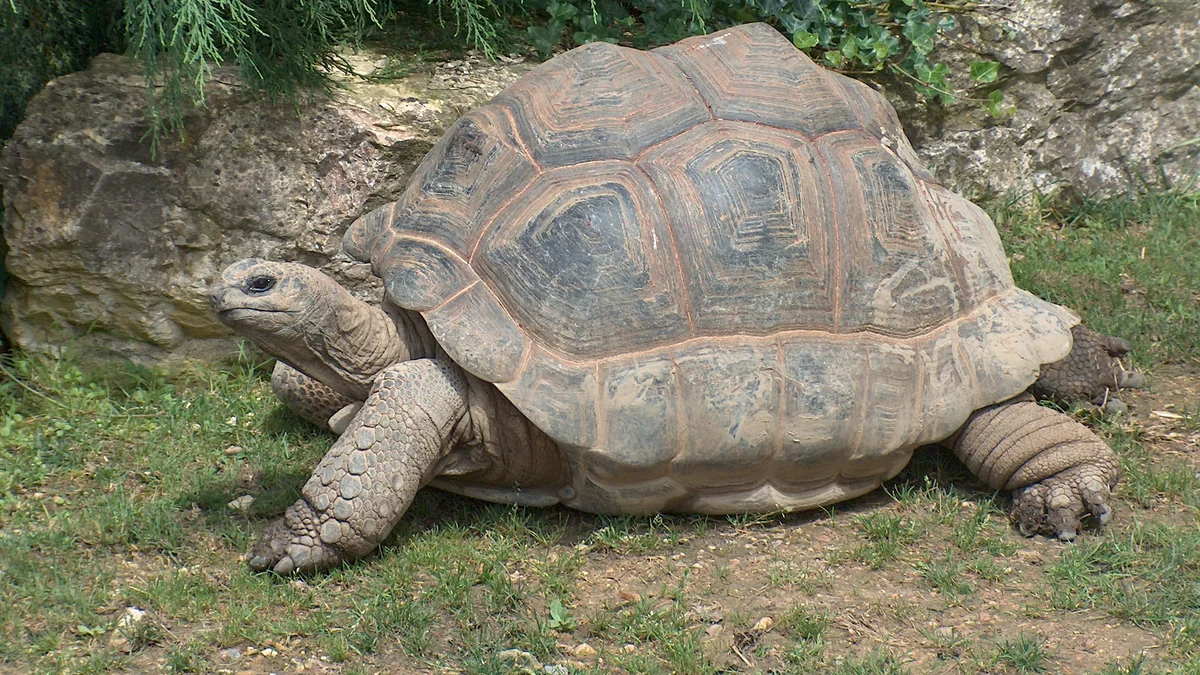
A Number That Shouldn't Be Possible
Start with the low point, because the Aldabra giant tortoise's high point only makes sense from there. In the nineteenth century, sailors and traders moving through the Indian Ocean had found a convenient solution to one of seafaring's oldest problems: how do you keep fresh meat on a long voyage? The Aldabra giant tortoise was their answer.
Slow, enormous, harmless, stackable in a ship's hold, able to survive for months without food or water. By the time the exploitation tapered off, the population on Aldabra Atoll had been ground down to fewer than a thousand individuals.
That number is worth sitting with. Fewer than a thousand animals left, on a remote coral atoll smaller than the city of Paris.
Now hold that thought, because the 2026 figure is 183,000.
A survey completed this year by the Seychelles Islands Foundation and the University of Exeter counted approximately 183,000 adult and sub-adult tortoises roaming freely across the atoll. That is not a misprint. The giant tortoises of Aldabra now outnumber the entire human population of the Seychelles, the island nation that governs them. The species went from a near-extinction low that could have fit inside a single school gymnasium to a population that would fill three of the world's largest football stadiums.
Somewhere on the island of Saint Helena, several thousand kilometres away, a tortoise named Jonathan is 194 years old. He is the oldest living land animal on Earth, and he hatched during the very era when his species was being pushed toward oblivion. He is a living relic of the catastrophe, still walking, still eating, still apparently unconcerned.
The number 183,000 is the distance between his birth and his present. It is one of the most dramatic conservation reversals in recorded natural history, and it raises questions that go well beyond simply counting heads.
How Do You Count 183,000 Aldabra Giant Tortoises?
The last time anyone attempted a rigorous, atoll-wide count of Aldabra's tortoises was in the late 1990s, and that effort produced a number that has echoed through conservation reports ever since: 100,000. It was a reasonable estimate for its time. It was also almost certainly wrong.
The 2026 survey, a five-year collaboration between the Seychelles Islands Foundation and the University of Exeter, knew exactly where the old count had failed. Aldabra is not a tidy English meadow. Dense scrub swallows animals whole.
A tortoise sitting motionless in a thicket is, for counting purposes, simply absent. The new method - Bayesian hierarchical distance sampling - addresses this directly. Rather than counting only the animals researchers could see, the model statistically reconstructs the ones they could not, weighting each sighting by the probability that an animal at that distance and in that habitat would even be detected.
As co-author Nancy Bunbury put it: "By modelling what we didn't see, as well as what we did, we've produced the most reliable baseline yet for this iconic Seychelles species."
What the model found was structure, not just abundance. Tortoise densities are highest in "tortoise turf" grasslands - low, closely cropped habitat that the tortoises themselves engineer through intensive grazing. The tortoises maintain the conditions they need to thrive.
That is not a small detail. It suggests the atoll's carrying capacity may be considerably higher than any previous model assumed, partly because the animals are actively expanding their own best habitat.
The 183,000 figure is not simply a better count of the same population. It is evidence of a system working.
The species went from a near-extinction low that could have fit inside a single school gymnasium to a population that would fill three of the world's largest football stadiums.
The Floor That Saved Them: From Exploitation to World Heritage
The recovery did not happen by accident. It happened because, in 1981, Aldabra became a strict nature reserve, and in 1982 UNESCO made it a World Heritage site. That pair of decisions put a legal floor under the population at the moment it needed one most, when the number of tortoises was still measured in the thousands rather than the hundreds of thousands.
Protection from human exploitation was necessary, but not sufficient. Vegetation is food, and feral goats were competing directly with 100,000-plus tortoises for every edible leaf on the atoll. By 2012, the Seychelles Islands Foundation had removed the last feral goat from Aldabra.
The tortoise turf grasslands, those dense low-canopy patches that tortoises essentially engineer through intensive grazing, could expand without a rival. One eradication programme, measurable decades later in tens of thousands of additional animals.
The threats that remain are smaller in scale but harder to eliminate. Black rats and feral cats prey on eggs and hatchlings, quietly trimming the population at its most vulnerable end before any census can detect the loss. Quantifying exactly how much they suppress total growth is one of the open questions in current research.
What makes the 2026 figure reliable is that it rests on five years of continuous on-site monitoring by staff living on the atoll, correcting for the tortoises hidden in dense scrub that earlier surveys simply missed. The number 183,000 is not a guess dressed up in statistics. It is a baseline, carefully built, designed to hold for decades.
The Genetic Paradox: How a Nearly Extinct Species Stayed Healthy
Picture a single room in a genetic library. Not a vast hall of endless shelves, but a narrow room, most of the books identical. By every rule of conservation biology, a species that squeezed through a bottleneck of fewer than 1,000 individuals should carry that near-death experience written into its DNA forever.
Low genetic diversity is supposed to be a slow sentence: reduced fertility, accumulated disease, the quiet slide toward an extinction vortex.
The Aldabra tortoise never read that chapter.
When researchers at the University of Zurich published the first full genome of the species in 2022, they expected to find the familiar wreckage of a genetic bottleneck. What they found instead was something tidier. During the population's long low point, the most harmful mutations had been quietly eliminated, a process biologists call purging.
If a deleterious gene is rare in a large population, it can hide in carriers for generations. Squeeze that same population hard enough, and the bad variants surface, meet each other, and are eliminated by natural selection. The crisis, paradoxically, became a kind of deep cleaning.
The result: a population that is genetically narrow but biologically robust. High resilience despite extremely low diversity. This is not how the standard textbook draws the diagram.
Aldabra may now sit at the centre of a genuine rethinking. If purging can act as a filter rather than a trap, then the genetic risk scores we assign to recovering species may need recalibration.
The room in the library is still narrow. The question - now open and genuinely interesting - is whether the books that remain are exactly the right ones.
Peto's Paradox and the Biology of Centuries
Here is the strange part. The mathematics of cancer predicts that larger animals, with more cells dividing over longer lifetimes, should face vastly higher rates of malignancy.
A whale, by this logic, ought to be riddled with tumours. An Aldabra tortoise, crossing two centuries of continuous cell division, should be worse. Yet Jonathan, at 194 years old and still ambling around Saint Helena, appears to have missed the memo.
This is Peto's Paradox, named for the epidemiologist Richard Peto, who noticed in the 1970s that cancer rates across species refuse to scale the way arithmetic demands. Giant tortoises are among the most extreme outliers. Genomic analysis identified 287 unique gene variants in Aldabra tortoises that appear to explain why: clusters of genes governing DNA repair, programmed cell death, and the stable management of cellular energy production.
Think of it as a quality-control system on the factory floor, one that checks for errors not just once but continuously, across timescales that make a human lifespan look like a lunch break. The analogy breaks down here - human repair mechanisms do much the same thing, but with a much shorter warranty.
Compare that to the standard evolutionary bargain. Most animals invest heavily in rapid reproduction and accept cellular deterioration as the price. The Aldabra tortoise appears to have struck a different deal: slower reproduction, but machinery built to last.
For ageing researchers, that trade-off is now the interesting question - less about saving one species, more about understanding a set of molecular tools that biology invented once and kept working for two hundred years.
A Name Worth Arguing About: The Taxonomic Paradox
Call something a species and you unlock a legal shield. Call it a subspecies and the shield dissolves. That is the argument waiting quietly beneath the Aldabra story, and it is not close to settled.
The tortoises on the granite islands of the Seychelles - classified as Dipsochelys hololissa and D. arnoldi - sit at the centre of a genuine dispute. Researcher Justin Gerlach described them as distinct species, resurrected from presumed extinction. Other taxonomists read the same morphological evidence and see Aldabra variants, not separate lineages.
Both sides have a reasonable case, which is precisely the problem.
The stakes here are not semantic. Species status determines eligibility for legal protection under international frameworks, shapes conservation funding priorities, and dictates which rewilding decisions the Indian Ocean Tortoise Alliance can legally pursue. Taxonomic inflation - the habit of elevating subspecies to full species rank - has distorted conservation resources before.
The 2022 University of Zurich genomic study mapped the first full Aldabra tortoise genome. It has not resolved the granite island question; the sequencing focused on Aldabra animals. But integrating that genomic baseline with fresh morphological analysis of D. hololissa and D. arnoldi is the logical next step.
A name, in conservation, is never just a name.
183,000 on a Shrinking Island: The Horizon Nobody Can See
Conservation rarely produces clean victories. What it sometimes produces, after long decades of stubborn work, is a new problem shaped by the old one's absence.
In 2018, the Indian Ocean Tortoise Alliance placed twelve sub-adult tortoises on Madagascar, the beginning of a trophic rewilding project aimed at restoring an ecological engineer that had been absent from that landscape for centuries. Twelve animals. The mathematics of recovery is patient arithmetic: you start where you can and count forward.
On Aldabra, the count has reached 183,000. And the atoll that holds them is low-lying coral, a few metres above a warming, rising ocean.
Predicted droughts will stress the vegetation those tortoises depend on. Rising sea levels will shrink the land itself, quietly at first, then less quietly. The exact carrying capacity of Aldabra under future conditions - different vegetation, different rainfall, different coastlines - remains genuinely unknown.
Nobody has a model that covers all of it, because nobody has faced quite this combination before.
This is what the paradox finally resolves into: not a contradiction, but a layered question. We figured out how to save the Aldabra giant tortoise.
We do not yet know how to save the place. A species that survived a bottleneck of a thousand individuals, that purged its own mutations, that outlives every human who studies it, now waits on a future that moves faster than any tortoise can walk.