A nuclear clock measures time by tracking energy transitions in an atomic nucleus rather than electrons. It offers up to 100 times more precision than current atomic clocks. In 2024, researchers successfully demonstrated the first working prototypes using thorium-229, marking a revolution in metrology and fundamental physics.
A nuclear clock uses the energy states of an atomic nucleus to create a timekeeping standard that is far more stable than the electron-based clocks powering today's GPS and financial networks. By moving from the outer edges of the atom to its core, scientists have found a way to shield time from the interference of the modern world.
The Problem with Perfect Time
Think about the clock in your phone for a moment. It is a tethered creature, relying on a heartbeat of signals from satellites orbiting high above us. If those satellites lost their rhythm for even a second, your GPS would begin to lie and global financial markets would stumble.
These satellites carry atomic clocks, our current gold standard for measuring the universe. They work by tracking the frantic dance of electrons as they jump between energy levels. It is a beautiful system, but it has a fundamental flaw: electrons are exposed to the electromagnetic "noise" of the environment.
A stray magnetic field or a flicker of heat can nudge an electron, subtly blurring the ticking of the clock. It is like trying to keep time with a pendulum swinging in a gale-force wind. To find a better rhythm, we have to look past the buzzing electron clouds and into the atom's heart.
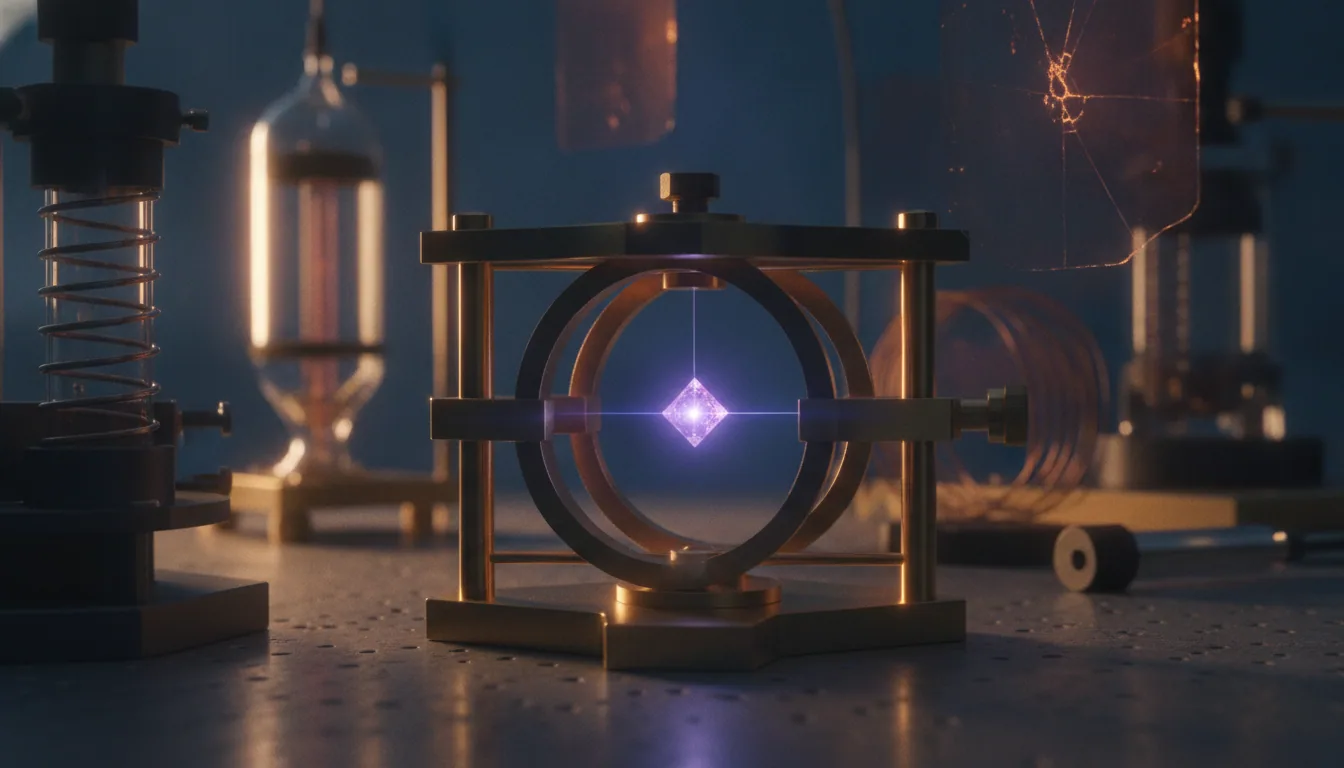
This nucleus is roughly 100,000 times smaller than the atom itself. The nucleus sits inside the atom like a diamond locked in a heavy steel vault, shielded by those same "noisy" electrons. By using this core as our new pendulum, we move into a quiet bunker where time remains untouched.
The Search for the Thorium-229 Frequency
In 2003, physicist Ekkehard Peik proposed that we could build a clock using the heart of an atom. This was a radical shift away from the jitter of electron shells toward the stable, silent center. The challenge was that most atomic nuclei are locked away behind immense energy barriers.
To nudge a typical nucleus, you would need a massive gamma-ray burst or a particle accelerator. Thorium-229 is the only known isotope with a nuclear state low enough to be reached with a laser. This unique property makes thorium the only viable candidate for a new generation of timekeeping.
Think of it as a loose brick in an otherwise solid wall. While other nuclei require a sledgehammer, thorium-229 responds to vacuum ultraviolet light at roughly 148.4 nanometers. For twenty years, researchers searched for this ghostly frequency in a massive spectral haystack.
How the First Nuclear Clock Became Reality in 2024
In April 2024, at TU Wien and PTB Braunschweig, the two-decade search finally ended. Researchers successfully "tickled" the nucleus with a vacuum ultraviolet laser at the exact energy address of 148.4 nanometers. For the first time, humans had manipulated the energy inside an atomic nucleus using a laser.
To build a functioning timepiece, however, you must be able to count the beats. On September 4, 2024, researchers at JILA in Colorado introduced an optical frequency comb to bridge the gap between light and time. This precision translator improved measurement accuracy by a factor of 100,000.
We moved from simply seeing the nucleus to measuring its heartbeat.
This breakthrough ignited a friendly global competition between research groups. Scientists across Europe and China were no longer just exploring; they were racing to surpass existing cesium and ytterbium clocks. The goal was to build the most stable ruler in the history of science.
A Tale of Two Cities: Vienna and Beijing
On October 7, 2026, the journal Nature published two papers that signaled the arrival of a new era. Two independent teams announced they had finally constructed the world's first working prototypes. This simultaneous success marks the end of the "atomic" monopoly on time.
In Vienna, Thorsten Schumm's team embedded thorium-229 nuclei into calcium fluoride crystals. This solid-state approach is remarkably sturdy, turning a delicate laboratory setup into something that could survive a rocket launch. The clock has effectively become a solid, portable object.
At the same time, Shiqian Ding and his team at Tsinghua University in Beijing revealed their own breakthrough. They developed a way to grow crystals using just 1.4 micrograms of the precious thorium isotope. The Chinese clock achieved a fractional frequency instability of 2 x 10^-12, representing a massive jump in performance.
Building a Clock from a Dusty Crystal
Most atomic clocks look like high-tech plumbing, requiring vast vacuum chambers to keep atoms floating in empty space. A nuclear timepiece, however, can live inside a solid crystal lattice. It is the difference between studying a single bee in a windy field versus one frozen in a block of clear amber.
The scale of these machines is shrinking toward the handheld. The speck of thorium used in Beijing is roughly the weight of a single grain of dust. Because the nucleus is wrapped in thick layers of electrons, it remains indifferent to the magnetic noise that ruins the precision of lesser clocks.
The heartbeat is provided by a vacuum ultraviolet laser tuned to 148.4 nanometers. This laser acts as a metronome, tickling the nucleus at a frequency of incredible stability. We are finally moving from delicate laboratory giants to rugged, solid-state devices.
Testing Dark Matter and Fundamental Constants
Why build a clock that is 100 times more accurate than the best current standards? It is not just about extreme punctuality; we are building a microscope for the laws of physics. Nuclear transitions allow us to probe the strong nuclear force with unprecedented precision.
If fundamental constants drift by even a tiny fraction over billions of years, our current models of physics are incomplete. These clocks are sensitive to these shifts because the nucleus responds to the universe differently than electrons. Researchers are already using these prototypes to search for dark matter candidates that might cause tiny oscillations in time.
This represents a major advance in measuring the constants of nature. We are no longer just counting the passage of seconds. We are checking if the rules of reality remain the same from one moment to the next.
The Unwritten Future of the Second
We have built the most precise gears in history, but we haven't yet decided how to read the dial. Since 1967, the "second" has been defined by cesium electrons, a standard the thorium clock now makes look like a sundial in a thunderstorm. Our measurement tools have finally outpaced our understanding of the materials that house them.
Consider the heart of the machine: thorium nuclei living inside calcium fluoride crystals, bathed in intense ultraviolet light. We still don't know the rate at which this light might slowly degrade the crystal's structure over decades. While the nuclear clock has arrived, the official timeline for redefining the second remains a work in progress.