
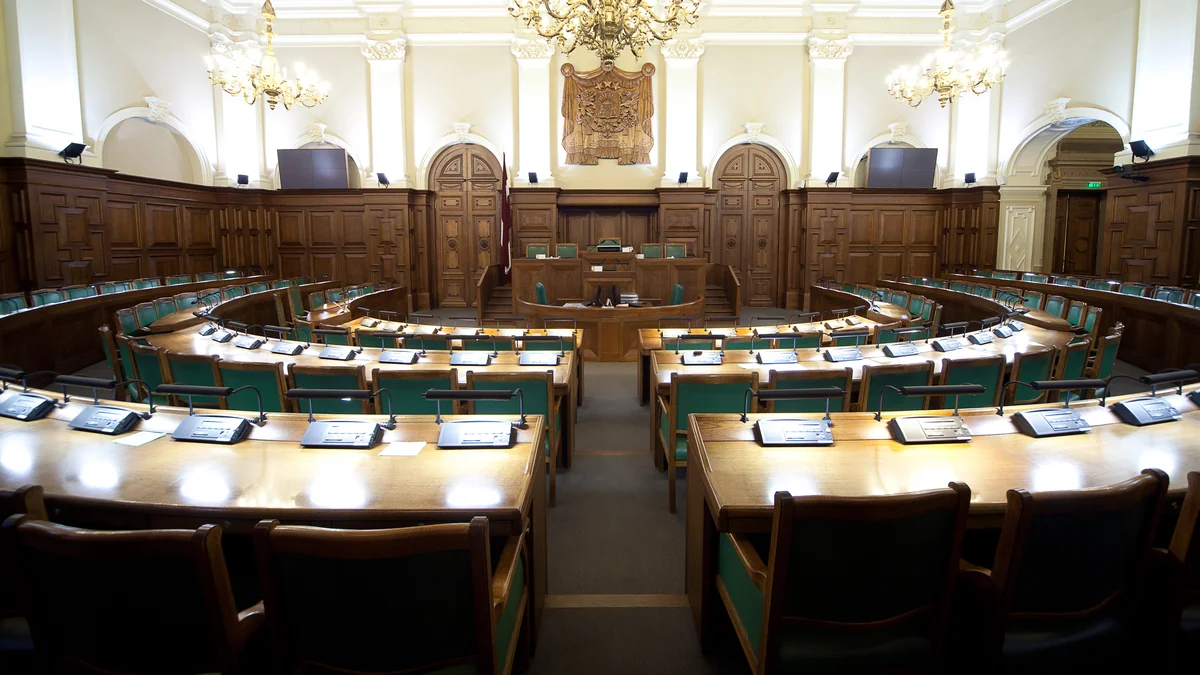
In the 2026 Latvian Saeima elections, the United List, led by Andris Kulbergs, secured a victory that reconfigures the Baltic political map. While the mandate appears strong on paper, it is anchored in the lowest voter turnout since the restoration of independence. The October 3 vote, triggered by a government crisis following a drone incident, resulted in a victory for technocratic centrism, yet the 50.81 per cent participation rate signals a deepening crisis of trust and the steady erosion of traditional political structures.
The Drone and the Caretaker: Why These Elections Happened
In the 1994 Latvian presidential elections, no candidate could secure the necessary majority in the initial rounds. The parliament remained in a deadlock for days, a crisis eventually resolved through a procedural compromise that left all parties involved equally dissatisfied. Thirty-two years later, Latvia again sought to define who governs, but this time the catalyst was not a legislative stalemate, but a drone.
In May 2026, Prime Minister Evika Siliņa resigned following a storm of public outrage caused by a drone that had strayed into Latvian territory. Siliņa's departure revealed a brutal reality: a single incident can bring down a government if it strikes the exposed nerve of cyber threats and border security. In the Baltic states, these questions have ceased to be abstract since 2022.
Siliņa was succeeded by Andris Kulbergs, a civil-servant-turned-prime-minister whose task was to fill the political vacuum without inviting further chaos. Technocratic crisis management is a well-worn life raft, previously deployed by Italy and Greece in moments of structural failure. Kulbergs, however, did not wait for comfort; he moved the country toward the elections for the 15th Saeima on October 3, 2026.
The Analysis of the Saeima Vote and the United List Mandate
Preliminary data from 995 polling stations showed the United List securing between 35.3 and 36.6 per cent of the vote. While the final decimal points may shift, the distribution of mandates will remain largely unchanged. Kulbergs' centrist, pro-Ukraine profile offered voters the opportunity to leave crisis management in familiar hands.
This result, achieved five months after he took office, is not an ideological landslide, but rather a procurement for stability. The Latvian electorate chose with caution, not enthusiasm. The United List's success is therefore a mandate, not a deep-seated conviction.
In this distinction lies both strength and vulnerability, as supporter loyalty is likely instrumental. As the sense of immediate crisis fades, the simple choice presented to the voter may disappear with it. The load-bearing walls of the new government will only be visible once the coalition agreement is drafted and the ministries are distributed. Everything else is moulding.
Fifty Per Cent: A Number Beyond the Day's Statistics
The 50.81 per cent turnout is the lowest Latvia has seen since the end of the Soviet era. This is not a statistical anomaly of a single bad day, but the floor of a twenty-year trend. The previous record low occurred during the elections for the 13th Saeima, when 54.56 per cent of the electorate participated.
For comparison, the 5th Saeima elections in 1993 saw a turnout of 89.9 per cent, though at that time the substance of the choice was existential. The 2026 voter knows the state exists, and this decline in participation cannot be explained away by any single scandal. The drone incident and the decision to count votes by hand were merely events, not root causes.
A state that is capable of saying "we do not trust our servers today" is demonstrating maturity, not weakness. Nevertheless, fewer than half of Latvia's adult population felt compelled to leave their homes this Saturday. What we are measuring is the weakening of the mandate chain. The United List won clearly, but more than half of the electorate played no part in that decision.
The Losers and the Threshold: The Collapse of New Unity
New Unity received 6.3 per cent of the vote, falling from the head of the government to the periphery of the parliament. This was not the result of an ideological pivot, but of political amortization. Meanwhile, the Union of Greens and Farmers (ZZS) failed to cross the threshold entirely, finishing with 4.5 per cent.
Latvia First (LPV) gathered over 11 per cent of the votes, placing second. The success of a populist protest vote does not necessarily imply an endorsement of their platform; it is often a vote against prevailing uncertainty. By taking second place, however, they have earned a seat at the negotiating table that was previously unavailable to them.
The centrist space in Latvian politics has contracted significantly. Traditional party loyalty has given way to situational voting. The voters who did appear at the polls made a conscious choice rather than a habitual one.
The President, Paper, and Cyber Threats: The Manual Count
At the initiative of President Edgars Rinkēvičs, the votes were counted manually to prevent the collapse of institutional trust. In an era of hybrid threats, the electoral system is no longer a purely technical matter. Latvia chose a deliberate distrust of digital infrastructure at a specific moment of security concern.
Manual counting sends a message that the result is verifiable and humanly observable. It stands in contrast to the Estonian model, where e-voting is the norm. By taking this step, the state demonstrated a certain maturity rather than technological backwardness.
The Russian Minority and Latvia First: Protest Without a Home
The marginalization of traditional parties representing the Russian minority has been a structural process lasting years. Language laws and the post-war context have pushed the Russian-speaking voter to the edge of the political space. The protest did not vanish; it simply changed its address.
The support for Latvia First in Russian-speaking regions demonstrates the inability of ethnic identity parties to mobilize. The result is paradoxical: a minority population supporting a party whose name is "Latvia First." It indicates a segment of the electorate that has become politically homeless.
A sober analysis must consider that Brussels may interpret this shift as a rise in populism. In reality, it reflects a crisis of representation. Those most unsettled by this shift are the ones who were supposed to represent the Latvian Russian community but failed to do so.
The Baltic Axis in October 2026: Madise and Rail Baltica
In September 2026, Ülle Madise was elected President of Estonia, a fact of regional significance. The coalition negotiations in Riga and the final composition of the Kulbergs government will determine the trajectory of cooperation with Tallinn. Rail Baltica remains on the agenda as a project everyone supports in principle, but which no one wishes to fund.
Regional infrastructure requires a level of trust between Tallinn and Riga that the new government configurations have yet to prove. The exact wording of the coalition agreement regarding Rail Baltica will show whether the project is moving forward or if we have returned to the starting point. Latvia is entering a period where government legitimacy no longer depends on ideological passion, but on the ability to keep the state functioning while the voter remains skeptical and guarded.