A School Gate in a Paris Suburb, September 18
France's school protests of 2026 began on the morning of September 18, when students at lycées on the outskirts of Paris walked out and didn't go back. By nightfall, videos were circulating across French social media - school gates blocked, chants in courtyards, the particular energy of young people who have decided they are done waiting.
What happened next moved fast. The mobilization spread from suburb to suburb, city to city, amplified by the same phones that students are told to put away during class. Within days it was no longer a Paris story.
Then came September 29. Students timed a mass mobilization to coincide with a public sector general strike, aligning themselves alongside teachers, civil servants, and transport workers already in the streets over the government's 43-billion-euro austerity program. That coordination was deliberate. Student unions - the USL, the MNL - were not acting alone. SNES-FSU teachers and CGT Éduc'action were marching in the same direction.
The numbers hardened quickly after that. In a single 24-hour period ending October 1, 180 schools across France experienced riots. Not protests. Riots.
When that many institutions fracture that fast, in that tight a window, something structural is breaking - not just a government policy, but an accumulated weight that students had been carrying for years. The suburbs where this began are not abstractions. They are places where families check their bank balances before buying school supplies. The anger that ignited on September 18 had been building long before anyone lit a match.
More Than 400 Schools Closed, and a Canteen in Flames
By October 2, more than 400 schools across France had been shut down or blockaded. That number is not the full picture. Out of 3,700 lycées in the country, 1,027 have been touched by the unrest in some form - blocked entrances, suspended classes, staff unable to enter buildings. Nearly one in three.
The disruption has reached universities too. Around 30 campuses, including sites in Paris and Marseille, are currently under blockade. Students who protested school conditions in September are now shutting down the institutions they were supposed to graduate into.
The worst single incident happened in Nantes. The Nelson Mandela lycée was set on fire. The canteen was destroyed, and 160 students had to be evacuated. A school named after a man who spent 27 years fighting for the right to a decent life, gutted by students who believe that right is being stripped from them inside classrooms with collapsing ceilings and no teachers.
Then there is the detail that is harder to explain away. A school director was reportedly sprayed with gasoline during the unrest. That is not a protest tactic. It is a signal that something has broken down much further than a curriculum dispute.
These are not isolated incidents spread thinly across a large country. In a single 24-hour period ending October 1, riots were recorded at 180 schools. The geography of the damage maps onto years of deferred maintenance, chronic vacancies, and class sizes pushing 40 students. The fire in Nantes is visible. The slow underfunding that preceded it is not. That is how systemic failures work - they stay invisible until something burns.
The French Education System Was Already Broken Before October
The protests shocked a lot of people. The conditions that caused them should not have. In 69% of French schools, at least one staff position is currently vacant. Not understaffed - missing a teacher entirely, a counselor, a technician. Someone who was supposed to be there and isn't.
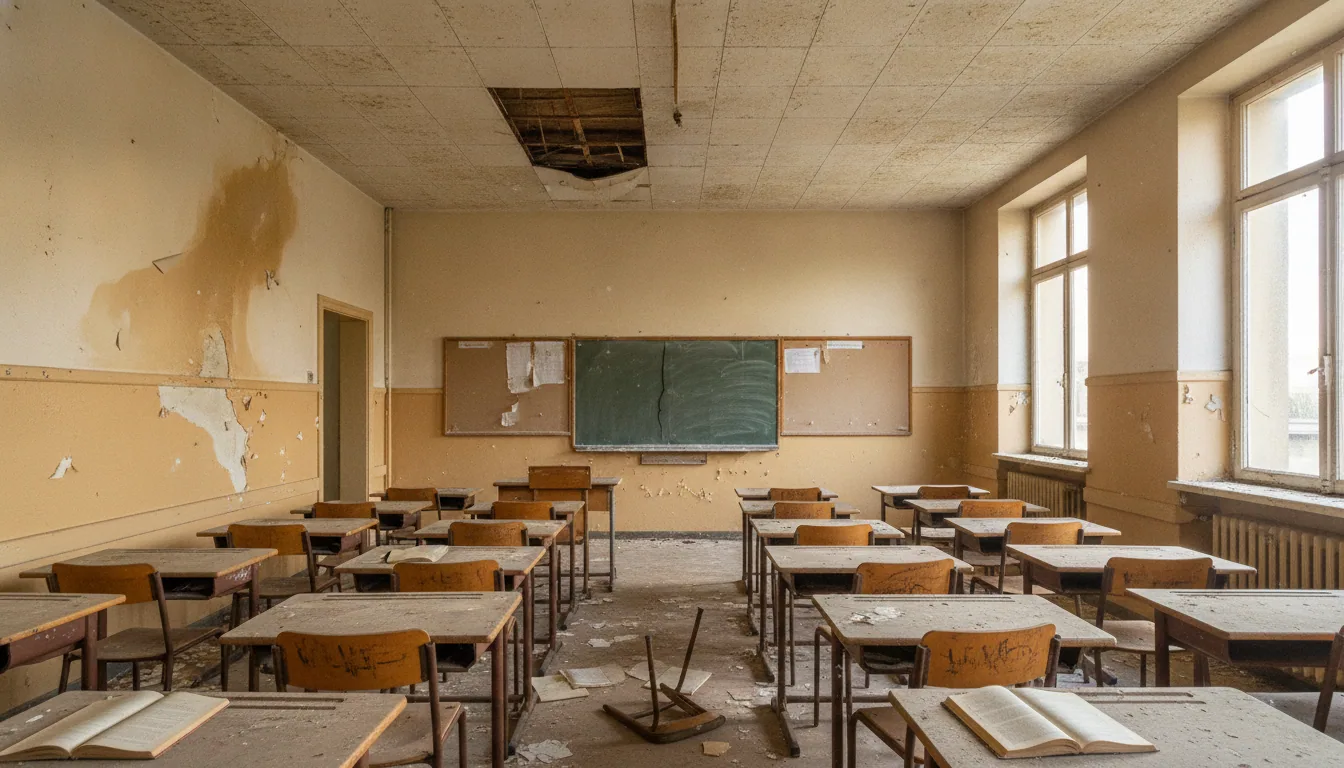
Class sizes in the most affected areas have reached 40 students. That is not a classroom anymore. That is a lecture hall without the acoustics or the budget. A teacher standing in front of 40 teenagers, many of them in buildings with leaking roofs, collapsing ceilings, pest infestations, and no air conditioning during summer heatwaves - that teacher was already doing triage before September 18.
Infrastructure decay is not a metaphor here. Students described the system as "asphyxiation." The word fits. When you are sitting in a room that is too hot, too crowded, and staffed by someone covering three jobs at once, learning is not the thing happening.
Now add the money. France's 2027 budget proposes 43 billion euros in total spending cuts, aimed at pulling the national deficit down to 5%. The education ministry is absorbing a disproportionate share of that pressure. When the people designing these cuts talk about efficiency, they mean fewer staff, larger classes, and deferred repairs. For families, that math looks different.
Do the arithmetic. Sixty-nine percent of schools with vacancies. Classes of 40. Ceilings that fall. And a budget process that treats education as a line item to compress rather than an investment to protect.
What students were protesting was not abstract austerity. It was the experience of showing up every day to a system that had been quietly underfunded for years - and then watching a government propose to underfund it further. The school gate on September 18 was not the beginning of this story. It was just the morning someone finally said it out loud.
What the Students Are Actually Demanding
Listen to what they say, and you hear one word more than any other: asphyxiation. Not anger, not injustice — asphyxiation. A system squeezing the air out before they have any chance to breathe.
The demands are concrete. First: abolish Parcoursup, the national university admissions platform that has spent years sorting French teenagers into winners and waiting lists. Students who grew up watching older siblings refresh the same screen for months know exactly what the platform does to a family. It does not democratize access. It mechanizes anxiety and dresses it up as fairness.
Second: reverse the cuts to APL, the student housing aid that makes the difference between a room in the city where your university is and a two-hour commute that costs you your degree. When housing support shrinks, poor students don't find cheaper flats. They drop out. These are not abstract policy preferences. They are the difference between finishing school and not.
The Union syndicale lycéenne (USL) and the Mouvement national lycéen (MNL) are coordinating the movement. Behind them stand the teachers - SNES-FSU and CGT Éduc'action - who have their own reasons to be in the streets. Teachers who leave mid-year because the pay doesn't cover rent in any city where schools actually exist.
The students are not demanding the impossible. They are demanding a school that functions. That is a remarkably low bar to still be fighting for.
Nearly 3,000 Arrests and a Switch to Remote Learning
On October 1 alone, 1,949 people were arrested. That is not a protest statistic. That is a number that belongs to a different kind of event.
By October 2, total arrests had reached nearly 3,000. For comparison, the 2018 gilets jaunes movement took weeks to accumulate comparable figures. This time it took days, and most of those arrested were teenagers.
The injuries tell the same story from three directions: 170 students hurt, 65 staff members, 83 police officers. A total of 318 people, across every side of the confrontation. No one walked away from this week without cost.
Prime Minister Lecornu convened a crisis cabinet on October 1 and warned that further escalation "would be irresponsible." Then his government did what governments do when the situation outpaces their capacity to explain it: they reached for a tool from the pandemic. Schools where security could not be guaranteed were ordered to switch to remote learning.
It is worth pausing on that choice. Remote learning in 2020 was an emergency response to a virus. Remote learning in 2026 is a response to students. The mechanism is identical. The reason is very different.
Education Minister Geffray, scheduled to meet student representatives on October 2, offered a different explanation for the scale of the unrest. The movement, he said, had been "hijacked" by external groups. He did not name them. He also said it was "essential" that students return to class - particularly those being prevented from attending.
Neither statement addresses why 1,027 lycées became protest sites in the first place. Naming an outside agitator is easier than answering that question.
What Any Parent Paying School Fees Should Take From This
Austerity in education is not a French specialty. It is a policy template, and France is just the country that ran the experiment loudest. When 69% of French schools currently lack at least one staff member, and class sizes reach 40 students, that is not a staffing crisis. That is a governance choice dressed up as a budget constraint.
The numbers matter beyond France. The proposed 2027 budget cuts total 43 billion euros, aimed at reducing the national deficit to 5%. Education took a disproportionate share of that pressure. Any EU country facing similar deficit targets is looking at the same menu. The French student uprising of 2026 is not an anomaly; it is an early indicator.
For families with children in exchange programmes, the disruption is already real. The 2026-27 exchange programmes connecting EU students to French lycées are already under review, with 1,027 schools affected and hundreds still closed.
The levers exist. Teachers' unions - SNES-FSU and CGT Éduc'action both joined this fight. Parent associations have formal consultation rights in most EU education systems. MEPs sit on committees that shape the European Semester, which directly frames national budget conditions. These are not glamorous instruments, but they work when enough people use them at the same time.
France's school protests of 2026 did not emerge from anger alone. They were built from 40 kids in a room, a ceiling that leaks, and a teacher who never arrived. The door is still open to do this differently.