A Moon That Has No Business Being This Interesting
Pick up a globe and find a country roughly 500 kilometres across. Estonia, say, or South Korea. Now imagine that as a sphere hanging in space. That is Enceladus: the sixth-largest moon of Saturn, the eighteenth-largest in the solar system, a ball of ice and rock small enough that its gravity cannot hold an atmosphere. Objects this size are geological fossils. The heat that drove their early activity leaked away billions of years ago, leaving behind cratered, inert surfaces that record nothing except time passing.
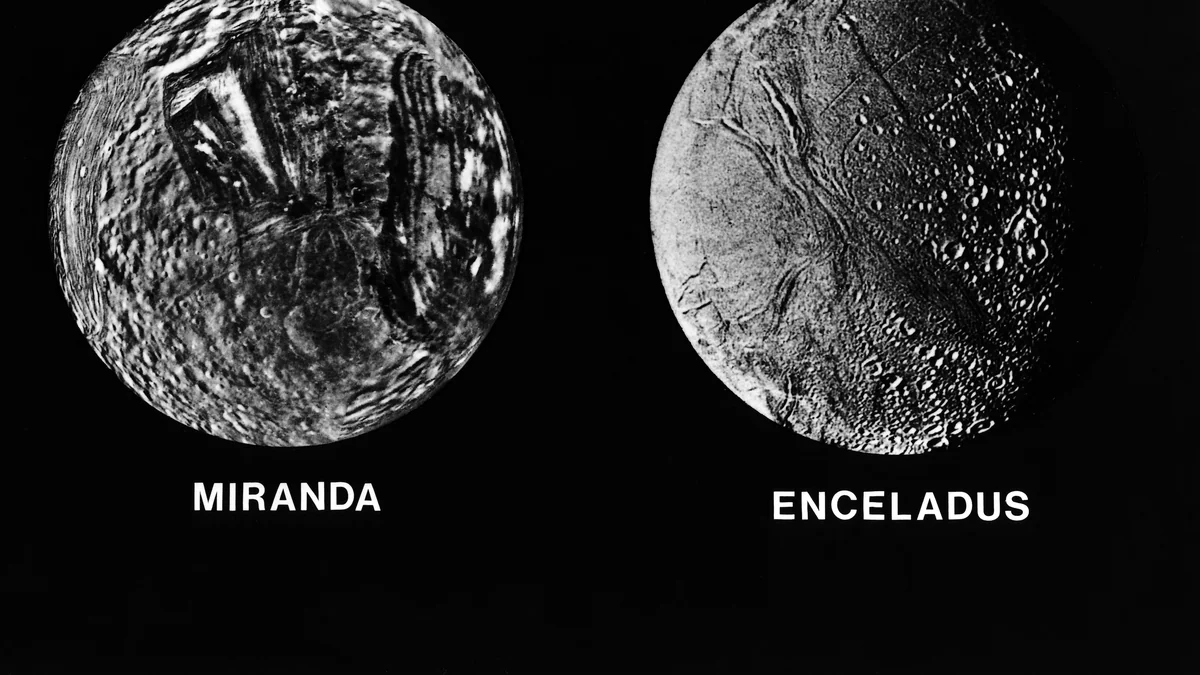
Enceladus does not look like that. Its surface is covered in clean, freshly deposited snow hundreds of metres thick, giving it the highest reflectivity of any body in the solar system. Not ancient ice, smoothed by aeons. Fresh. Something is continuously renewing the surface from below, erasing craters almost as fast as they form.
Here is the strange part. Enceladus has lost roughly 20 percent of its mass since it formed. That is not a rounding error in some planetary budget sheet. That is an enormous, ongoing haemorrhage of material, quietly written into the moon's present-day density and orbit. Something inside this small, supposedly dead world has been driving matter outward with enough energy and persistence to hollow it, incrementally, over geological time. The tension between what Enceladus should be, given its size, and what it plainly is, given everything we can measure, is the anomaly that has rewritten our maps of where life might exist.
What Cassini Found at the South Pole
The Cassini-Huygens spacecraft arrived at Saturn in 2004, and Enceladus was not the main attraction. Then the cameras swung south.
Four long parallel fractures ran across the south pole, each one roughly 130 kilometres long, and they were erupting. These are the tiger stripes — the name feels almost too playful for what they represent. On a moon this small, this cold, and this far from the sun, geysers simply should not exist.
Yet there they were. The south polar terrain was firing roughly 200 kilograms of material per second into space: ice particles, water vapour, salts, and organic compounds launched hundreds of kilometres above the surface, feeding Saturn's diffuse E ring with fresh material. Cassini flew through the plumes directly, tasting them. What the instruments found changed the conversation entirely.
The plumes do not come from surface ice warmed by some shallow process. They originate from a subsurface liquid ocean — a body of water sitting in direct contact with a rocky core. That contact matters enormously. Rock and water, under pressure and heat, produce chemistry. On Earth, hydrothermal vents on the ocean floor support ecosystems that have never seen sunlight. Enceladus appears to have the same basic architecture, compressed into a moon one-fortieth the volume of Earth.
Cassini ended its mission in September 2017, deliberately plunged into Saturn to avoid contaminating the moons it had spent thirteen years studying. The irony is that the spacecraft's sacrifice was partly motivated by what it had found: a place worth protecting. In a single mission, Enceladus went from a minor entry in the catalogue of icy satellites to the single most compelling biological target in the outer solar system. That is not a reclassification. That is a revolution.
The Plumes Are Doing the Chemistry for Us
In June 2023, researchers combing through archived Cassini data confirmed what the astrobiologists had been waiting for: phosphates. That completed the CHNOPS checklist — carbon, hydrogen, nitrogen, oxygen, phosphorus, sulfur — every element life on Earth requires, all detected in material Enceladus throws freely into space. The moon had been generous with its secrets before. Now it had handed over the last piece.
But the 2026 work from Frank Postberg's group at Freie Universität Berlin added something that changes the practical equation entirely. As plume droplets freeze — and they freeze slowly, hurtling outward at up to 1,000 kilometres per hour — that gradual process physically sorts the ocean's chemistry. Sodium chloride ends up in different ice grains than sodium carbonate. The compounds don't travel as undifferentiated slush; they travel as separated, concentrated parcels.
Think of it this way. Imagine emptying a mixed bag of sand and salt into water, then watching the ocean hand you back two separate labeled jars. That is roughly what Enceladus is doing — and doing it automatically, at 200 kilograms per second, for free.
The pre-sorting that analytical chemists spend considerable time achieving in a lab, a moon 1.3 billion kilometres away is performing through nothing more than orbital physics and thermodynamics.
The scientific significance is real, but the practical one is almost startling. Postberg put it plainly: "Enceladus actually does a lot of the work for us in preparing samples for analysis that usually take a lot of effort in chemical labs on Earth." For mission designers, this is not a small detail. It means a spacecraft flying through those plumes receives not raw, mixed ocean material but chemically distinct, concentrated grains — each one a sorted sample waiting to be read. The plumes are, in a precise and literal sense, a natural laboratory that has already done half the analysis.
Testing Saturn's Ocean Moon in a Lab on Earth
Somewhere in a terrestrial laboratory, a researcher lowers a sealed chamber to near-freezing temperatures, adjusts the hydrogen and carbon dioxide concentrations, and waits. The experiment looks modest. What it is asking is not.
The organism inside is Methanothermococcus okinawensis, a single-celled archaeon that makes its living near hydrothermal vents on the floor of the Pacific Ocean. It breathes hydrogen, exhales methane, and thrives in conditions that would kill most things. Scientists chose it precisely because Enceladus's subsurface ocean, sitting against a warm rocky core, may offer something remarkably similar: dissolved hydrogen, dissolved carbon dioxide, crushing pressure, and almost no light. Replicate those conditions closely enough, and you have yourself a proxy ocean.
The organism survived. It metabolized. That result is worth reading carefully, because it is easy to misread it.
This is not evidence that life exists on Enceladus. Nobody is claiming that. What the experiment actually demonstrates is something more precise: the threshold between "the chemistry is right" and "something could survive there" is not obviously blocked by any law of physics or chemistry we know of. The door is not locked from the inside. Before this kind of work, habitability was largely a theoretical argument, a list of ingredients checked against a recipe. Now it is also an experimental one, run under measurable conditions that can be challenged, revised, and repeated. The quality of the question being asked has genuinely changed, and that, in science, is often how progress actually begins.
The Enceladus Pivot: Two Space Agencies Bet Billions on the Same Moon
Every decade, the National Academies of Sciences asks the planetary science community a blunt question: if you could only do a few things, what would they be? The 2023–2032 Planetary Science Decadal Survey, titled Origins, Worlds, and Life, answered with the Enceladus Orbilander ranked as the second-highest flagship mission priority. First place went to the Uranus Orbiter and Probe, which is fair — Uranus has been waiting a long time. But second place, out of the entire solar system, is a statement.
Then, in March 2024, ESA independently named Enceladus the top target for its L4 large-class mission in the Voyage 2050 plan. Two agencies, two separate strategic reviews, the same moon. That kind of parallel convergence is historically rare. When NASA and ESA agree on something expensive, it usually means the science has become impossible to politely ignore.
The mission design reflects the discovery that makes Enceladus unusual. The Orbilander would spend 1.5 years in Saturn orbit, then descend and spend 2 years on the surface, flying through the plumes repeatedly to collect and analyze material. No drilling required. Compare this to proposed missions to Europa, Jupiter's other ocean moon, where reaching the liquid water means punching through kilometers of ice with technology we do not yet have. Enceladus brings the ocean to the spacecraft. That is not a minor convenience; it is the entire argument.
The estimated cost sits at 4.9 billion USD in FY2025 dollars, with a proposed launch in 2038 and Saturn arrival in 2045. That number buys seventeen years of anticipation and a great deal of political negotiation still ahead. Congressional budget approval is not guaranteed, and 4.9 billion is a commitment that outlasts administrations. What has changed is not the price of ambition — it is that the scientific case has grown strong enough that declining to go would itself require an explanation.
What We Still Don't Know — and Why That Is the Best Part
All the evidence gathered so far tells us one thing with precision: the ocean of Enceladus is not hostile to life. That is not the same as saying life is there. The conditions are permissive. The tenant has not been found.
The timeline is the quieter problem. Life on Earth took hundreds of millions of years to gain a foothold, and we still do not know how long Enceladus has maintained a liquid ocean. A warm, wet world that froze solid a billion years ago is a very different prospect from one that has been churning hydrothermal vents continuously since the solar system's formation. No one has that number yet.
Then there is the money. The Decadal Survey ranked the Enceladus Orbilander second among flagship priorities, at an estimated $4.9 billion in FY2025 dollars, with a proposed launch in 2038 and Saturn arrival around 2045. A recommendation, however well-reasoned, is not a budget line. Congressional approval remains unsecured, and a second-place ranking means there is always something ahead of it in the queue.
And Enceladus is losing itself. The south pole ejects 200 kilograms of matter per second, and the moon has already shed roughly 20 percent of its mass since accretion. What that means for its orbital stability, its tidal heating, its long-term future as a liquid world: open calculation.
These are not failures of the science. They are the map of the next twenty years. Every gap is a mission, and every mission is a question that a civilization decided was worth asking. We still do not know whether we are alone — and the Enceladus pivot, more than any other move in planetary science right now, is the one that keeps that question honest.