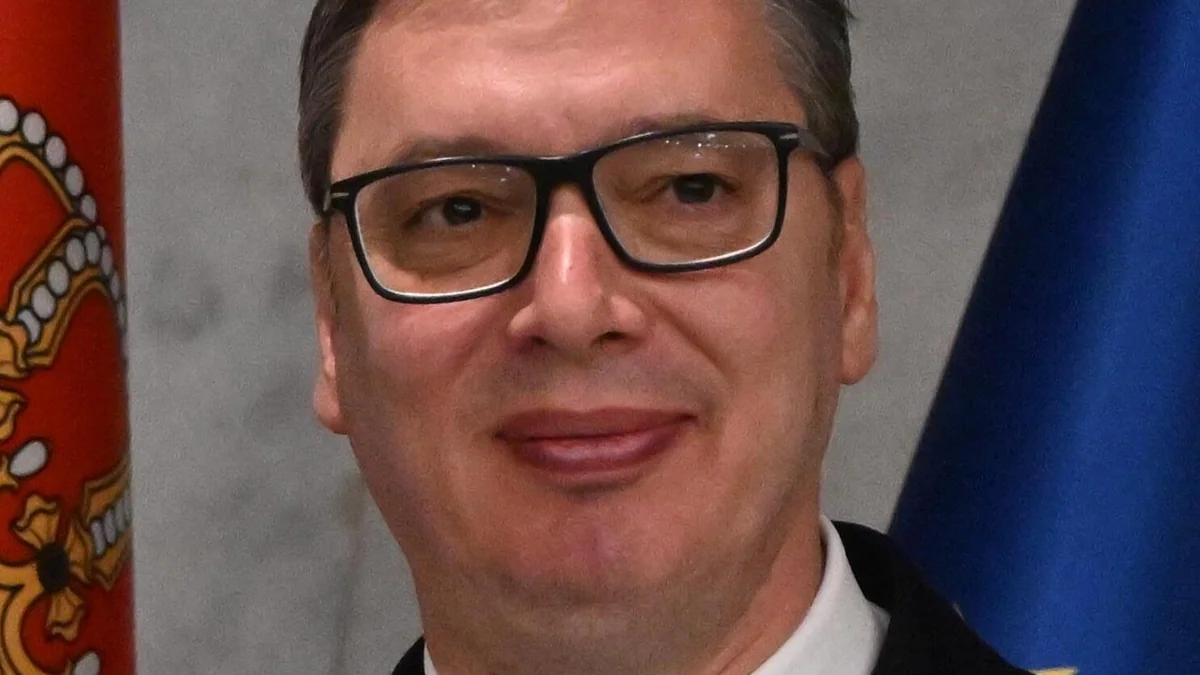
Fourteen Years and a Constitutional Clause
Aleksandar Vučić's resignation on September 27, 2026, is not a transfer of power — it is a transfer of office. Serbia's longest-serving political figure is vacating the presidency to pursue the prime ministerial role, a constitutional maneuver that satisfies the letter of term limits while leaving the underlying architecture of control intact.
In April 2020, Vladimir Putin's government quietly amended the Russian constitution to reset his term count to zero. The mechanism was blunt and undisguised. Serbia's version is considerably more elegant.
Vučić has held the load-bearing levers of Serbian politics for fourteen years, moving across offices the way a careful man moves through a house he owns — pausing in each room long enough to rearrange the furniture before stepping into the next. Prime Minister from 2014 to 2017, then President for two consecutive terms: the path was always forward, until the Serbian constitution placed a wall across it. A third presidential term is prohibited. So the office changes, and the man does not.
The comparison to Putin and Medvedev's 2008 rotation is obvious, and it is worth interrogating before it calcifies into received wisdom. Medvedev held real institutional distance from Putin for exactly as long as the cameras required. Vučić is not offering even that. He is resigning the presidency to lead his Serbian Progressive Party into snap parliamentary elections on October 25, openly seeking the Prime Minister's role — the office that, under Serbia's semi-presidential system, carries the formal centre of executive gravity. There is no handoff. There is no designated placeholder given genuine latitude. There is Ana Brnabić, installed as interim president, and there is Vučić, already campaigning.
The structural logic is not novel. The Serbian execution, conducted in full daylight with a pardon of 49 individuals folded into the resignation announcement, has a particular texture. Somewhere a constitutional clause was quietly satisfied.
The Station at Novi Sad
On November 1, 2024, the concrete canopy over the entrance of Novi Sad's renovated railway station collapsed. Sixteen people died. The station had recently undergone a high-profile reconstruction linked to Chinese contractors — one of the signature projects of Serbia's infrastructure diplomacy, the kind of ribbon-cutting that translates geopolitical hedging into steel and concrete and, occasionally, into rubble.
The renovation contract became the thread. Opposition researchers and journalists pulled it, and what came loose was not merely shoddy workmanship but the familiar architecture of state capture: procurement without transparent oversight, subcontracting chains that obscured liability, a prestige project insulated from scrutiny by its very political usefulness. The disaster was not ungovernable because the death toll was high — it was ungovernable because it made the mechanism visible.
Ask the small question first: who is the borderland here, and who is the empire? In the case of Novi Sad, the answer was domestic — the borderland was the Serbian public, and the empire was a patronage state that had spent fourteen years confusing its own continuity with national development.
Vesić went on November 4, Momirović on November 20. The resignations were calibrated, not spontaneous — controlled pressure releases from a system accustomed to managing dissent by sacrificing expendable components while leaving load-bearing ones untouched. Construction and trade ministers are mouldering. The concrete that falls on sixteen people, and the contract that approved it, is something else entirely. The protesters understood this distinction from the first week, which is precisely why the releases failed to release anything.
Studenti Pobedjuju: The Movement That Outlasted the Pressure
What made "Students Win" structurally different from previous Serbian opposition cycles was not crowd size. Earlier movements — 1996, 2019 — peaked and contracted because they depended on spectacle: the full square, the visible mass, the moment that photographs well. Studenti pobedjuju built something harder to photograph and harder to dissolve: a distributed coordination network that continued to function between demonstrations, not only during them.
By the time Vučić stepped down on September 27, 2026, the movement had sustained pressure on the SNS for approximately two years — the longest continuous opposition arc since the fall of Slobodan Milošević in 2000. That duration matters more than any single march. The Serbian government ran its standard sequence: exhaust, fragment, wait. It did not work this time.
The sequence of ministerial exits records the ratchet clearly. Goran Vesić resigned from the Construction portfolio in November 2024, Tomislav Momirović from Trade by the end of that same month. Neither concession broke the pressure. When Prime Minister Miloš Vučević resigned on January 28, 2025, the SNS was offering the second-largest piece it had — the head of government itself. The square did not empty. What the movement had learned, sometime between 2024 and 2026, was the difference between a demand satisfied and a structure unchanged. Vučević's departure removed a face; it left the patronage network, the media capture, the contracts, all of it, intact. The students knew the difference, which is why they were still there when the president finally had to move.
What the movement had learned, sometime between 2024 and 2026, was the difference between a demand satisfied and a structure unchanged.
September 27: What Vučić's Resignation Actually Contains
On a Sunday morning, Aleksandar Vučić signed the document that ended his presidency and handed the interim office to Ana Brnabić, the outgoing Parliament Speaker. The mechanics were clean. A signature, a handover, a date — September 27, 2026 — logged into the constitutional record seven months before his second term was due to expire.
Before he left, he issued 49 pardons. Twenty-three of them went to students. The rest went to individuals whose names have not been fully disclosed. The pardon list is the departure's most legible price signal: a gesture calibrated to drain some pressure from the streets without conceding the structural argument the streets were making.
Vučić described his nine years as a period in which he had "preserved peace and stability." The Friedrich Naumann Foundation called the resignation a political charade. Both readings contain information. His framing tells you what the SNS needs its base to hear before October 25. The Foundation's verdict tells you what the office-swap looks like to an observer not invested in the outcome.
The staging is the argument. A resignation issued on a Sunday, paired with a pardon list, timed to a snap election seven weeks out — none of this is improvised. The SNS read its own electoral position and concluded that Vučić on the campaign trail, freed from the daily accountability of the presidency, is a stronger asset than Vučić defending a terminal office against two years of accumulated grievance. The pardons are a receipt. The timing is a calculation. The word "resignation" is doing considerable work here for a document that transfers very little.
Between Brussels and Beijing
Serbia has maintained, for roughly a decade, the diplomatic posture of a country that cannot quite decide who it is losing to. Vučić has pursued EU accession talks while sustaining parallel courtship of Moscow and Beijing — a triangulation so practiced it began to resemble structural policy rather than improvisation. The Novi Sad station renovation itself was a Chinese-led project, which made the canopy's fall something more than a construction failure.
The EU has watched this with the particular patience of an institution that needs the Western Balkans more than it will admit. That patience has limits, and one indicator of where Serbia actually sits inside it is not a diplomatic communiqué but a ranking: 104th out of 180 countries in the 2026 World Press Freedom Index. Press freedom is not decoration. It is load-bearing. A state that cannot sustain independent reporting cannot sustain the institutional framework EU accession formally requires.
The formation the EU can work with is European Serbia, the main pro-Western opposition coalition. Its limitations are real — it has not yet demonstrated the capacity to convert protest energy into governing arithmetic. But it exists, and it is coherent, which is more than can be said of every previous cycle of Serbian opposition politics. Moscow and Beijing offer Vučić a route around Brussels; European Serbia offers Belgrade a route back to Brussels. The question is which offer the October 25 result makes easier to refuse.
Watch by December
Two dates now carry the weight of everything that has happened since November 2024. The first is October 25, when snap parliamentary elections will test whether the Serbian Progressive Party can hold its legislative majority without the presidential office as a stabilising anchor. The second is late December, when a presidential election must be held by constitutional requirement. Between those two dates, the maneuver either completes or it doesn't.
The October vote is the prior indicator. If the SNS secures a working majority outright, Vučić moves to the prime ministerial office with full structural control intact. If it falls short, coalition arithmetic enters the picture — and coalition partners, as every student of Balkan post-communist politics knows, eventually price their cooperation. A coalition government is not the same instrument as a single-party one, and Vučić has never governed at the mercy of arithmetic he did not himself set.
The December presidential election is the deeper test. The SNS has not yet named its candidate. That name, when it comes, will tell you whether Vučić's resignation was designed as a transfer of the centre of gravity or merely its relocation. If the new president governs as an independent figure, something moved. If the office functions as a forwarding address, the evidence forces one conclusion: the resignation changed the title, not the arrangement.