
South Africa’s police crisis is defined by a systemic failure to protect township residents, leading to a murder rate of 45 per 100,000 people. This breakdown is driven by severe understaffing, deep-seated corruption, and a massive investigative backlog that leaves mass shootings largely unpunished.
South Africa’s police crisis is a structural breakdown where the state’s retreat from township peripheries has allowed local gunmen to claim sovereignty. In September 2024, the record shows eighteen dead in Lusikisiki and a series of official promises regarding reform. The comparison with today’s carnage is lazy because it assumes that official horror leads to structural change.
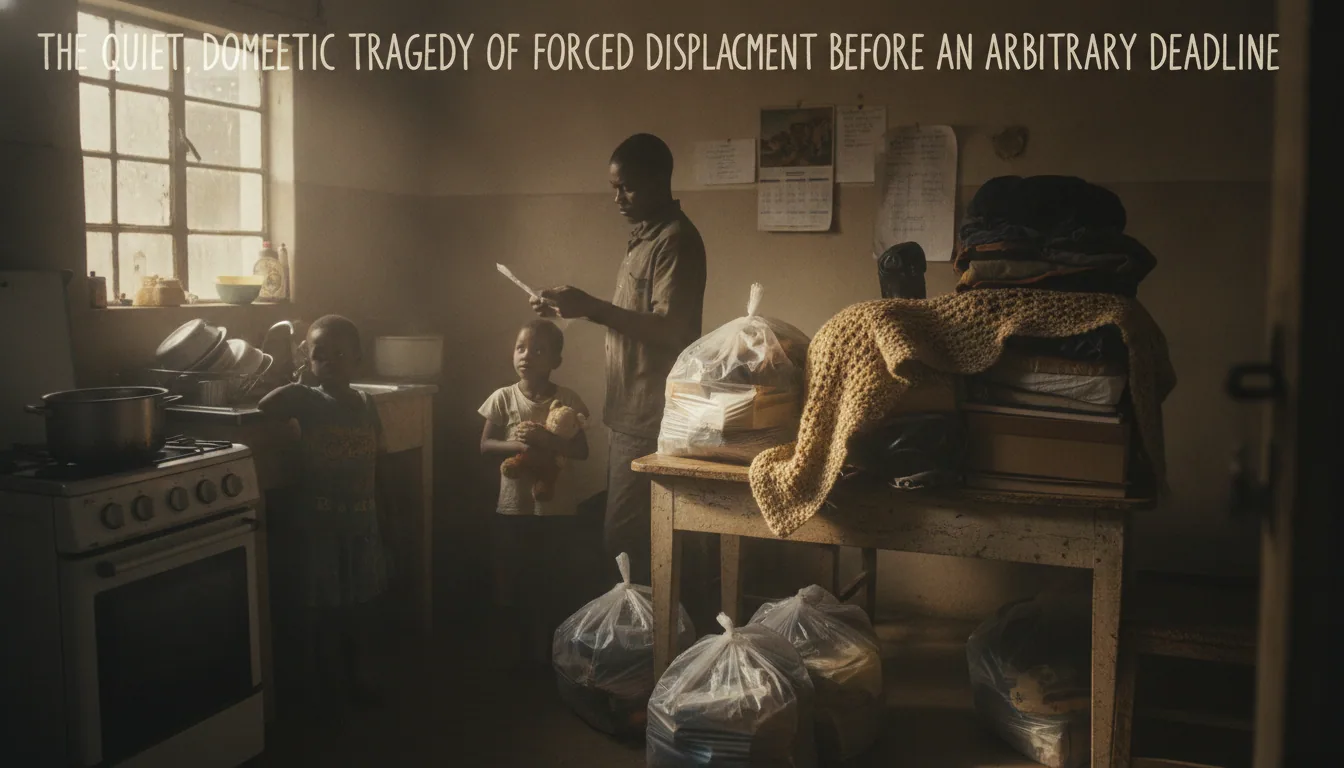
In South Africa, the massacre is not a rupture but the architecture of the township night. On September 22, 2024, three gunmen entered a house party in the KwaMakhutha township south of Durban. They killed eleven people and wounded three others, including a pregnant woman.
This was not a robbery but a demonstration of local sovereignty in a space where the state has retreated. Four days later, the geography of the collapse moved to Wedela near Johannesburg. Eight men armed with AK-47s and pistols opened fire in a bar, killing seventeen.
That same weekend, ten more died in a shop in Lwandle, leaving 38 dead across the country. These killings are described as "tensions" by the international press. In the townships, they represent the final erasure of the state’s monopoly on force.
High-volume homicide is the new architecture of the borderlands, where the police are occasional visitors rather than a presence. In 2024, the nation averaged 70 murders per day. The murder rate stood at 45 per 100,000 people, a statistic that signals a failing central order.
Somewhere a spreadsheet was quietly updated to include the 38 lives lost to South Africa’s police crisis in just one week of September. The arithmetic of this order has lost its grip on the streets.
The Structural Roots of South Africa’s Police Crisis
In any state, the police-to-citizen ratio is the structural blueprint of order. In South Africa, that ratio now stands at one officer for every 414 residents. This is the load-bearing wall of the post-1994 security model, and it is visibly cracking.
When the center allocates resources this thin, the townships are effectively abandoned to the logic of the AK-47. It appears the state finds it easier to balance its books than its streets. National Commissioner Fannie Masemola recently admitted the police system must be cleansed of corrupt officers.
He acknowledged that public trust has reached its lowest point since 1994. It is a rare moment of bureaucratic candor that usually precedes an institutional collapse. These admissions do not comfort the victims in Wedela or Lwandle.
They merely signal that the leadership can no longer hide its own rot. From the small-nation floor, the view of centralized security is always one of skepticism. When power is hoarded at the top, the failure of the center becomes a death sentence for the periphery.
The September massacres suggest that a unified command projecting safety across extreme inequality is now a fiction. Security in these borderlands is no longer a right, but a commodity the state has failed to deliver. If the state cannot secure a shop or a tavern, the sovereign contract is being rewritten by whoever holds the most illegal firearms.
A Ledger of Irregular Expenditure
The budget of the South African Police Service is a document of managed decline. According to Ian Cameron, chairman of the Parliamentary Committee on Police, the service recorded 640 million rand in irregular expenditure during the 2024/25 fiscal year. This sum, roughly 32 million euros, was diverted through the structural theft that hollows out a state.
While the ledger leaks, the front line erodes. The public record shows that 111 police officers were killed in the line of duty over the past year alone. There is a grim ratio at work here, where the cost of institutional decay is paid in the lives of under-equipped constables.
When the state cannot account for its rands, it cannot account for its citizens.
The Cameron report functions as a forensic indictment of how a national force loses its capacity to protect. It reveals that funds meant for protective gear and vehicle maintenance disappear into the void of irregular contracts. Corruption is often treated as a moral failing, but in the SAPS, it is a mechanical one.
The Oversight Backlog as a State Instrument
The Independent Police Investigative Directorate (IPID) occupies an office that exists to produce paper. By 2025, the record shows 14,469 cases sitting in the backlog. These are not merely files on a dusty shelf, but the untended ghosts of a failing system.
The protector has become the predator. The statistics for 2023/24 strip the official language of its comfort. IPID recorded over 5,000 cases of misconduct and 460 deaths resulting from police action.
When the state kills its own citizens at this rate, the word "incident" is a lie. This is a structural feature of the security apparatus. Rape cases in police custody rose by 75 percent in the latest reporting period.
A woman entering a precinct for protection may find the door locked from the inside by an officer. In these rooms, the blue uniform ceases to be a sign of order. These figures represent the slow collapse of the constitutional promise made in 1994.
The oversight body is a decorative entity designed to signal a functional democracy to foreign capitals. In practice, the 14,469-case backlog functions as a silent instrument for immunity. A crime that remains uninvestigated for a decade effectively ceases to exist.
Ledger lines show salaries for investigators who lack the fuel to reach a crime scene. This is the small-nation floor where the citizen is caught between the gunman and the constable. One shoots with an AK-47; the other hides behind a mountain of unsolved paperwork.
The Economy of Illegal Firepower
In the late twentieth century, the AK-47 was the primary currency of liberation movements. Today, it is merely the commercial overhead for territorial control in the townships. Illegal firearms are now the primary cause of death in South African homicides, replacing the knives of the previous generation.
The September 2024 Lusikisiki massacre remains the benchmark for this violent systemic failure. While suspect Siphosoxolo Myekethe faces the court, the state remains unable to trace the military-grade supply lines. The rise of the "zama zamas," or illegal miners, has turned territorial disputes into tactical military exercises that mimic small-scale insurgencies.
These groups use automatic weaponry to secure mine dumps where the national monopoly on violence has evaporated. The gunmen in Wedela and Lwandle are the collection agents for a lead-based economy where human life is cheaper than the hardware.
The Marker to Watch: Devolution or Collapse
The Democratic Alliance now uses the rising body count to argue for the dismemberment of the national police hierarchy. Their core thesis is that centralized management has become a machine for distributing corruption rather than security. They seek to move operational control from Pretoria to provincial capitals.
The trial of Siphosoxolo Myekethe will serve as a barometer for this institutional exhaustion. If the judicial system fails to secure a conviction in a case of this magnitude, the demand for provincial autonomy will shift. The data suggests the center has already lost its grip.
SAPS irregular expenditure reached 640 million rand in the latest fiscal year, while the officer-to-citizen ratio remains stagnant. In this vacuum, safety becomes a regional commodity purchased by wealthier provinces and denied to the borderlands.
The marker to watch is the specific language in forthcoming legislative debates on police decentralization. Look for the word "devolution" versus "coordination" in the final committee reports. If the text preserves the national commissioner’s veto over provincial appointments, South Africa’s police crisis will remain unresolved, and the cycle of massacres will continue until the system collapses under its own weight.