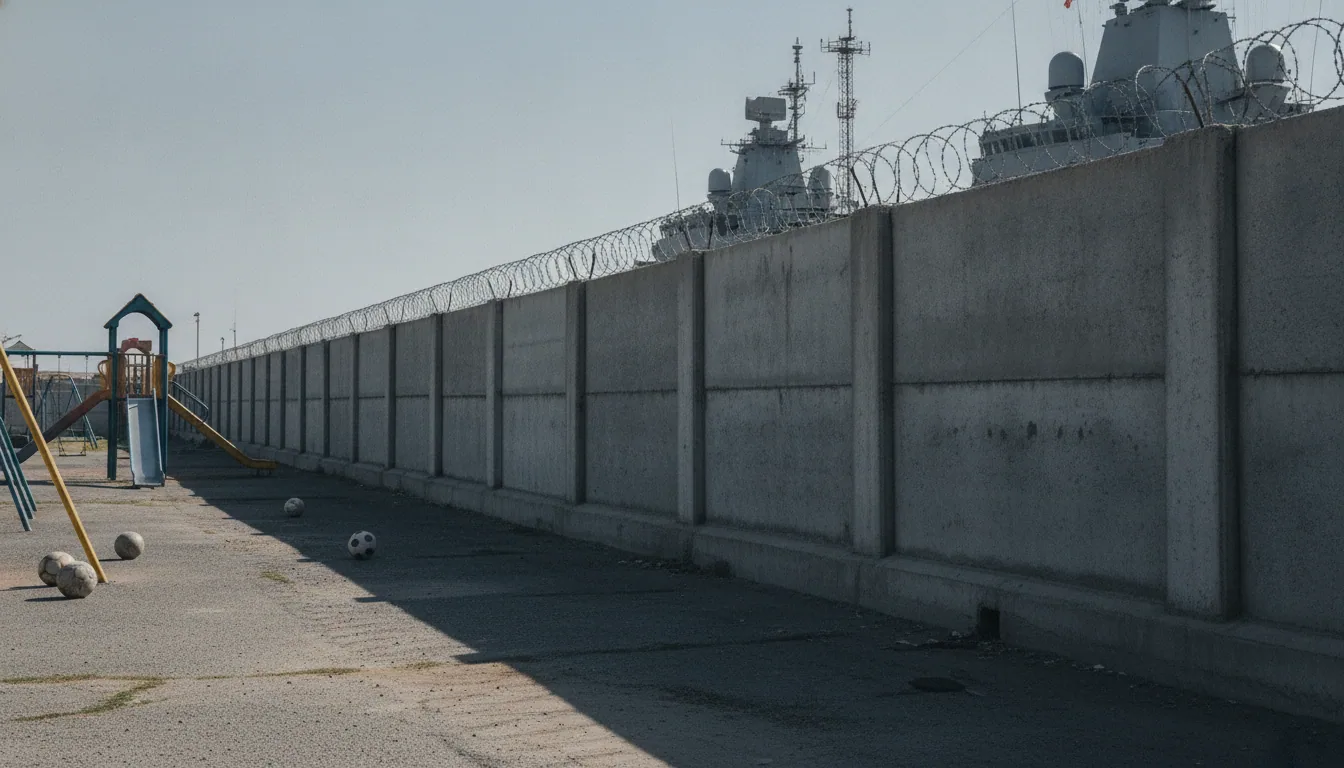
On February 28, 2026, a military AI failure in Minab, Iran, killed 123 children at Shajareh Tayyebeh Elementary School in the first twenty-four hours of the U.S. aerial campaign against Iran. The site had been misclassified as an IRGC facility in CENTCOM's primary targeting database for a decade.
One School, Two Missiles, and a Site the Pentagon Had Not Reclassified in a Decade
The ledger entry for the 1999 Chinese embassy strike in Belgrade read, years later, as a parable about stale maps and institutional indifference - an outdated CIA database, an unchanged address, and three people dead in a building everyone had already stopped thinking about. The comparison to Minab on February 28, 2026, is tempting.
It also breaks almost immediately, because what happened at Shajareh Tayyebeh Elementary School was not a single bureaucratic lapse in a careful campaign. It was the first day.
Two Tomahawk missiles hit the school during the opening twenty-four hours of the U.S. aerial campaign against Iran. The confirmed dead numbered 123 children. Total casualties exceeded 150.
The campaign had not yet found its tempo, had not yet accumulated the small corrections a long operation forces on its planners. This was the opening stroke.
The proximity that made the error plausible to the targeting system is not in dispute. The school sat fewer than 100 yards from an active IRGC naval installation. That spatial fact is the load-bearing wall of every subsequent explanation offered by commanders, vendors, and spokesmen.
The rest, as will become apparent, is moulding.
What the proximity cannot explain is why the database still classified the site as an IRGC facility a full decade after the compound walls were built to separate school from base. The ground changed between 2013 and 2016. The record did not follow.
Children arrived each morning through a gate the Pentagon's systems had never bothered to re-examine - a detail so mundane and so catastrophic that no official statement has yet found comfortable language for it.
The Land That Changed Use While the Database Stayed Fixed
The school did not appear from nowhere. Between 2013 and 2016, walls were built across what had been the outer perimeter of an Islamic Revolutionary Guard Corps compound in Minab, partitioning the military installation from the new civilian construction beside it. Shajareh Tayyebeh Elementary School opened on land that had been IRGC property.
The physical separation was real, documented, and visible on commercial satellite imagery.
The database did not notice. A decade after the walls went up, the primary targeting database used by CENTCOM in February 2026 still classified the site as an IRGC facility. That is not an oversight in the ordinary bureaucratic sense - it is a structural condition of fragmented intelligence architecture, where records persist until someone with the right access and the right institutional incentive forces a correction through.
Someone did try. A U.S. intelligence analyst flagged the site's conversion to civilian use in 2019. That flag was recorded.
It simply was not linked to the primary targeting database that would be queried, seven years later, when Maven Smart System compiled its recommendations for the opening wave. The 2019 update existed in one system. The kill list drew from another.
Data lineage - the chain of custody that should connect an updated assessment to every downstream database that relies on it - had broken somewhere in the gap between them.
That gap is the load-bearing wall. The AI did not fabricate a threat from nothing; it processed a decade-old misclassification and returned a confident answer. The system worked precisely as designed.
The design assumed the underlying data was current. It was not, and no one had built the mechanism to catch the difference.
A Thousand Targets Before Midnight: How the AI Targeting System Abolished the Human in the Loop
Over 1,000 Iranian targets were processed and struck in the first twenty-four hours of the campaign. That number tells you everything you need to know about what "human-in-the-loop" had become by the time two Tomahawk missiles crossed the coordinates of Shajareh Tayyebeh Elementary School.
Palantir's Maven Smart System was designed to do exactly what it did: fuse intelligence feeds, render targeting recommendations, and compress what had previously required multi-hour verification into minutes. The internal findings, as reported by people familiar with the review, confirmed that "prepare was condensed into minutes with the help of Maven."
Speed was not a bug. Speed was the product.
The failure that followed was cognitive, not mechanical. Targeting personnel assumed the system would independently flag outdated or inconsistent intelligence - that some automated tripwire would catch a site reclassified years ago and never migrated to the primary database. That assumption is what investigators named automation bias, and it is the assumption that nullified every procedural safeguard on the books.
The human signature at the end of the chain was no longer a check. It was a formality performed at pace.
Ask the small question first: what does a thousand targets in twenty-four hours actually require of any individual reviewer? Not judgment. Not verification. Throughput.
When the tempo of an operation exceeds the cognitive bandwidth of the oversight it nominally retains, the oversight does not become faster - it becomes theatrical. The kill chain kept its human step. It simply ceased to require that the human think.
This is target saturation as institutional design. The pace was not an accident of high-tempo warfare pressing against an otherwise sound system. The system was built for this pace, and the human-in-the-loop requirement was carried along as moulding rather than load-bearing structure.
When the tempo of an operation exceeds the cognitive bandwidth of the oversight it nominally retains, the oversight does not become faster - it becomes theatrical.
The Room That Was Deliberately Left Empty
The Pentagon did not stumble into the strike on Shajareh Tayyebeh. It walked in through a door it had quietly removed from the frame.
Before the aerial campaign began, civilian harm mitigation staff across the department had been cut by ninety percent. That is not a rounding error. It is a policy.
CENTCOM's own civilian harm mitigation team had numbered ten personnel. By February 28, it numbered one. A single staff member, responsible for a theatre processing over a thousand targets in twenty-four hours.
The internal Pentagon review would later call what followed a "cascade of preventable failures" - and the word cascade is doing careful work there, because cascades require height, and the height was engineered.
Pete Hegseth oversaw the reductions. The cuts were not the product of operational emergency or budget crisis. They were administrative. Deliberate.
The institutional friction that civilian harm staff exist to provide - the slow, inconvenient, career-inconveniencing habit of asking whether a site had changed use - was removed before the first missile left its tube.
The room was not left empty by accident. Someone signed the memo.
What civilian harm mitigation teams do, at their most basic, is hold the question open a little longer. They are the people whose job description is inconvenient delay. Strip them out, and the kill chain has no gristle left in it - only the smooth, accelerating logic of throughput.
The 2019 flag about the school never reached the active targeting list. There was, by then, almost no one left whose formal duty was to look.
The Dispersal of Blame: A Software Vendor, a Former General, and a President Who Cannot Say
Palantir stated that it was not responsible for the underlying data or for identifying intelligence deficiencies. The Maven Smart System processed what it was fed. The database was someone else's ledger.
Former military officials offered the complementary position: humans, not AI, were to blame. This framing has the advantage of being technically accurate and the disadvantage of explaining nothing.
Naming human error as the cause without naming which human, which decision, and which institutional condition made that error structurally inevitable is not an answer. It is a category.
The third move belonged to the president. In July 2026, Donald Trump suggested that nobody would ever be able to say what happened. Compare that to the posture of, say, the Israeli military's post-Jenin inquiries of the early 2000s, which were inadequate and contested but at least procedurally asserted the right to examine.
Trump's construction does not close a file; it declines to open one. The passive voice is load-bearing here: not "we will not investigate" but "nobody will ever know," which distributes the impossibility evenly across the universe and removes any actor from the sentence entirely.
Each party gestures toward the next. The vendor points to the data curators. The generals point to the personnel.
The president points to the fog of war that his own staffing decisions deliberately thickened. Somewhere in that triangle, 123 children remain unattributed.
What the Record Now Forces Us to Conclude
The UN Independent International Fact-Finding Mission on Iran has stated there are reasonable grounds to believe the Minab strike constitutes a war crime. That is not an activist claim. It is the considered finding of an independent legal body working from the same public record reviewed here.
Six months later, on September 1, 2026, a U.S. strike on a wedding party in Kuhestak killed at least five civilians. The school was not the exception.
The load-bearing question was never whether AI failed. Algorithms do not stand trial. The question is whether any architecture of oversight remained standing to catch the failure - and the evidence of a ninety-percent staffing cut, a 2019 analyst flag left unlinked, and review windows compressed to minutes answers that question without ambiguity.
One marker remains. The Pentagon's full internal review has not been declassified. Read one line - if its language on command accountability says shall, someone is being held responsible; if it says should, no one is, and this military AI failure will be back on your screen before the next campaign begins.