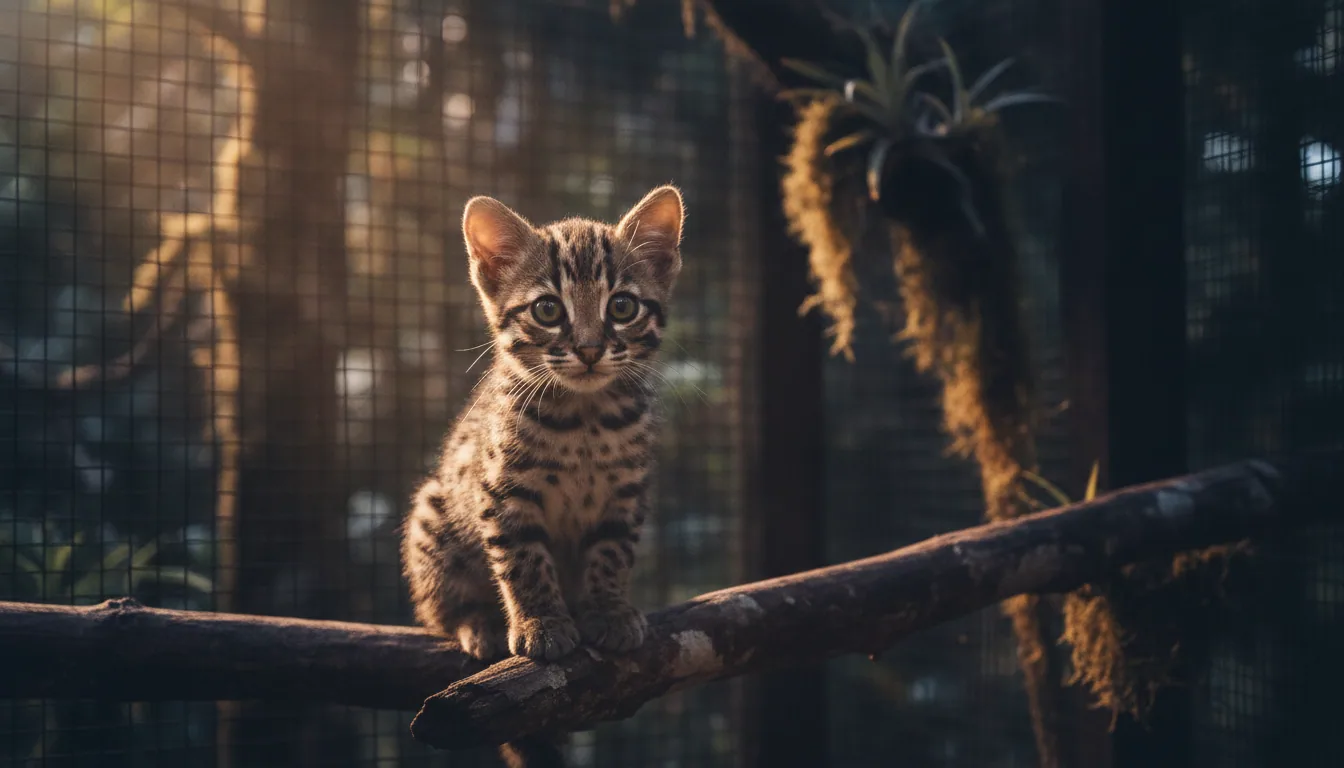
One Kitten, One Sanctuary, One Question That Wouldn't Go Away
In 2016, a small male kitten arrived at Senda Verde Wildlife Sanctuary in Bolivia — and the Bolivia tiger cat discovery that followed would take a decade to complete. Staff named him Tigrino. And then the question came: what exactly was he?
It sounds simple. It was not. Paola Nogales-Ascarrunz, a National Geographic Explorer and the researcher who would spend years chasing the answer, ran genetic tests against the most obvious candidate — Leopardus tigrinus, the oncilla, the tiger cat species known across South America. The results came back negative. Tigrino was not that cat. He matched nothing cleanly in the known catalogue.
Here is the strange part. A single rescued kitten, sitting in a Bolivian sanctuary, had just opened a crack in the scientific record of living felids.
Nogales-Ascarrunz did not let it close. What began as a classification problem became a decade-long investigation, pulling in genomic laboratories, international collaborators, and museum specimen archives. Tigrino himself remained at Senda Verde - to this day, the only confirmed living member of his kind in captivity. Wild individuals are believed to exist in the cloud forests outside the sanctuary walls, but Tigrino is the animal that started the clock.
This is how biology sometimes works. Not a grand expedition to a remote plateau, not a sonar sweep of the deep ocean. One small cat in a rescue center, uncooperative with the reference books. The investigation he seeded would eventually reach back 1.4 million years and forward into the pages of Current Biology in September 2026. But in 2016, there was only Tigrino, and a researcher who refused to file him under "unknown" and move on.
Thirty-Eight Genomes and a Family Tree That Had to Be Redrawn
Tigrino's DNA was the first thread pulled. But to see what unraveled, the researchers needed the whole tapestry. Jonas Lescroart at the University of Antwerp, working alongside Paola Nogales-Ascarrunz and Eduardo Eizirik's team in Brazil, sequenced 38 whole genomes drawn from across the Leopardus genus, from museum skins to fresh tissue samples collected in the field. That is not a small undertaking. Whole-genome sequencing reads every letter of an animal's DNA blueprint, not just the few marker genes that older studies relied on.
What the data returned was a family tree that looked wrong by previous standards, and was therefore right. The tiger cats, long grouped into one or two loosely defined species because their spotted coats are nearly indistinguishable to the human eye, resolved into five distinct lineages. Five species, each with its own evolutionary history, its own geography, its own clock ticking since the moment it parted ways with its nearest relative. For Leopardus tilcayo, that parting happened approximately 1.4 million years ago, before the last ice age had even begun.
The revision did not stop at Tigrino's species. The same analysis formally validated the clouded tiger cat, Leopardus pardinoides, as a separate species in its own right, and identified a new subspecies alongside it. The full study appeared in Current Biology on September 17, 2026, making it official in the way science makes things official: peer-reviewed, published, citable. A taxonomic reckoning more than a century in the making, resolved not by a better microscope or a sharper field sketch, but by reading the genome itself. The ladder of evidence had simply never been tall enough before.
A Portrait of Leopardus tilcayo: Small, Spotted, and Nocturnal
Pick up a domestic cat. Now imagine something lighter. Leopardus tilcayo weighs between 1.4 and 2.0 kilograms, meaning the smaller individuals sit below what most household cats tip the scale at. That is not a rounding error. This is genuinely a compact animal.
The fur is light brown and patterned with large dark rosettes, the kind of spotted camouflage that dissolves a small body into dappled forest shadow. The ears are short and rounded, and the face has a distinctively compressed quality, wide and scrunched, giving it an expression that sits somewhere between alert and permanently startled. Head to tail-base, the body runs roughly 425 to 500 millimeters, about the length of a standard school ruler and a half.
What little behavioral data exists comes from camera traps and careful collection of fecal samples in the field. The camera traps tell us it moves mostly at night, slipping through the cloud forest while the sun is down. The fecal analysis confirms what a small nocturnal predator in mountain forest would eat: small rodents, caught in the dark.
The habitat is as specific as the animal. The Yungas is the cloud forest band draped along the eastern slope of the Bolivian Andes, a narrow vertical world wedged between high mountain and low Amazon. Persistent cloud cover, moss-covered trees, cool temperatures: it is one of the most biodiverse corridors on the continent, and it belongs entirely to this cat. Nowhere else. The word "endemic" sounds like a technicality. What it actually means is that if the Yungas goes, Leopardus tilcayo goes with it.
A Million Years of Divergence: How Leopardus tilcayo Went Unnoticed
Somewhere in the Pleistocene, when our own ancestors were still chipping flint beside ice-age rivers, a small spotted cat in the Andes took a quiet evolutionary turn. The population that would eventually become Leopardus tilcayo separated from its tiger cat relatives around 1.4 million years ago. That is a long time to be your own thing without anyone writing it down.
The reasons for the delay are almost embarrassing in retrospect. Tiger cats across South America look, to any human eye, essentially the same: light brown fur, dark rosettes, small rounded ears, a compact scrunched face. Taxonomists in the field had no obvious reason to suspect they were counting distinct species instead of one widely distributed animal. This is what biologists call cryptic speciation — evolution doing serious, lasting work in a register invisible to us.
So the gap widened. The last time anyone formally named a new living feline species was 1923, when the Pampas cat was described. One hundred and three years. In that interval, humans split the atom, landed on the Moon, sequenced the human genome, and built the internet - yet one Andean cloud forest cat was simply not looked at closely enough. Not because it was hiding, but because the tools and the attention were pointed elsewhere, toward the charismatic, the large, the already-famous.
Absence of evidence in taxonomy is almost never evidence of absence. It is, more often, evidence of where the scientists were not. The wild is full of things waiting patiently for a question no one has thought to ask yet.
Absence of evidence in taxonomy is almost never evidence of absence. It is, more often, evidence of where the scientists were not.
The Name the Community Already Knew
Long before a kitten arrived at Senda Verde, before a single genome was sequenced, the people living near the Yungas cloud forest already had a word for what they saw moving through the undergrowth at night. They called it the tilcayo. They had called it that for generations.
The word is not Spanish. It is not Quechua. Its etymology is, as far as linguists can tell, genuinely unknown — which makes it older, in some sense, than either colonial language that now surrounds it. It belongs to the landscape the way the animal does: native, particular, unaccounted for in any official record.
When Paola Nogales-Ascarrunz named the species, she did not reach for a Latin construction built from physical traits or geography. She kept the word the community already owned. "This is a traditional knowledge that they have in the community," she said. "We didn't want to give it another name." That choice flips the usual relationship between institutional science and local knowledge: the paper, in this reading, is not a discovery so much as a formal acknowledgment. The community described the animal first. The genome study simply arrived with better instruments and slower paperwork.
Leopardus tilcayo is, in this sense, science catching up. Not for the first time in history, and certainly not the last.
What Formal Recognition Does Not Yet Settle
A name on a page is not a population in a forest. Leopardus tilcayo is now real in the scientific record, but its status on the IUCN Red List remains pending, and that gap matters enormously. The genomic study reclassified what was once a loosely defined group into five distinct species. Each new species inherits a smaller slice of the original count. Conservation math is unforgiving: the smaller the number, the faster "vulnerable" slides toward "endangered."
What the researchers cannot yet report is nearly as long a list as what they can. The total wild population of the tilcayo is unmeasured. The precise boundaries of its range beyond the La Paz and Nor Yungas regions are uncharted. Breeding cycles, social structure, territory size — none of it is on record. Meanwhile, habitat loss from agricultural expansion, mining, and deforestation is already well underway in the Yungas. As Tadeu de Oliveira observed plainly: "All of them are in habitats that are vanishing fast."
So the Bolivia tiger cat enters the scientific canon at a particular kind of crossroads. It has been found, named, and placed inside evolutionary history spanning 1.4 million years. Whether it is also being lost is a question we have only just earned the right to ask. That is not a bow. That is a clock.