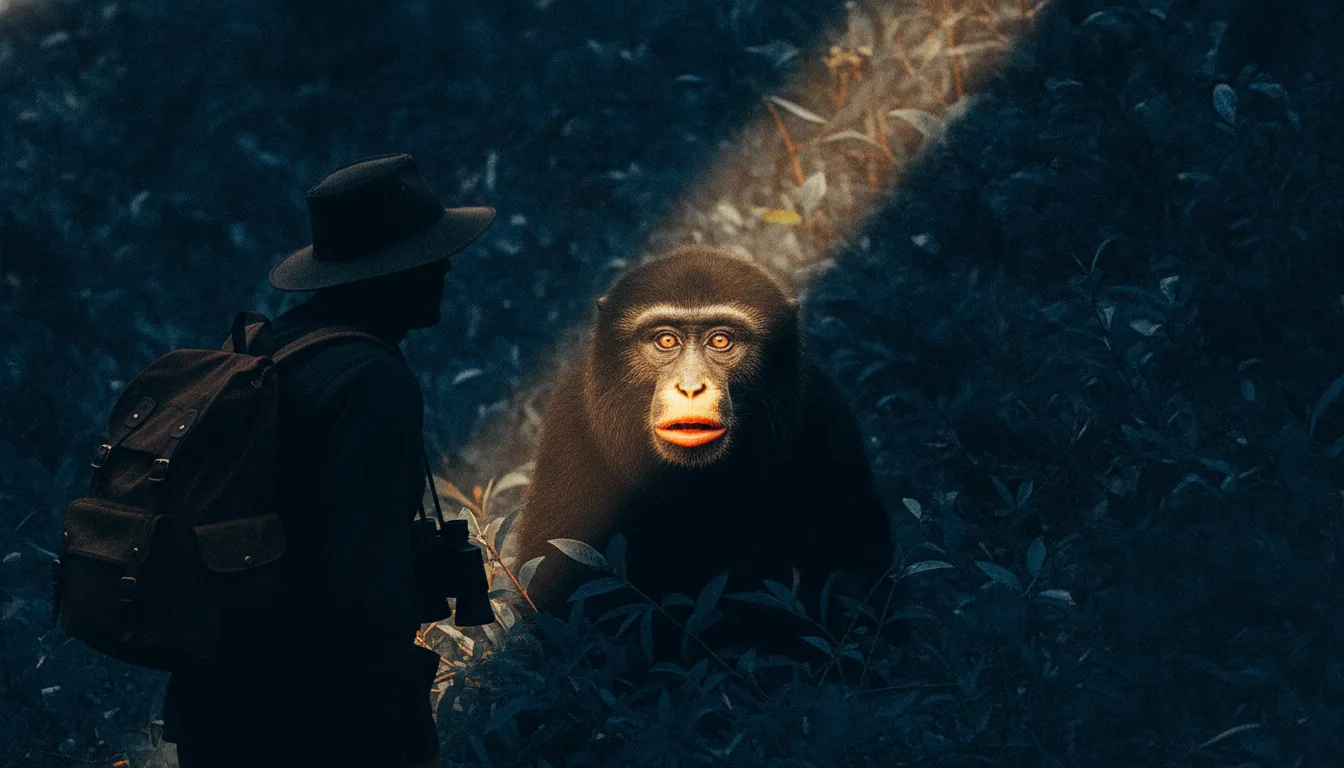
Scientists have officially identified a new monkey species in the Congo, known as Colobus congoensis, which features distinctive orange-cream lips and a lineage dating back five million years. This primate, known locally as the Likweli, was formally described in July 2026 after years of genetic analysis and field sightings. It represents only the fifth African monkey discovery in seventy-five years.
Imagine looking at a photograph so blurred it could be anything from a shadow to a smudge on the camera lens. In 2008, Bernard Ikembelo and Ashley Vosper stared at just such an image, captured deep in the Democratic Republic of Congo. It was a dark shape with a flash of something impossible: bright, orange-cream lips.
Scientists are usually quick to claim a breakthrough, but in the Lomami Basin, nature keeps its secrets with stubborn patience. Turning that digital smudge into a proven species required years of tracking, DNA analysis, and scientific grit. In reality, science is like grinding a telescope mirror by hand, slowly refining our vision until the blur becomes a sharp edge.
The Face with the Orange Smile
To understand why this discovery felt so impossible, you have to look at the monkey’s face. Its body is draped in deep black fur, but the nose and mouth are framed by startling patches of orange-cream or pinkish-orange. It looks less like a wild animal and more like a stage performer who forgot to remove his greasepaint.
While science only officially met the animal in July 2026, the people of the Lomami Basin have known this neighbor for generations. In the Kilanga language, they call it the Likweli, while the Mituku people know it as the kasaba nkoni. This discovery is essentially a formal translation of ancient local knowledge into the global scientific ledger, bridging two different ways of seeing the world.
The formal description published in the journal PLOS One gave it a new title: Colobus congoensis. Despite the Congo being a global powerhouse of biodiversity, this is the first monkey species named directly after the country itself. It serves as a biological tribute to the specific land that kept it secret for so long.
The Lomami Basin: A New Monkey Species in the Congo’s Isolated Heart
To find where this primate lives, look at a map of the Congo and find the two great liquid borders. Within the Lomami National Park, the Lualaba River guards the east, and the Lomami River defines the west. Between them sits a pocket of rainforest that behaves exactly like an island, even though it is surrounded by land.
Evolution often treats a wide, deep river exactly like an ocean, making a kilometer of open water an impassable abyss for a canopy dweller. This isolation created the Lomami Gap, a biological sanctuary where species have been quietly doing their own thing for millions of years. Now hold that thought.
The total habitat for this new monkey is estimated at just 1,700 square kilometers. Imagine the country of Luxembourg, then take away a third of it, and you have the entire world for every Likweli on the planet. Such a tiny footprint makes the discovery both a miracle and a warning.
A Five-Million-Year Evolutionary Path
When the researchers at Yale and Florida Atlantic University finally peered into the monkey's genetic code, they were looking at an evolutionary clock. By comparing DNA samples, they could count the tiny mutations that had piled up like dust on a very old, quiet shelf. The math returned a result that feels more like geology than biology.
This monkey has been walking its own evolutionary path for four to five million years, isolated and unseen. When this species first diverged, our own ancestors were barely walking upright on the African savanna. Since then, ice ages have come and gone, yet the Likweli simply kept being itself in the deep canopy.
By looking at the shape of its skull and its unique orange smile, researchers used morphological analysis to compare bone and fur. The DNA confirmed a lineage that has survived in total isolation since long before the dawn of humanity. We still don't know how many other secrets the Lomami Basin is guarding.
Protecting a species requires more than just high-tech genetic sequencing.
Roars from the Green Ceiling
On the forest floor, the Congo is a world of muffled shadows and damp decay. But eighty feet up, in the green ceiling, life operates on a louder, more aggressive frequency.
Most monkeys of this size are nimble acrobats that prefer to vanish before a leaf even stops shaking.
Colobus congoensis does not hide in the traditional silence of the hunted. Instead, it announces its presence with roar-like snorts that can tear through the thickest humid air. In the dense rainforest, where visibility is often less than ten meters, sound is the primary diagnostic tool.
While other colobus species have rhythmic honks, the Likweli’s roar was an acoustic anomaly that begged for visual confirmation. That proof finally emerged in 2018 when a patrol team led by Jean Pierre Kapale secured the first clear photographic record. Seeing it clearly turned a ghostly sound into a physical creature with defiant orange lips.
Rare African Primate Discoveries
In the world of biology, finding a new mammal is a career-defining event, but finding a new primate is a statistical anomaly. Since 1951, scientists have identified and formally described only five new African monkey species. This means that for every human generation, we only manage to shake hands with two or three "new" relatives.
This particular region of the Congo is becoming a repeat offender for these surprises. Identifying this new monkey species in the Congo was only possible because of the region’s unique geography. The 2026 naming of the Likweli directly mirrors the 2012 discovery of the Lesula monkey in the same basin.
Since this species diverged from its relatives four million years ago, it has survived through 160,000 generations of total isolation. To someone standing here in 1610, the idea of cataloging every life form on Earth would have been indistinguishable from magic. We still don't know how many more neighbors are out there.
Conservation Challenges for the Likweli
There is a bittersweet irony in the act of scientific naming. Giving Colobus congoensis a formal label means immediately drafting its survival plan. Researchers recommended an "Endangered" status the moment it officially stepped onto the global stage.
The orange-lipped primate is a biological marvel, yet it faces concrete human threats. The commercial bushmeat trade and habitat loss are constant shadows over the Lomami Basin. Protecting them means answering the "so what" for the communities who have lived alongside the Likweli for centuries.
We still don't know the exact population count or the intricate details of their social lives. We still don't know if they can survive outside the thin protection of the national park. Every sighting of this new monkey species in the Congo reminds us that the green ceiling still holds untold stories.