Ice, Rock, and River: What the Satellite Saw on August 26
The 1970 Huascarán avalanche in Peru killed roughly 20,000 people in under four minutes - a mountain simply came apart, and the Andean communities below it had no name for the process that had undone them. The comparison to the Bhotekoshi-Trishuli valley on August 26, 2026, is tempting, and like most tempting comparisons it misleads: Huascarán was a single seismic trigger, a discrete event. What the satellite record shows above Nepal that morning is more complex, and the complexity matters enormously for what comes next.
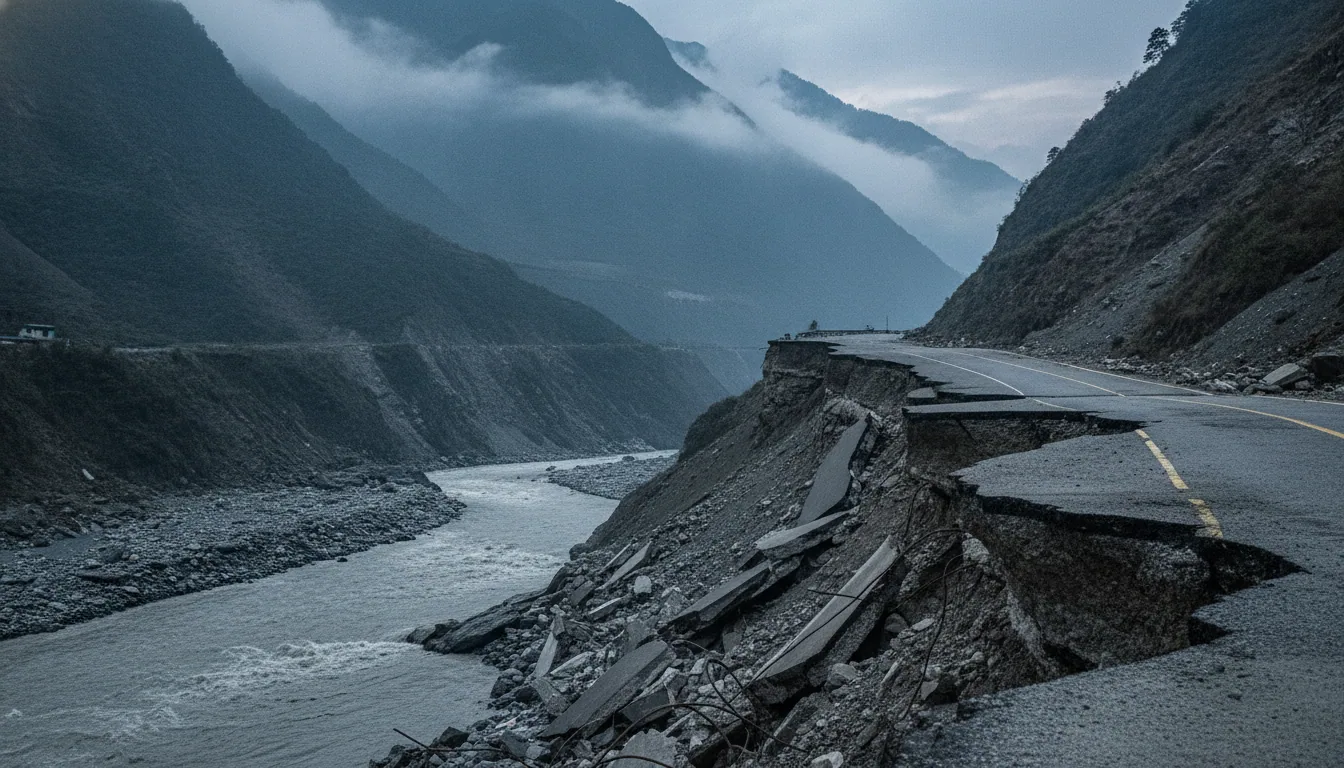
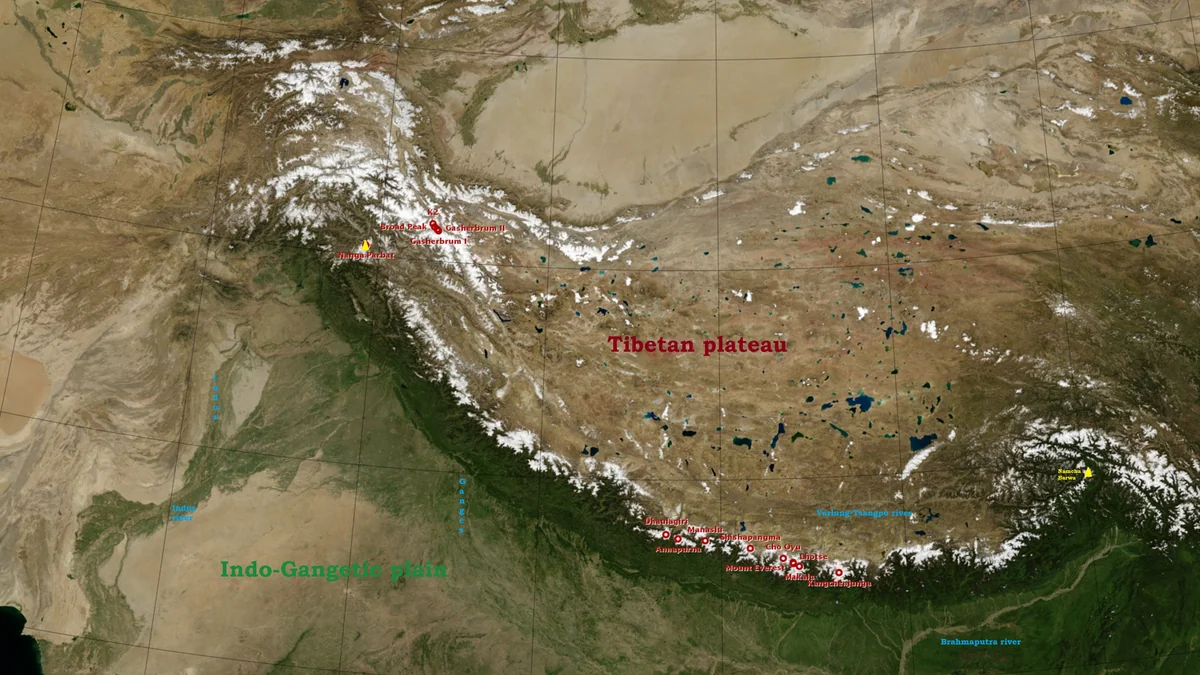
Imagery analysed in the disaster's aftermath identified not one cause but three operating in combination: an ice avalanche, permafrost movement, and a rockslide. The Hindu Kush Himalayas are warming at roughly twice the global average, and permafrost that has held high-altitude slopes in place for centuries is no longer reliable architecture. When the mountain above the Bhotekoshi-Trishuli valley gave way, it did not choose a side of the border: the avalanche began on Nepali territory and crossed into China, leaving damage on both faces of the Himalayan divide.
By early September, the confirmed dead numbered 1,344, with approximately 5,600 people still missing. Those are the figures the record holds; the actual toll, on both the Nepali and Tibetan sides of the border, is not yet known. The physical event is not in dispute.
What the satellite cannot resolve - and what no satellite will - is the question at the heart of Nepal's climate justice claim: a formal diplomatic note to the United Nations arrived six days later asking who is responsible for the conditions that made the mountain come apart.
A Nation's Arithmetic of Ruin
The numbers are not metaphors. Economic losses from the August 26 disaster are estimated between $4 billion and $7 billion - roughly 10 percent of Nepal's entire gross domestic product, erased in the hours it took a mountainside to reach the valley floor. A single flood event produced a damage bill that would strain the treasuries of nations ten times Nepal's size.
The hydropower figure is more specific, and in some ways more damning. The disaster destroyed 10 percent of Nepal's installed hydropower capacity - infrastructure that had taken decades and considerable international financing to build. Nepal, a country that exports electricity to its neighbours during normal seasons, was converted into an importer.
Somewhere a grid operator updated a flow chart, and the arithmetic of the national economy quietly shifted direction.
Set against this, Nepal's share of global greenhouse gas emissions: less than 0.1 percent. The United States alone accounts for roughly 25 percent of cumulative historical CO2 output. The disproportion is not a rhetorical flourish - it is the load-bearing fact on which the entire legal claim rests.
Nepal did not cause the warming that destabilises the Hindu Kush permafrost; it absorbed the consequence. This is the structural condition that Foreign Minister Shisir Khanal's letter to the Fund for Responding to Loss and Damage attempts to translate into a legal instrument. Whether the instrument holds is a different question.
But the arithmetic itself is not contested - and any framework that processes climate liability while ignoring it is describing a different problem than the one Nepal is living.
From Supplicant to Plaintiff: The Logic of Nepal's Climate Justice Claim
On September 1, 2026, Foreign Minister Shisir Khanal sent a formal demand letter to the co-chairs of the UN Fund for Responding to Loss and Damage. The letter names the United States, China, and India as principal liable parties, grounded in their historical greenhouse gas emissions. It demands $20 million in immediate compensation.
The word choice is the strategy. Nepal did not request emergency relief. It demanded compensation - a single rhetorical step that carries structural weight, because it presupposes liability rather than generosity.
"This is not a matter of charity; it is a matter of legal and moral liability," Khanal stated publicly. The distinction between those two sentences is the difference between a supplicant and a plaintiff, and Nepal chose the second word deliberately.
This is what the practical shift looks like for any government watching from Kathmandu or Dhaka or Suva: the aid model places the burden of proof on the victim, who must demonstrate need. The liability model places the burden on the emitter, who must rebut causation. Nepal contributes less than 0.1 percent of global greenhouse gas emissions.
The United States alone accounts for roughly 25 percent of cumulative historical CO2 output. That asymmetry is not a rhetorical flourish - it is the load-bearing argument in the claim.
Ask the small question first: who is the borderland here, and who is the empire? Nepal's answer, filed in writing on September 1, is that the borderland now has legal standing to ask. Whether the fund's board treats that standing as a live question or a procedural inconvenience is what the next weeks will determine.
Nepal did not cause the warming that destabilises the Hindu Kush permafrost; it absorbed the consequence.
The Load-Bearing Opinion: The ICJ and the Polluter-Pays Principle
The legal scaffolding for Nepal's September claim was laid fourteen months earlier, in a Geneva conference room where no avalanche debris had settled and no river ran brown. On July 23, 2025, the International Court of Justice issued its Advisory Opinion on state obligations for climate harm - the first time the court had mapped, in systematic terms, the legal duty of states to protect the climate system. Nepal's foreign ministry had prepared for that moment.
In December 2024, Kathmandu had submitted its own position to the ICJ proceedings, framing the argument that vulnerable states cannot meet their human rights obligations when climate disasters consume the national economy.
The polluter-pays principle is old enough to seem obvious. What the 2025 opinion did was give it an address - a recognizable doctrinal home inside the law of state responsibility, close enough to binding judgment that a government could attach a monetary figure and call it a claim, not a plea. Nepal's lawyers read that distance carefully.
An advisory opinion is not a ruling; the ICJ tells you what the law is, not what the defendant owes. The scaffolding holds on the side of obligation. Where it gives is enforcement.
Still, Nepal filed. The September 1 loss and damage claim against the Fund for Responding to Loss and Damage is, by any reading of the record, the first major test case for a mechanism that has so far processed pledges and procedures rather than payouts. The FRLD carries $822 million in total pledges; Nepal is asking for $20 million from a single disaster that erased roughly ten percent of its GDP.
The arithmetic is not complicated. Whether the fund's board will treat the ICJ opinion as load-bearing or as decorative moulding - that is the question the claim forces into the open.
The Fund and Its Arithmetic
The numbers are plain. Total pledges to the Fund for Responding to Loss and Damage stand at $822 million; of that, $350 million is currently allotted for disbursement. Nepal's documented losses from a single event run between $4 billion and $7 billion.
Compare the fund to the Marshall Plan and the comparison flatters no one - the Marshall Plan was undersized for its moment too, but it at least pretended to match the scale of the wreckage. The FRLD does not pretend. A mechanism whose entire disbursable capacity is roughly one-twentieth of one small nation's flood losses is not a financial instrument; it is a gesture recorded in a ledger, which is a different thing.
The United States, historically responsible for roughly 25 percent of cumulative global carbon emissions, has now withdrawn from the funding mechanism entirely. President Trump's characterisation of climate change as a hoax is the stated reason. The departure does not merely reduce the fund's capitalisation - it removes the architecture's largest load-bearing contributor and signals to every other reluctant donor that the exit door is open.
The structural gap between the fund's design and its purpose is not a technical flaw awaiting a patch. It is the design. Wealthy emitters agreed to a mechanism generous enough to be photographed signing but modest enough never to threaten a treasury.
Nepal's claim exposes this in the only way that cannot be ignored: by doing the division in public and publishing the remainder.
The Scientist's Caveat and the Marker to Watch
Satellite imagery analysed by senior divisional hydrologist Binod Parajuli identifies the August 26 event as a compound failure: ice avalanche, permafrost movement, rockslide, each layer compounding the next. That forensic precision is useful for engineers. For lawyers, it is the beginning of a much longer problem.
Attribution science is now the legal gatekeeper, and it moves on its own schedule. Confirming that a specific mountainside failure in the Bhotekoshi-Trishuli valley was materially caused by warming driven by identifiable emitters requires multi-decadal climate modeling, counterfactual scenarios, and peer review. The process can take years.
A claim filed in September 2026 can be procedurally correct and scientifically incomplete at the same time, and the FRLD's technical secretariat knows the difference. This is the soft fact that may bury the hard claim in a modeling queue while 5,600 people remain listed as missing.
Nepal contributes less than 0.1 percent of global greenhouse gas emissions against the named respondents' combined historical share that dwarfs any reasonable proportionality argument. The science, when it arrives, will likely confirm what the physics already suggests.
The one marker worth watching is narrow and concrete: whether the FRLD board convenes an emergency session in the next sixty days or silently routes Nepal's climate justice claim through the standard eleven-step funding cycle. Emergency session means the fund is a mechanism. Standard routing means it is a monument, and the next small nation watching will have learned exactly what the arithmetic was always telling them.