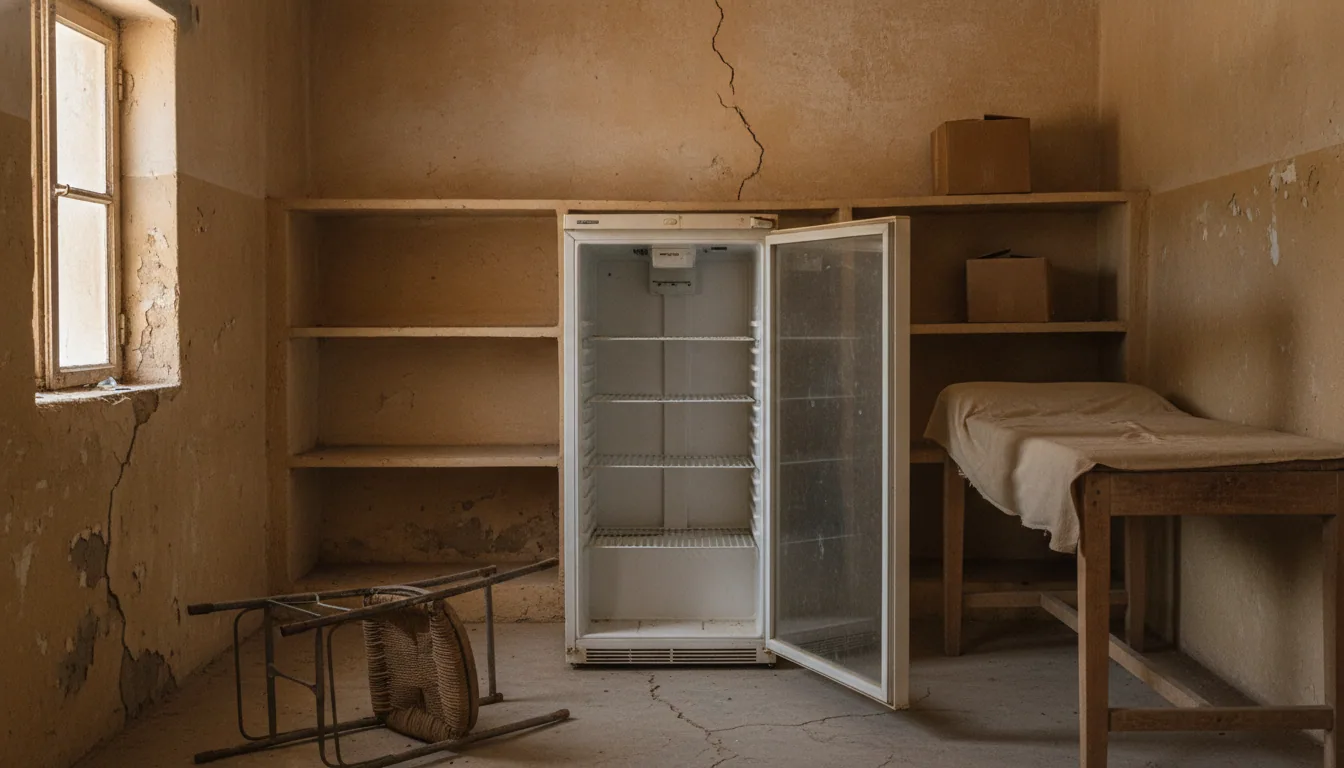
The Shelves Ran Out in Late 2025. Nobody Has Refilled Them.
The last routine vaccine shipment arrived in Houthi-controlled northern Yemen in September 2025. After that, nothing. By late 2025, the stocks were completely depleted. No measles vaccines. No polio vaccines. No top-ups coming.
That is not a bureaucratic delay. That is a wall.
Right now, approximately 5 million children in Houthi-controlled areas are living without access to routine immunization - the human face of Yemen's vaccine crisis. Five million. To understand what that number means at the household level, consider what routine vaccination actually does: it is the quiet infrastructure of childhood. A measles shot given at twelve months. A polio dose before a child starts walking to school. Vaccines that most parents in wealthy countries have never had to think about, because the system delivered them without asking.
In northern Yemen, that system stopped delivering nine months ago and has not restarted.
Routine immunization is not a luxury program. It is the baseline. When it collapses, the diseases do not wait politely. They move into the gap immediately, and they find the youngest children first - the ones born after the last shipment arrived, the ones who never got their first dose.
Five million children is not a statistic you can hold in your head. Try this instead: it is roughly the entire child population of Denmark and Finland combined, all unvaccinated, all in a conflict zone, all right now.
The shelves ran out. The question the rest of this article asks is simple: who decided not to refill them, and why.
They Called It a Western Conspiracy. Then They Locked the Door.
Banning door-to-door vaccination campaigns takes a specific kind of conviction. Not the logistical "we don't have fuel for the vehicles" kind. The kind where you stand in front of a policy decision and say: these vaccines are a foreign intelligence tool, and we will not allow them into our homes. That is what Houthi authorities in Sanaa have done, branding routine childhood immunization as a Western conspiracy. A logistical failure can be fixed with a supply chain. An ideological prohibition is a different problem entirely.
The practical consequences stack quickly. Without house-to-house campaigns, coverage in conflict zones collapses - that is not a guess, it is documented across every major outbreak response since the 1990s.
In communities where clinics are damaged, where roads are controlled by armed checkpoints, where parents work twelve hours and cannot easily travel, the door-to-door visit is not a convenience. It is the system.
Then came the detentions. Since May 2024, Houthi authorities have detained dozens of UN and NGO personnel, including 17 UN staff members. The health term for what follows is "chilling effect." The practical meaning is simpler: if your monitors are in detention, you cannot verify what is happening. If you cannot verify, you cannot respond. The data stops moving. The outbreak keeps moving.
This matters beyond Yemen's borders because the logic is now structural. The authorities in Sanaa have not paused vaccination access pending negotiation. They have built an ideology around refusing it. What cannot be monitored cannot be corrected. What cannot be corrected spreads. That is what policy feels like when the obstruction is deliberate and the door is bolted from the inside.
Yemen's Immunization Collapse: Polio, Measles, and Cholera Fill the Space
When vaccine coverage collapses, the diseases do not wait. They move into the gap immediately, predictably, and without mercy.
Yemen had been polio-free since 2006. That declaration took years of work, millions of doses, and thousands of health workers knocking on doors. It was lost. Since 2021, Yemen has recorded 451 cases of circulating vaccine-derived poliovirus type 2 - and 96% of those cases are in children under five.
This is what vaccine-derived poliovirus means in practical terms: the virus mutates and spreads when coverage is too low to stop it. The vaccine works when enough children receive it. When coverage falls, the protection disappears and the disease returns in a new form, harder to fight than the original.
Measles is the same story, told faster. In 2024, Yemen recorded 27,517 measles cases and 260 deaths. Then, between October 2025 and March 2026 - after the last vaccine shipment arrived and stocks ran out - another 11,354 cases appeared. Measles requires roughly 95% coverage to stop transmission. In some Yemeni regions, first-dose coverage sits at 41%.
Do the arithmetic. At 41% coverage, almost six in ten children are unprotected. In a country with overcrowded displacement camps, bombed hospitals, and collapsing water systems, measles travels fast. So does cholera.
The cholera outbreak that began in March 2024 had, by early 2026, produced 339,371 suspected cases and 1,102 deaths. Cholera is a disease of contaminated water and overwhelmed health infrastructure. It is treatable. It is preventable. In a functioning system, it does not kill a thousand people over two years.
These three outbreaks are not coincidental. They are concurrent and interconnected - the result of the same supply chain failure, the same blocked campaigns, the same funding gap. When one disease gains ground, health workers are pulled away from the others. The system that might have caught each outbreak early no longer has the capacity to catch any of them.
That is what empty shelves produce. Not just absence. Replacement.
More Than 450 Clinics Have Closed. The Ones Still Open Are Nearly Empty.
Picture a health clinic that still technically exists. The door is unlocked. A nurse shows up. But the refrigerator that should hold vaccines has been running on fumes for months, and now it holds nothing, because there has been nothing to hold since September 2025. The cold chain does not break dramatically. It just quietly stops being useful.
Across Yemen, 59% of health facilities remain fully functional. That number sounds like a majority until you think about what it means for the other 41%. Between 2025 and 2026, more than 450 health facilities closed due to resource shortages - 76 of them hospitals. Not temporarily suspended. Closed.
The cold-chain infrastructure in the north is a particular kind of problem. Refrigeration equipment requires maintenance, electricity, and something to keep cold. After a year without vaccine deliveries, the capacity to store vaccines - even if a shipment somehow arrived tomorrow - has quietly deteriorated. You cannot just switch it back on.
When a clinic closes in a city, patients find another one. When a clinic closes in a rural Yemeni governorate, families walk further, then stop walking. The distance becomes the answer. They go without. There is no secondary option listed on any form, no other address to try. The closure is the end of the road.
This is what a funding gap looks like from the inside - not a budget line, but a locked door and a refrigerator that no longer matters.
It is a choice made by people sitting in capitals far from Yemen's clinics.
Seventy-One Point Nine Million Dollars Was Needed. Nine Million Arrived.
Here is what donor fatigue looks like in practice. UNFPA reported an 87% funding gap as of March 2026: $9 million received of the $71.9 million required. The 2025 Humanitarian Needs and Response Plan for Yemen was funded at 29%. Not a shortfall. A collapse.
When a response plan is 71% short, something has to give. What gives is the shipment that doesn't get ordered, the cold chain technician who stops being paid, the surveillance officer who disappears from the district roster. MSF warned in 2026 that funding cuts have significantly weakened disease surveillance and outbreak response - which means outbreaks are not caught early, they are caught late, when children are already sick and hospitals are already overwhelmed.
This is what makes the comparison with other humanitarian crises so damning. Yemen is not an obscure emergency that slipped beneath the radar. It has been the world's largest humanitarian crisis for years. The international community knows the geography, knows the disease profile, knows that 5 million children in the north have no vaccines. It knows. And still the plan arrived 71 cents short of every dollar it needed.
Compare this to the southern response. In government-controlled areas, where international partners could actually operate, polio transmission was interrupted by March 2026.
A July 2025 campaign reached 1.3 million children with the novel oral polio vaccine. IOM reached 13,700 children in Marib during August 2026 emergency measles campaigns. The infrastructure was fragile, the conditions were terrible, and it worked.
The north has a Houthi problem. But the south had a funding problem too, and the funding came. Thirty percent of a plan is not an inevitability. It is a choice made by people sitting in capitals far from Yemen's clinics.
In the South, They Stopped Polio. That Matters More Than It Sounds.
In July 2025, health workers in IRG-controlled areas vaccinated 1.3 million children using the novel oral polio vaccine type 2, nOPV2. By March 2026, cVDPV2 transmission had been successfully interrupted in southern Yemen. That sentence deserves a moment. In a country recording 451 polio cases since 2021, in a region where 96% of victims are children under five, one part of Yemen actually stopped the virus.
In August 2026, IOM reached 13,700 children in Marib with emergency measles campaigns. Marib holds some of the highest concentrations of displaced people in the country. Getting vaccines to those children required logistics, funding, and access. All three existed in the south. None of them exist, consistently, in the north.
The same disease. The same region. Two different outcomes. The difference is not geography or luck. It is access and money and whether authorities allow health workers through the door.
WHO's own language points to what the south proved possible: "sustained and flexible donor support is essential to maintain immunization coverage." That is not a complicated prescription. It means showing up with funding before the outbreak, not after the headlines. It means keeping campaigns running when they are boring and preventable, not just when they are catastrophic and visible.
The south interrupted polio. That is a proof of concept, not a consolation prize. The Yemen vaccine crisis will not resolve through headlines or goodwill - it requires the donors who funded that southern campaign to keep showing up, before five million children in the north run out of time.