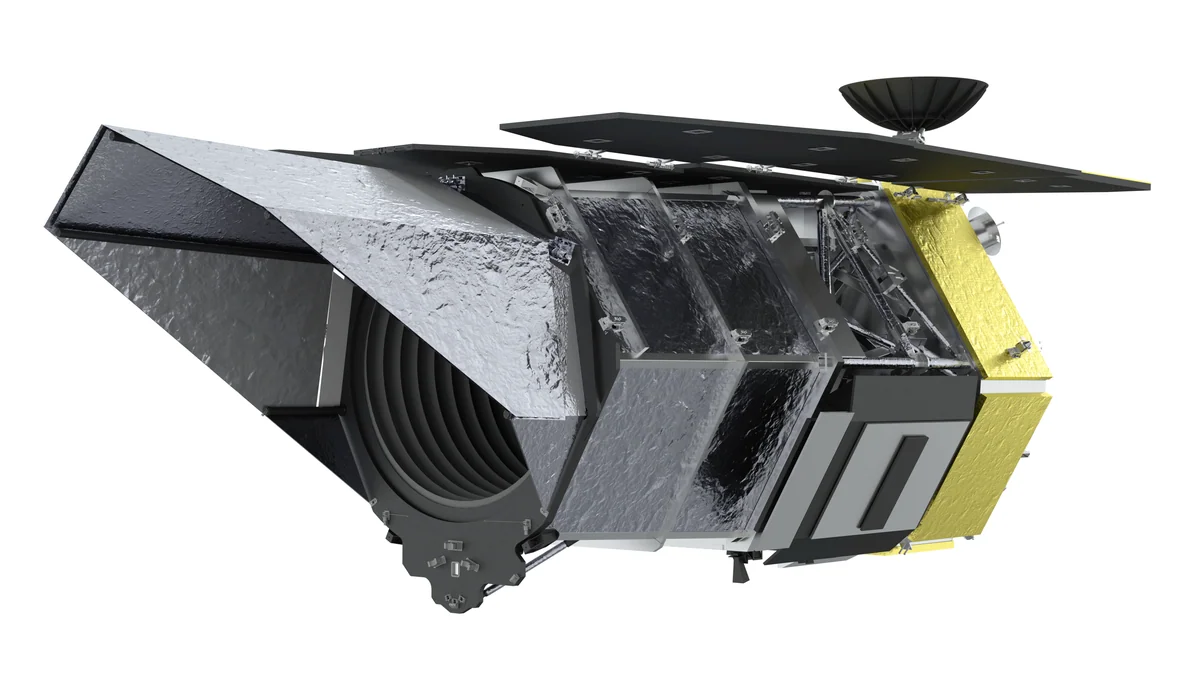
Thirty Minutes Over the Atlantic, and Then a New Observatory Existed
At 7:26 in the morning, Florida time, NASA's new space telescope left Earth with a quiet reliability that still somehow astonishes. A rocket the size of a sixteen-story building lit its engines at Kennedy Space Center and pushed eighteen thousand pounds of precision optics into the sky. That was the straightforward part.
Here is the strange part: two of the three booster cores then turned around, flew themselves back to Cape Canaveral, and landed upright, side by side, like a practiced stunt. The SpaceX Falcon Heavy's reusable side boosters touched down within seconds of each other while the rocket's upper stage — and the telescope riding it — continued climbing. Thirty minutes after liftoff, the Nancy Grace Roman Space Telescope separated cleanly from the upper stage, and a new observatory quietly blinked into existence above the atmosphere.
Back on the ground, the phones were already ringing. President Donald Trump called NASA to congratulate agency officials, calling the launch "beautiful." NASA Administrator Jared Isaacman took the call. It was, by any reading, an unusual grace note to a morning already dense with technical milestones.
What had just left Earth was a machine four billion dollars in the making, bound for a gravitational parking spot 1.5 million kilometers away, at a place called Lagrange Point 2. It carries a mirror exactly as wide as Hubble's, but it sees a patch of sky roughly a hundred times larger in a single glance. The universe, as of August 30, 2026, was about to be mapped at a scale nobody has attempted before.
The Same Mirror as Hubble, but a Hundred Times the Sky
Roman's primary mirror is 2.4 meters across. That is exactly the same diameter as Hubble's. Hold that fact for a moment, because what follows is where the instrument stops being familiar.
The field of view is between 100 and 200 times wider than Hubble's infrared eye. Imagine you are looking at the night sky through a drinking straw. Now replace the straw with a porthole. The angular area of sky that Hubble captures in one exposure, Roman captures in a fraction of a second, and then sweeps on. A single full-resolution image from its 300-megapixel wide-field camera covers a patch of sky equivalent to 45 city blocks. One photograph. Forty-five blocks.
The camera produces that image at a resolution that does not smear or soften the edge of what it is watching. This is precision at panoramic scale, which is genuinely unusual. Most optical systems trade one for the other.
To do this without interference from Earth's atmosphere and orbital debris, Roman is not staying anywhere near home. It is traveling to Lagrange Point 2, a gravitationally stable position 1.5 million kilometers out, where the gravitational pulls of the Earth and the Sun balance in a way that lets a spacecraft hover without burning constant fuel. The James Webb Space Telescope is already parked there. Roman will be its neighbor.
The entire mission carries a price of $4.3 billion, which sounds large until you divide it by the number of stars it will survey. The arithmetic becomes absurd quickly, and deliberately so. Scale is Roman's instrument, and the engineers who built it knew exactly what they were constructing: not a telescope that looks deeper, but one that finally looks wider.
What Roman Is Actually Looking For: The Invisible Architecture of the Universe
Ninety-five percent of the universe is missing. Not lost, exactly. We can measure its gravitational fingerprints, watch galaxies behave as though something unseen is holding them together or pushing them apart. But dark matter and dark energy have never been directly caught in a detector, photographed, or given a satisfying explanation. Roman's deepest purpose is to map those fingerprints at a scale never attempted before, hoping that a wide enough view will finally reveal the pattern hiding behind the pattern.
Dark matter acts as gravitational scaffolding, the invisible framework on which galaxies are strung like beads. Dark energy does the opposite, a repulsive pressure accelerating the universe's expansion. Together they account for roughly 95 percent of everything that exists. Roman will survey vast swaths of sky, tracking how galaxies cluster and how light bends around things that cannot be seen, building the most detailed map yet of where that missing 95 percent actually lives.
Planets are the other quarry. Through gravitational microlensing, Roman will watch background stars flicker as a passing planet's gravity momentarily bends their light, a cosmic magnifying trick that reveals worlds too faint and distant to see directly. Scientists expect between tens of thousands and 100,000 new exoplanets from this method alone. The numbers are staggering only until you realize Roman is essentially conducting a census of the galaxy's entire planetary population in a single five-year survey.
Then there is the coronagraph, an experimental instrument that physically blocks a star's light so faint orbiting planets can be photographed directly. Whether it can image something Earth-sized, or only larger gas giants, remains an open question. What Roman can do, though, is act as a scout, flagging the most intriguing targets for the James Webb Space Telescope to examine in close-up detail. Wide net first, then the magnifying glass.
Two Thousand Five Hundred Terabytes, or: How Astronomy Becomes a Data Science
Julie McEnery, the mission's senior project scientist, once said Roman will "redefine what it means to find a needle in a haystack." That is a memorable line. What makes it more than rhetoric is a specific number: 2,500 terabytes.
That is how much data Roman will send home over its five-year primary mission. Hubble, across thirty years of operation, accumulated 172 terabytes — Roman will lap that total roughly fourteen times over, and it will do so while scanning the sky approximately one thousand times faster than its famous predecessor. Pause on that ratio for a moment: one thousand times. If Hubble was a person reading a city's worth of books one page per minute, Roman tears through the same library before lunch.
Roman is traveling toward an answer we have not yet had the wit to fully ask.
The consequence is not just speed. It is a structural shift in how astronomy gets done. No team of human eyes can triage a river of data that wide and that fast, which means automated pipelines and machine-learning classifiers will make the first cut on most discoveries. The astronomer's job migrates upstream toward designing the questions and downstream toward interpreting the answers. The middle, the patient squinting at plates, largely disappears.
Roman does not work alone in this new landscape. Its survey data feeds directly into a collaboration with ESA's Euclid spacecraft and the Vera C. Rubin Observatory in Chile, a ground-based telescope built for exactly this kind of sky-spanning census work. The three instruments together form something like a distributed nervous system for cosmological observation — each catching what the others miss, each amplifying the others' reach.
The Mirror That Used to Watch the Earth
The telescope now heading toward the edge of the inner solar system was, not long ago, pointed in exactly the opposite direction. Roman's primary mirror, 2.4 meters across, was originally built for a classified reconnaissance satellite, a piece of hardware designed to photograph cities from orbit. The National Reconnaissance Office donated it to NASA, and engineers who once aimed optics at human geography are now using the same glass to map the geometry of the cosmos. A spy mirror, repurposed for wonder.
Compare that to Hubble, whose mirror famously left the factory subtly wrong, ground to the wrong prescription, and required a corrective lens fitted by astronauts in 1993. Roman's donated optic arrived already tested, already precise. A hand-me-down that needed no fixing.
The telescope is named for Nancy Grace Roman, who died in 2018 and never saw the mission fly. Roman was NASA's first chief of astronomy, its first female executive, and the relentless institutional force behind Hubble itself: she spent years convincing Congress that a space-based telescope was worth the money. It is a fitting inheritance. She built the argument for one era's great observatory; her namesake is the next one. The telescope weighs 18,000 pounds, roughly the mass of two adult male African elephants, and carries, at its heart, a mirror that has been watching things from orbit for decades. It just took a while to point it at the right sky.
The Questions NASA's New Space Telescope Cannot Answer Yet
Roman's primary mission runs five years. But the spacecraft was built with a longer argument in mind: design features that allow for robotic refueling could extend its life to a decade, though no refueling mission is yet scheduled, funded, or even firmly proposed. Five years is the promise. Ten is the hope. The gap between them is paperwork and politics.
The coronagraph is similarly hedged. It will block starlight to reveal faint companions orbiting nearby stars, but whether it can resolve something as small as an Earth-sized planet, or whether it tops out at gas giants, remains genuinely open. The instrument is experimental. That word carries real weight here.
Then there is the Hubble Tension: the stubborn fact that two different methods of measuring the universe's expansion rate give two different answers. Roman's data may sharpen one side of that argument, or complicate both, or reveal that the question itself needs reframing. Nobody knows yet, which is precisely the point.
First light, that ceremonial first image from NASA's newest space observatory after the three-month journey and commissioning phase, has no firm date. Roman is traveling toward an answer we have not yet had the wit to fully ask. That, historically, is exactly when science gets interesting.