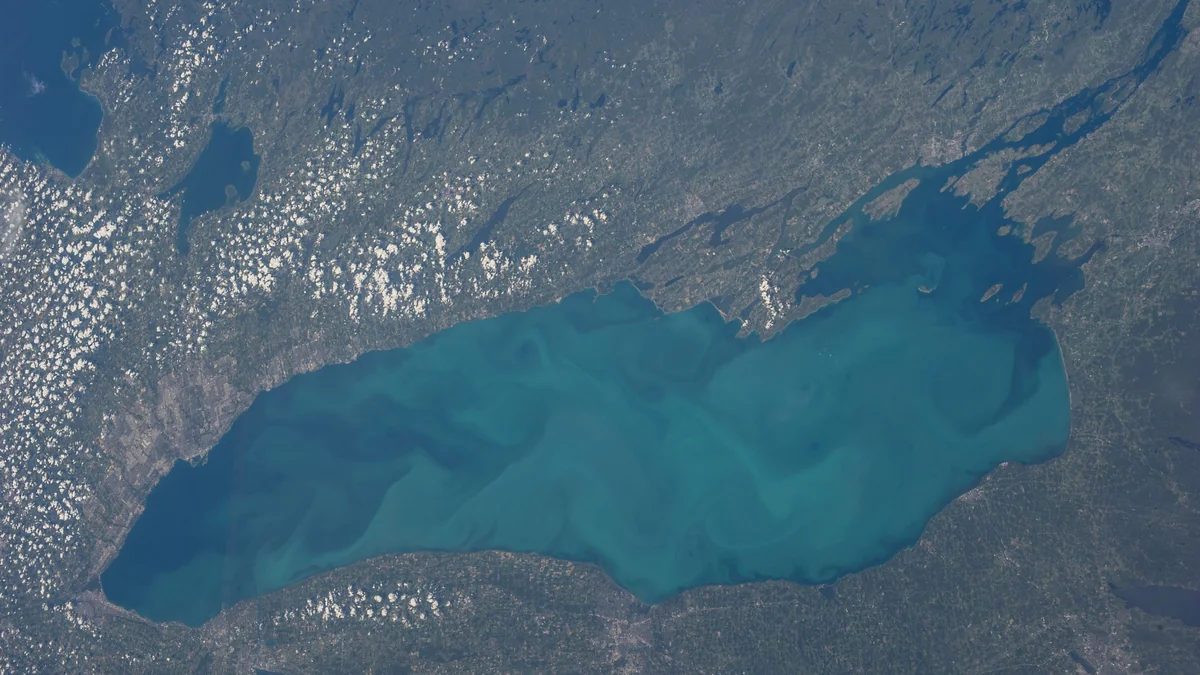
Yes, This Actually Happened: Lake Ontario Has Been Officially Renamed and the Order's Title Is Longer Than the Lake Is Wide
Imagine waking up one morning, looking out at the same body of water you've looked at your entire life, and being informed by the federal government that you've been pronouncing it wrong. Not mispronouncing it, exactly. Just calling it by the name it has had for four hundred years. The correct name, effective August 27, 2026, is Lake America. Congratulations to the lake.
Executive Order 14420 is a real document that a real president signed with a real pen. Its full title is "Honoring the American History of the Great Lakes and Renaming Lake Ontario as Lake America," which is a sentence that works very hard to sound like it was written by someone who believes in what they're doing. The title alone is doing more cartographic heavy lifting than any body of water should have to witness.
Here's the thing: this is not a first offense. On January 20, 2025, the same administration renamed the Gulf of Mexico the Gulf of America, and the world kept spinning, which was apparently interpreted as permission to continue. One renaming is a stunt. Two renamings are a pattern. A pattern, at the federal level, is called a policy, which means someone, somewhere, is now formally employed to think of new things to rename, and that is somehow the most alarming detail in this entire story.
The Official Justifications, Which Are Real and You Should Treat Them With the Gravity They Deserve
The White House did not, to its credit, just say "because we felt like it." There are reasons. Official, documented, executive-order-grade reasons. Let's examine them with the seriousness they deserve, which is a very specific and limited amount.
Justification one: the United States has invested $4 billion in the Great Lakes ecosystem over the last decade. This is real money. Genuinely spent. Nobody is disputing the investment. The logic connecting "we spent money on an ecosystem" to "we rename the lake in that ecosystem" is doing so much heavy lifting here that it has developed a stress fracture — and is currently lying on the ground making small whimpering noises.
Justification two: nine of the eleven Great Lakes icebreakers are U.S. Coast Guard vessels. Again, factually accurate. Also the kind of reasoning that, if applied consistently, would mean the country with the most garbage trucks in a shared landfill gets to rename it. Maritime operational dominance does not, in any established legal tradition, constitute cartographic authority. It constitutes having a lot of icebreakers.
Here's the thing about these justifications that nobody wants you to understand: they are not actually justifications. They are decorations. The actual geopolitical backdrop is $20 billion of Canadian goods hit with 50% tariffs — automotive parts, steel, wine, dairy — in a trade war that had been escalating for months. The icebreakers are not the point. The $4 billion is not the point. The lake is a lever, dressed up in a spreadsheet and handed to the Department of the Interior.
What the Lake Ontario Renaming Actually Changes — Which Is Considerably Less Than Advertised
So what does Executive Order 14420 actually change, mechanically, in the physical universe? The Department of the Interior and the Board on Geographic Names have 30 days to update the Geographic Names Information System — which is the federal database that tells federal agencies what to call things. That's it. That's the scope.
The name change is legally binding for exactly one category of entity: U.S. federal agencies. Your passport office, your Army Corps of Engineers, your Department of Commerce letterhead. The lake itself is unimpressed. Canada, which owns approximately 53% of Lake Ontario's surface area, was not consulted, will not comply, and has the legal standing of two functioning international treaties to back up its general attitude of "no."
Those treaties are the 1909 Boundary Waters Treaty and the Treaty of Ghent — both of which identify the body of water as Lake Ontario, in ink that dried well before anyone currently alive had opinions about anything. Treaties, unlike executive orders, require international agreement to rewrite. This is the kind of detail that matters enormously to lawyers and not at all to whoever drafted this order.
The practical outcome is something like this: American federal maps will say "Lake America." Canadian maps will say "Lake Ontario." The lake will continue to be a lake. Commercial shipping operators will need to figure out which document their contract references. International navigation systems will presumably not reorganize themselves because one government renamed half of a shared body of water. The 53% that belongs to Canada does not, under any reading of geometry or treaty law, rename itself at the request of the other 47%.
Renaming something doesn't erase what it was called. It just tells you something about who's doing the renaming — specifically, it tells you they're someone who found the old name inconvenient, which is a category of person that has never once, in the entire historical record, turned out to be the hero of the story.
A Brief, Unsolicited History of the Word You Just Crossed Out
The Wendat people stood at the edge of a very large, very cold lake sometime in the early 1600s and named it Ontari'io — meaning "beautiful lake" or "big lake," depending on which linguist you ask, though both translations are doing more honest geographic work than "Lake America" has managed in its entire 24 hours of existence. That name stuck for over 400 years. It survived wars, treaties, two separate nations assembling themselves out of colonial paperwork, and roughly fourteen different European powers deciding they owned something they had never actually seen.
The Wendat named this thing before Canada existed. Before the United States existed. Before the concept of an executive order existed. Before anyone in Washington had figured out what Washington was, the name was already there, sitting in the language of people who actually lived beside the water and presumably had opinions about it.
Renaming something doesn't erase what it was called. It just tells you something about who's doing the renaming — specifically, it tells you they're someone who found the old name inconvenient, which is a category of person that has never once, in the entire historical record, turned out to be the hero of the story. The lake was Ontari'io when the Wendat named it. Mark Carney called it Lake Ontario when he said "naming reality means calling it Lake Ontario — then, now and always." The lake itself, predictably, had no comment.
The Part Where Basically Everyone Involved Says No, Including Someone Who Lives in the Same Country
Normally when you rename something, it helps to have the cooperation of at least one person who lives near the thing you're renaming. Executive Order 14420 did not manage this. Canadian Prime Minister Mark Carney, who presumably checked a map before responding, offered the following devastatingly calm rebuttal: "Naming reality means calling it Lake Ontario — then, now and always." He also noted the name is over 400 years old, predating both the Confederation of Canada and the Declaration of Independence, which is the diplomatic equivalent of showing up to an argument with receipts, a lawyer, and a time machine.
New York Governor Kathy Hochul, who represents actual Americans who live next to the actual lake, kept it even shorter. "New York won't be calling it that." No footnotes. No explanatory paragraph. The whole rejection fits in six words, which may be the most efficient thing a politician has produced in years.
Ontario Premier Doug Ford called it "real foolishness" and addressed the President directly as "buddy," which is either the most Canadian insult imaginable or exactly the right register for this conversation. Nova Scotia Premier Tim Houston took to social media to express similar enthusiasm. British Columbia Premier David Eby suggested a boycott of U.S. travel. The chorus of rejection spans two countries, at least three levels of government, and one Premier who apparently decided diplomacy should rhyme with a bad Yelp review.
What Happens When You Say the Wrong Name — and What Comes Next, Which Is More of This
The Associated Press already has a file on what noncompliance costs. After the outlet declined to use "Gulf of America" in its reporting, White House correspondents found their access restricted, which is a very civilized way of saying the administration punished a news organization for using a word that predates the current presidency by approximately four centuries. That's the documented precedent. The compliance infrastructure is not hypothetical; it is operational and road-tested.
Trump has also floated, in the same conversational register one uses to discuss lunch options, renaming the Atlantic or Pacific oceans. Whether that is a joke or a roadmap is genuinely unclear, and the fact that it is genuinely unclear is the entire problem with treating any of this as routine political noise. The Gulf of Mexico became the Gulf of America in January 2025, Lake Ontario became Lake America in August 2026, and the two remaining oceans are apparently on the table for whenever the tariff negotiations get sufficiently ugly.
Canadian retaliatory tariffs of up to 50% on U.S. goods are scheduled to begin September 8, 2026. That's a number, a date, a consequence shaped like a bill that American consumers will eventually open. Meanwhile, the lake that Executive Order 14420 rechristened "Lake America" — 53% Canadian surface area, 100% named by people who were there long before either government existed — will be called Lake Ontario by every Canadian, every New Yorker, every shipping company, and every person who passed fourth-grade geography. The federal map will say something different. The water will not care. It will just keep being cold and enormous and named, in every meaningful sense, Lake Ontario.