On August 14, the Dots Went Quiet
The news didn't arrive the way celebrity deaths usually do, in a burst of breaking alerts and hot takes before you've even had your morning coffee. It arrived thirteen days late, quietly, on August 27, 2026, when Yayoi Kusama Inc. and Yayoi Kusama Studio Inc. issued a formal statement: she had died on August 14, in a Tokyo hospital, of multiple organ failure. She was 97. The world had already been carrying on without her for nearly two weeks, and somehow that felt exactly right for an artist who spent her life teaching us to look more slowly.
Ninety-seven years is a long time to build a legacy. It is an especially long time to be painting. The studio confirmed what people who followed her closely had always suspected: she was working until the very end, in the facility in Tokyo where she had lived voluntarily since 1977, brush in hand, dots multiplying, the world dissolving into pattern the way it had since she was a small girl in Matsumoto having hallucinations nobody else could see. Her studio said her wish was that the work continue to offer hope. Of course it was.
What you feel when you hear this is not exactly grief. It is something quieter. The specific stillness of losing someone who permanently altered the way you see a field of flowers, a mirrored room, a simple polka dot on a white wall. She didn't just make art. She handed you a different pair of eyes and asked, politely but firmly, that you keep them.
She Chose Her Room and Then Filled It with the Universe
The psychiatric facility in Shinjuku is not a locked ward and never was. Since 1977, Kusama chose to live there, walked to her studio across the street each morning, and walked back each evening. That choice matters. It was not confinement but architecture, a structure she built around a mind that had been, since childhood, genuinely overwhelming to inhabit.
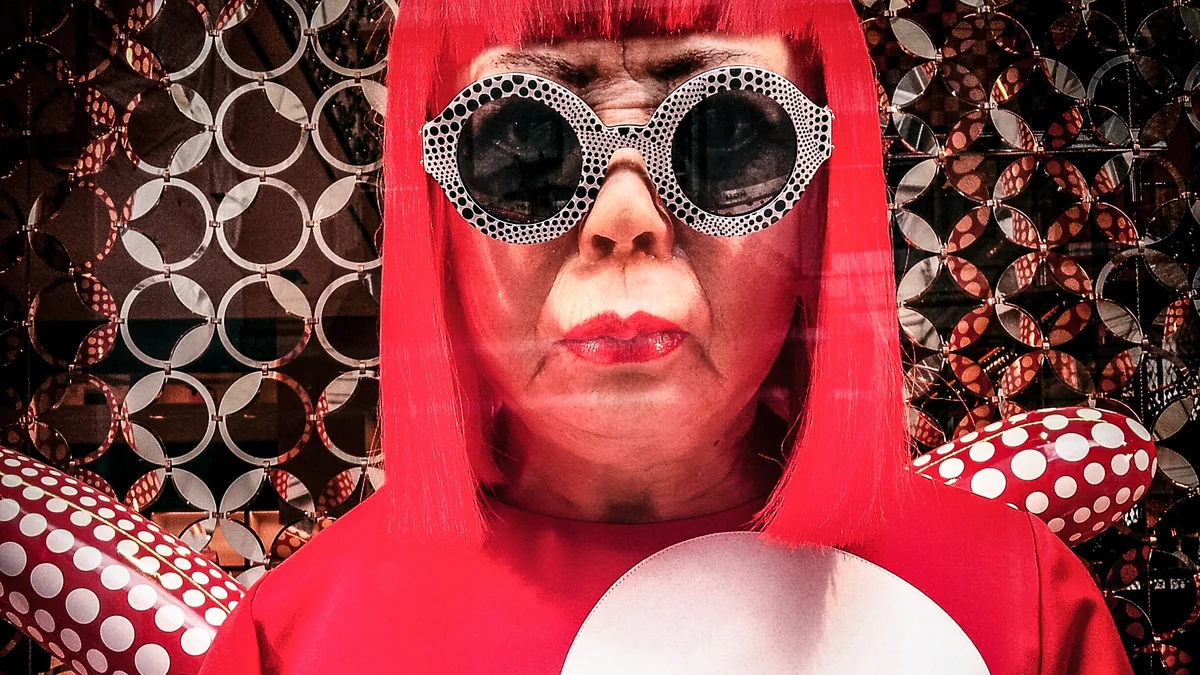
The hallucinations started early: flowers that spoke to her, fields that pulsed with repeating pattern, the world insisting on multiplying itself until the edges dissolved. Most people would call that a symptom to be treated and contained. Kusama called it raw material. The dots were not decoration; they were the actual texture of what she saw when she closed her eyes, and then when she opened them. She looked at her own terror and decided to paint it so completely that it could no longer frighten her.
She looked at her own terror and decided to paint it so completely that it could no longer frighten her.
This is what she meant by "self-obliteration." The idea sounds bleak until you sit with it. It is not erasure. It is dissolution, the anxious, isolated self released into an infinite repeating field until the boundary between you and the universe becomes usefully unclear. Each polka dot was a cell, a star, a small unit of something larger than the person holding the brush. Each pumpkin, with its warty surface and its reliable roundness, was a thing she loved enough to paint until love and obsession became the same word.
The motifs that look, from a distance, like a brand identity are, up close, a survival system. Polka dots, pumpkins, nets stretching across every surface of a canvas: each one rooted in the specific geography of her inner life, not chosen for their visual appeal but because they were already there, insisting. She just had the nerve to let them out.
Before the Pumpkins, There Was a Young Woman in New York with Something to Prove
Picture Manhattan, 1960s. A young Japanese woman setting up phallic sculptures in a loft, organizing naked happenings in city parks, making work so confrontational and so strange that galleries didn't quite know what to do with her. They mostly chose to look the other way. She did not stop.
Kusama planted herself at the center of the New York avant-garde and refused to be moved. She performed, she provoked, she showed up. The art world she walked into was white, male, and not particularly interested in making room, and she spent eight decades pushing back against exactly that establishment anyway. Not around it. Through it.
Here is the historical irony that sharpens everything: she influenced artists who went on to become far more famous than she was. Andy Warhol, Claes Oldenburg — the repetition, the radical installation logic, the boundary-dissolving scale. The debts were real. The credit was thin. She kept working.
And then she outlasted all of them. Not just survived — outlived and outpaced, still painting in her nineties while the market finally caught up to what she had been doing since before most collectors were born. The white, male art establishment that spent decades trying to ignore her eventually had to build queues around the block for her work.
What this actually means for how you understand Kusama's legacy: the pumpkins and the mirrored rooms are not the whole story. They are the roof. What she built underneath, in those difficult New York years, is the part that holds the whole structure up.
How a 97-Year-Old Became the Most Instagrammed Artist on Earth
Here is the thing that still catches me slightly off guard: it was not art critics who made Yayoi Kusama a household name in her eighties and nineties. It was people with phones. The Infinity Mirrored Rooms, those dark chambers lined floor to ceiling with mirrors and tiny lights, photographs as though they were built for it, because in some essential way they were. You step inside and suddenly you are standing inside the universe, or at least inside a very convincing replica of one. You take the picture. The picture travels. Hundreds of thousands of people see it and immediately want to go themselves. The queues were, and remain, frankly unreasonable.
When Melbourne's National Gallery of Victoria opened its Kusama retrospective in 2024, it drew over 570,000 visitors before the show closed, breaking every attendance record Australia had ever kept for a single exhibition. That is not a cult following. That is a phenomenon, and it belongs to a woman who was in her mid-nineties at the time, still painting every morning in a psychiatric facility in Shinjuku.
Meanwhile, in August 2024, her largest permanent public sculpture in the United Kingdom, "Infinite Accumulation," went up at Liverpool Street station in London, big and bold and polka-dotted among the commuters. Thousands of people walked past it daily, stopped, photographed it, looked it up. That is how legacy works now: it finds you in transit, between platforms, before you have even decided you are interested in art. She figured that out long before the rest of the art world caught on.
What Her Work Is Worth — and Where You Can Still Stand Inside It
The market knew before the rest of us caught up. In March 2025, "Infinity-Nets [ORUPX]" sold for $3.5 million at Art Basel Hong Kong. That was not a surprise to anyone watching the auction charts — Kusama had been one of the world's best-selling female artists for years. It was confirmation of something else: the price of access to a living legend, already priced in.
Compare that to a Basquiat or a Hirst, whose markets rode waves of critical reinvention and hype cycles. Kusama's trajectory was different: dismissed, then rediscovered, then turned global phenomenon mostly without the machinery of blue-chip gallery management propping her up. The market caught her late. It is making up for lost time now, and posthumous premiums will only sharpen that.
For the rest of us, the good news is that you do not need $3.5 million. You need a plane ticket and a timed entry slot.
The Yayoi Kusama Museum in Shinjuku, Tokyo, opened in 2017 and remains the primary home of her archive. Tickets sell out weeks in advance, so book the moment you know your dates. The museum is small by major-institution standards, which is exactly the point — it is not a crowd experience. It is a close one.
Then there is Amsterdam. The Stedelijk Museum opens a posthumous retrospective on September 11, 2026, gathering over 300 works — the first full reckoning of a seven-decade career, assembled without the artist alive to approve the hang. Book early. The Melbourne show drew 570,000 people; Amsterdam will not be quieter.
Stand in the room. That is the whole instruction.
Yayoi Kusama's Legacy Belongs to Everyone Now — Handle It Carefully
The Yayoi Kusama Foundation issued a formal warning in June 2026 about fraudulent websites and fake investment funds operating under her name. Think about what that means for a moment. You do not build scam infrastructure around a minor figure. You build it around someone whose name moves money, whose image carries weight, whose dots people will follow anywhere.
Her studio has confirmed it will continue her work and her wish that art provide hope. The work does not stop because she did. That is not a press release sentiment; it is a commitment backed by an archive spanning eight decades, and a 300-work retrospective opening at the Stedelijk Museum in Amsterdam on September 11, 2026 — the first major posthumous reckoning with everything she made.
Here is what you actually do with all of this. You do not need a plane ticket to Amsterdam, though booking one would not be the worst decision you made this year. Look up what is showing at your nearest institution carrying her work. Go on a weekday. Go slowly. Let the dots do what they were always designed to do — pull you out of your own head and into something larger.
The good plates are for Tuesday. Kusama's legacy is for this month.